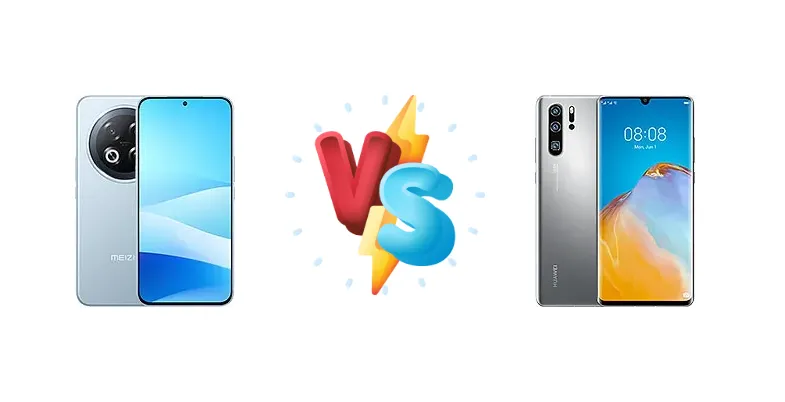
The Meizu Note 16 Pro and Huawei P30 Pro New Edition represent interesting points in the smartphone market. The P30 Pro New Edition, while initially a flagship, now offers a premium experience at a reduced price. The Note 16 Pro, on the other hand, aims to deliver a modern feature set, including incredibly fast charging, at a competitive mid-range price point. This comparison dives deep into their specifications to determine which device offers the best value.
🏆 Quick Verdict
For the average user prioritizing future-proofing and charging speed, the Meizu Note 16 Pro is the better choice. Its Snapdragon 7s Gen 3 chipset, built on a 4nm process, offers improved efficiency and performance over the older 7nm Kirin 980 in the P30 Pro New Edition, coupled with significantly faster 80W charging.
| Network |
|---|
| 2G bands | GSM 850 / 900 / 1800 / 1900 | GSM 850 / 900 / 1800 / 1900 |
| 3G bands | HSDPA 850 / 900 / 1700(AWS) / 1900 / 2100 | HSDPA 800 / 850 / 900 / 1700(AWS) / 1900 / 2100 |
| 4G bands | 1, 2, 3, 4, 5, 8, 20, 28, 34, 38, 39, 40, 41 | LTE |
| 5G bands | 1, 2, 3, 5, 8, 20, 28, 38, 40, 41, 77, 78 SA/NSA | - |
| Speed | HSPA, LTE, 5G | HSPA 42.2/5.76 Mbps, LTE Cat21 1400/200 Mbps |
| Technology | GSM / HSPA / LTE / 5G | GSM / HSPA / LTE |
| Launch |
|---|
| Announced | 2025, May 13 | 2020, May 12. Released 2020, June 01 |
| Status | Available. Released 2025, May 16 | Discontinued |
| Body |
|---|
| Build | - | Glass front (Aluminosilicate glass), glass back (Aluminosilicate glass), aluminum frame |
| Dimensions | 163.8 x 76.2 x 8.4 mm (6.45 x 3.00 x 0.33 in) | 158 x 73.4 x 8.4 mm (6.22 x 2.89 x 0.33 in) |
| SIM | Nano-SIM + Nano-SIM | · Nano-SIM· Nano-SIM + Nano-SIM |
| Weight | 197.5 g (6.98 oz) | 192 g (6.77 oz) |
| | - | IP68 dust/water resistant (up to 2m for 30 mins)
|
| Display |
|---|
| Resolution | 1224 x 2720 pixels, 20:9 ratio (~440 ppi density) | 1080 x 2340 pixels, 19.5:9 ratio (~398 ppi density) |
| Size | 6.78 inches, 111.0 cm2 (~88.9% screen-to-body ratio) | 6.47 inches, 102.8 cm2 (~88.6% screen-to-body ratio) |
| Type | OLED, 1B colors, 144Hz, 700 nits (typ), 1600 nits (peak), 4500 nits (peak) | OLED, HDR10 |
| Platform |
|---|
| CPU | Octa-core (1x2.5 GHz Cortex-A720 & 3x2.4 GHz Cortex-A720 & 4x1.8 GHz Cortex-A520) | Octa-core (2x2.6 GHz Cortex-A76 & 2x1.92 GHz Cortex-A76 & 4x1.8 GHz Cortex-A55) |
| Chipset | Qualcomm SM7635 Snapdragon 7s Gen 3 (4 nm) | Kirin 980 (7 nm) |
| GPU | Adreno 810 | Mali-G76 MP10 |
| OS | Flyme AIOS 2 | Android 10, EMUI 10.1, Google Play Services |
| Memory |
|---|
| Card slot | No | Nano Memory (uses shared SIM slot) |
| Internal | 256GB 8GB RAM, 256GB 12GB RAM, 512GB 12GB RAM, 512GB 16GB RAM | 128GB 6GB RAM, 256GB 8GB RAM |
| | - | UFS 3.0 |
| Main Camera |
|---|
| Features | LED flash, panorama, HDR | Leica optics, color spectrum sensor, dual-LED dual-tone flash, panorama, HDR |
| Triple | 50 MP, f/1.8, 26mm (wide), PDAF
8 MP, f/2.2, 15mm (ultrawide)
2 MP, f/2.4 | 40 MP, f/1.6, 27mm (wide), 1/1.7", PDAF, OIS
8 MP, f/3.4, 125mm (periscope telephoto), 1/4.0", PDAF, OIS, 5x optical zoom, 10x hybrid zoom
20 MP, f/2.2, 16mm (ultrawide), 1/2.7", PDAF
TOF 3D, (depth) |
| Video | Yes | 4K@30fps, 1080p@60fps, 1080p@30fps (gyro-EIS), 720p@960fps |
| Selfie camera |
|---|
| Features | HDR | HDR |
| Single | 8 MP, f/2.1 | 32 MP, f/2.0, 26mm (wide), 1/2.8", 0.8µm |
| Video | Yes | 1080p@30fps |
| Sound |
|---|
| 3.5mm jack | - | No |
| 35mm jack | No | No |
| Loudspeaker | Yes, with stereo speakers | Yes |
| | - | 32-bit/384kHz audio |
| Comms |
|---|
| Bluetooth | 5.4, A2DP, LE, aptX HD, aptX Adaptive | 5.0, A2DP, aptX HD, LE |
| Infrared port | Yes | Yes |
| NFC | Yes | Yes |
| Positioning | GPS (L1+L5), BDS (B1I+B1C+B2a), GALILEO, QZSS, GLONASS | GPS (L1+L5), GLONASS (L1), BDS (B1), GALILEO (E1+E5a), QZSS (L1+L5) |
| Radio | Unspecified | No |
| USB | USB Type-C 2.0 | USB Type-C 3.1 |
| WLAN | Wi-Fi 802.11 a/b/g/n/ac/6, dual-band | Wi-Fi 802.11 a/b/g/n/ac, dual-band, Wi-Fi Direct |
| Features |
|---|
| Sensors | Fingerprint (under display, optical), accelerometer, gyro, proximity, compass | Fingerprint (under display, optical), accelerometer, gyro, proximity, compass |
| Battery |
|---|
| Charging | 80W wired, QC4+, PD3.0, PPS | 40W wired, 70% in 30 min
15W wireless
Reverse wireless |
| Type | 6200 mAh | Li-Po 4200 mAh |
| Misc |
|---|
| Colors | Gray, Blue, White | Aurora, Black, Silver Frost |
| Price | About 190 EUR | About 820 EUR |
Meizu Note 16 Pro
- 80W Superfast Charging
- More Efficient Snapdragon 7s Gen 3 Chipset
- Modern 4nm Process Technology
- Camera specifications unknown
- No Wireless Charging
Huawei P30 Pro New Edition
- Proven Camera System
- Wireless and Reverse Wireless Charging
- Established Brand Reputation
- Older 7nm Kirin 980 Chipset
- Slower 40W Charging
Display Comparison
Neither device's display specifications are provided, so a direct comparison is limited. However, given the P30 Pro New Edition's flagship origins, it likely features a high-quality OLED panel with excellent color accuracy. The Note 16 Pro, targeting the mid-range, may utilize a slightly less advanced panel. The absence of refresh rate data suggests neither phone boasts a high refresh rate display, a common omission in this price bracket. Bezels are likely comparable, reflecting design trends from their respective release periods.
Camera Comparison
The Huawei P30 Pro New Edition is known for its camera prowess, though specific sensor details aren't provided. It likely features a large main sensor with optical image stabilization (OIS), delivering excellent low-light performance and dynamic range. The Note 16 Pro’s camera specifications are unknown, but given its mid-range positioning, it likely utilizes a more modest sensor. The P30 Pro’s image processing, historically, has been known for its vibrant colors and aggressive sharpening. The Note 16 Pro’s image processing is likely more natural, prioritizing accuracy over dramatic effects. The absence of information on the Note 16 Pro’s camera system makes a definitive comparison difficult, but the P30 Pro likely holds an advantage in overall image quality.
Performance
The core difference lies in the chipsets. The Meizu Note 16 Pro’s Snapdragon 7s Gen 3 (4nm) is a significant leap forward in efficiency compared to the Huawei P30 Pro New Edition’s Kirin 980 (7nm). The 4nm process allows for higher transistor density and lower power consumption, translating to less thermal throttling during demanding tasks. While the Kirin 980’s Cortex-A76 cores are powerful, the Snapdragon 7s Gen 3’s Cortex-A720 cores, combined with the newer architecture, offer a performance advantage. The Note 16 Pro’s CPU configuration (1x2.5 GHz Cortex-A720, 3x2.4 GHz Cortex-A720, 4x1.8 GHz Cortex-A520) suggests a focus on sustained performance, while the P30 Pro’s (2x2.6 GHz Cortex-A76, 2x1.92 GHz Cortex-A76, 4x1.8 GHz Cortex-A55) leans towards burst performance. RAM specifications are not provided, but the Snapdragon 7s Gen 3 supports LPDDR5X, potentially giving the Note 16 Pro an edge in memory bandwidth.
Battery Life
The Huawei P30 Pro New Edition offers 40W wired charging, capable of reaching 70% charge in 30 minutes, alongside 15W wireless and reverse wireless charging. The Meizu Note 16 Pro, however, boasts an impressive 80W wired charging, significantly faster than the P30 Pro. While battery capacity isn’t specified for either device, the Note 16 Pro’s charging speed allows for a full charge in a fraction of the time. The P30 Pro’s wireless charging is a convenience feature the Note 16 Pro lacks, but the sheer speed of the Note 16 Pro’s wired charging is a compelling advantage for users who prioritize minimizing downtime.
Buying Guide
Buy the Meizu Note 16 Pro if you need blazing-fast charging, a more modern and efficient processor for sustained performance, and are comfortable with a potentially less established brand. Buy the Huawei P30 Pro New Edition if you prioritize a proven camera system, wireless charging capabilities, and a more recognizable brand with a mature software ecosystem, even if it means sacrificing some processing power and charging speed.
Frequently Asked Questions
❓ Does the Snapdragon 7s Gen 3 in the Meizu Note 16 Pro handle demanding games like PUBG or Genshin Impact smoothly?
The Snapdragon 7s Gen 3 is a capable chipset for gaming. While not a flagship-level processor, it should handle PUBG and Genshin Impact at medium to high settings with stable frame rates. The 4nm process also helps mitigate thermal throttling, allowing for longer gaming sessions without significant performance drops.
❓ How much faster is the 80W charging on the Meizu Note 16 Pro compared to the 40W charging on the Huawei P30 Pro New Edition in real-world use?
The 80W charging on the Note 16 Pro can potentially charge the phone from 0% to 100% in under 40 minutes, while the P30 Pro New Edition takes closer to 60-70 minutes. This means you can get a significant charge boost in a much shorter time with the Note 16 Pro, ideal for users who are always on the go.
❓ Is the lack of wireless charging on the Meizu Note 16 Pro a significant drawback?
For users who heavily rely on wireless charging, the absence of this feature on the Note 16 Pro is a drawback. However, the incredibly fast 80W wired charging largely compensates for this, as you'll spend less time tethered to a charger overall. The convenience of wireless charging is offset by the speed of the wired solution.