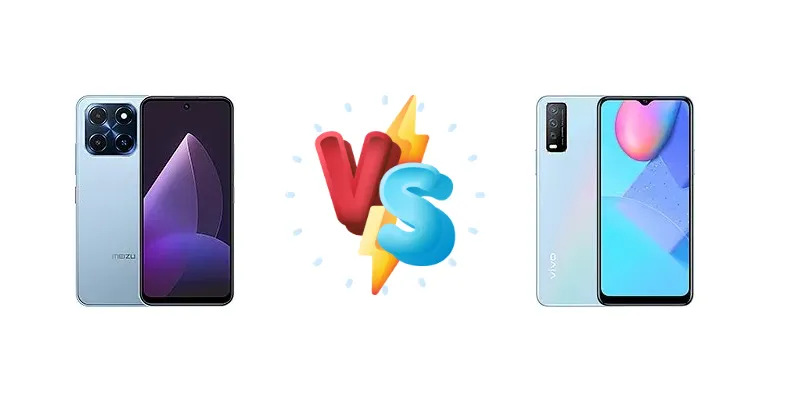
The Meizu Mblu 22 and vivo Y12s 2021 represent the ultra-budget end of the smartphone spectrum. Both aim to deliver essential functionality at the lowest possible price point, but they take different approaches to achieving this. This comparison dissects their core components to determine which offers the best value for users prioritizing performance and longevity.
🏆 Quick Verdict
For the average user, the vivo Y12s 2021 emerges as the slightly better choice. While both phones offer similar basic functionality, the Snapdragon 439’s 12nm process provides a noticeable efficiency advantage over the Unisoc SC9863A’s 28nm node, translating to potentially better battery life and sustained performance.
| Network |
|---|
| 2G bands | GSM 850 / 900 / 1800 / 1900 | GSM 850 / 900 / 1800 / 1900 |
| 3G bands | HSDPA 850 / 900 / 1700(AWS) / 1900 / 2100 | HSDPA 850 / 900 / 2100 |
| 4G bands | 1, 2, 3, 4, 5, 7, 8, 12, 17, 18, 19, 20, 26, 28, 38, 40, 41, 66 | 1, 3, 5, 7, 8, 38, 40, 41 - International |
| Speed | HSPA, LTE | HSPA, LTE |
| Technology | GSM / HSPA / LTE | GSM / HSPA / LTE |
| | - | 1, 3, 5, 8, 38, 40, 41 - India |
| Launch |
|---|
| Announced | 2025, March 04 | 2021, May 12 |
| Status | Available. Released 2025, May 20 | Available. Released 2021, May 12 |
| Body |
|---|
| Build | - | Glass front, plastic back, plastic frame |
| Dimensions | 170.8 x 77.5 x 8.9 mm (6.72 x 3.05 x 0.35 in) | 164.4 x 76.3 x 8.4 mm (6.47 x 3.00 x 0.33 in) |
| SIM | Nano-SIM + Nano-SIM | Nano-SIM + Nano-SIM |
| Weight | 200 g (7.05 oz) | 191 g (6.74 oz) |
| Display |
|---|
| Resolution | 720 x 1640 pixels (~264 ppi density) | 720 x 1600 pixels, 20:9 ratio (~270 ppi density) |
| Size | 6.79 inches, 109.5 cm2 (~82.7% screen-to-body ratio) | 6.51 inches, 102.3 cm2 (~81.6% screen-to-body ratio) |
| Type | IPS LCD, 90Hz | IPS LCD |
| Platform |
|---|
| CPU | Octa-core (4x1.6 GHz Cortex-A55 & 4x1.2 GHz Cortex-A55) | Octa-core (4x1.95 GHz Cortex-A53 & 4x1.45 GHz Cortex A53) |
| Chipset | Unisoc SC9863A (28 nm) | Qualcomm SDM439 Snapdragon 439 (12 nm) |
| GPU | IMG8322 | Adreno 505 |
| OS | Android 15 (Go edition) | Android 11, Funtouch 11 |
| Memory |
|---|
| Card slot | microSDXC | microSDXC (dedicated slot) |
| Internal | 64GB 3GB RAM, 64GB 4GB RAM, 128GB 4GB RAM | 32GB 3GB RAM, 64GB 3GB RAM |
| | - | eMMC 5.1 |
| Main Camera |
|---|
| Dual | - | 13 MP, f/2.2, (wide), PDAF
Auxiliary lens |
| Features | LED flash, panorama, HDR | LED flash, Panorama |
| Single | 13 MP, f/1.8, 26mm (wide), AF
auxiliary lens | 8 MP, f/1.8 |
| Video | Yes | 1080p@30fps |
| Selfie camera |
|---|
| Single | 5 MP, f/2.2 | 8 MP, f/1.8 |
| Video | Yes | 1080p@30fps |
| Sound |
|---|
| 3.5mm jack | - | Yes |
| 35mm jack | Yes | Yes |
| Loudspeaker | Yes, with stereo speakers | Yes |
| Comms |
|---|
| Bluetooth | 4.2, A2DP | 4.2, A2DP |
| NFC | No | No |
| Positioning | GPS, GALILEO, GLONASS, BDS | GPS, GLONASS, GALILEO, BDS |
| Radio | No | FM radio |
| USB | USB Type-C, OTG | microUSB 2.0, OTG |
| WLAN | Wi-Fi 802.11 b/g/n | Wi-Fi 802.11 a/b/g/n/ac (Y12s), Wi-Fi 802.11 b/g/n (Y12G) |
| Features |
|---|
| Sensors | Fingerprint (side-mounted), accelerometer, proximity | Fingerprint (side-mounted), accelerometer, proximity, compass |
| Battery |
|---|
| Charging | 10W wired | 10W wired
5W reverse wired |
| Type | 5000 mAh | 5000 mAh |
| Misc |
|---|
| Colors | Titan Black, Snow White, Sea Blue | Mysterious Black (Phantom Black), Ice Blue (Glacier Blue) |
| Models | M2511 | V2069, V2039, V2068 |
| Price | About 80 EUR | About 120 EUR |
Meizu Mblu 22
- Potentially lower price point
- Simple and straightforward software experience
- Functional for basic tasks
- Less efficient chipset (Unisoc SC9863A)
- Likely slower performance
- No reverse charging
vivo Y12s 2021
- More efficient chipset (Snapdragon 439)
- Better sustained performance
- 5W reverse wired charging
- May be slightly more expensive
- Software updates may be limited
- Basic camera capabilities
Display Comparison
Neither device boasts a standout display. Both are likely to feature LCD panels, typical for this price bracket. The absence of detailed display specifications necessitates focusing on the chipset impact on UI smoothness. The more efficient Snapdragon 439 in the vivo Y12s 2021 will likely contribute to a more responsive user experience when navigating the interface, even if the panel itself is similar.
Camera Comparison
Both phones likely feature basic camera setups. Given the price point, detailed camera analysis is limited by the lack of sensor information. It’s safe to assume both will rely on software processing to enhance image quality. The presence of a 5MP main sensor is probable on both, but the image signal processor (ISP) within the Snapdragon 439 is generally more capable, potentially leading to slightly better image quality and faster processing times for the vivo Y12s 2021.
Performance
The core difference lies in the chipsets. The vivo Y12s 2021’s Qualcomm Snapdragon 439, fabricated on a 12nm process, is significantly more efficient than the Meizu Mblu 22’s Unisoc SC9863A (28nm). While both are octa-core, the Snapdragon 439 utilizes Cortex-A53 cores clocked at 1.95 GHz, offering a performance edge over the Mblu 22’s 1.6 GHz Cortex-A55 cores. This translates to faster app loading times and smoother multitasking on the vivo. The larger process node of the Unisoc chip will likely result in more heat generation under load, potentially leading to performance throttling.
Battery Life
Both devices feature 10W wired charging, indicating similar charging speeds. However, the Snapdragon 439’s superior power efficiency gives the vivo Y12s 2021 a distinct advantage in battery life. While both will likely offer a full day of light use, the vivo will likely last longer under moderate load. The addition of 5W reverse wired charging on the vivo Y12s 2021 is a unique feature, allowing it to charge other devices, albeit slowly, which the Meizu Mblu 22 lacks.
Buying Guide
Buy the Meizu Mblu 22 if you need a phone for extremely basic tasks like calls, texts, and light social media, and are prioritizing the absolute lowest possible price. Buy the vivo Y12s 2021 if you prefer a device that can handle slightly more demanding applications, offers the convenience of 5W reverse charging, and benefits from Qualcomm’s generally more optimized software support.
Frequently Asked Questions
❓ Will the Unisoc SC9863A in the Meizu Mblu 22 struggle with modern apps?
The Unisoc SC9863A is an entry-level chipset. While it can handle basic apps like messaging and social media, it will likely struggle with more demanding applications or multitasking. Expect slower loading times and potential lag when running multiple apps simultaneously.
❓ Is the 5W reverse charging on the vivo Y12s 2021 actually useful?
While 5W reverse charging is slow, it can be a lifesaver in emergencies. It's ideal for topping up accessories like wireless earbuds or a smartwatch, or providing a small boost to a friend's phone if they're in a pinch. Don't expect to fully charge another phone quickly, but it's a convenient feature to have.
❓ How will the 28nm vs 12nm process affect long-term performance?
The 28nm process of the Unisoc chip generates more heat. Over time, this can lead to thermal throttling, where the chip reduces its clock speed to prevent overheating, resulting in consistently slower performance. The 12nm Snapdragon 439 will maintain more consistent performance over extended use.