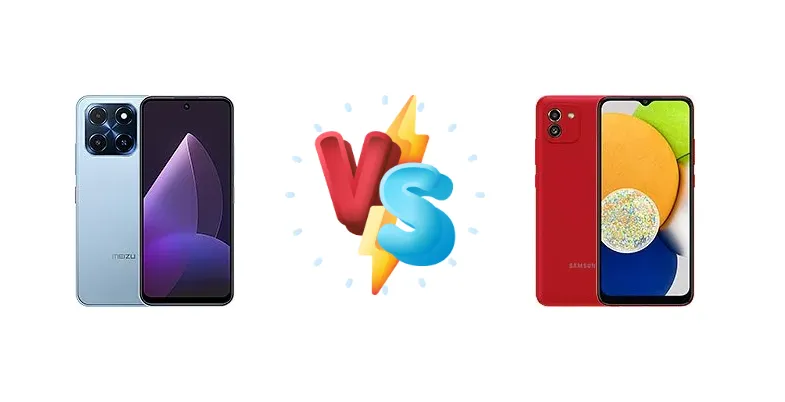
The Meizu Mblu 22 and Samsung Galaxy A03 represent the extreme end of the budget smartphone market. Both devices aim to deliver essential smartphone functionality at the lowest possible price point, but they achieve this with different approaches to internal hardware. This comparison dissects the key differences, focusing on the core performance implications of their respective Unisoc chipsets.
🏆 Quick Verdict
For the average user prioritizing overall responsiveness and efficiency, the Samsung Galaxy A03 is the better choice. Its Unisoc T606, built on a smaller 12nm process, offers a noticeable performance advantage over the Meizu Mblu 22’s older 28nm SC9863A, translating to smoother multitasking and app loading.
| Network |
|---|
| 2G bands | GSM 850 / 900 / 1800 / 1900 | GSM 850 / 900 / 1800 / 1900 |
| 3G bands | HSDPA 850 / 900 / 1700(AWS) / 1900 / 2100 | HSDPA 850 / 900 / 2100 |
| 4G bands | 1, 2, 3, 4, 5, 7, 8, 12, 17, 18, 19, 20, 26, 28, 38, 40, 41, 66 | 1, 3, 5, 7, 8, 20, 28, 38, 40, 41 |
| Speed | HSPA, LTE | HSPA 42.2/5.76 Mbps, LTE Cat4 150/50 Mbps |
| Technology | GSM / HSPA / LTE | GSM / HSPA / LTE |
| Launch |
|---|
| Announced | 2025, March 04 | 2021, November 26 |
| Status | Available. Released 2025, May 20 | Available. Released 2022, January 21 |
| Body |
|---|
| Build | - | Glass front, plastic back, plastic frame |
| Dimensions | 170.8 x 77.5 x 8.9 mm (6.72 x 3.05 x 0.35 in) | 164.2 x 75.9 x 9.1 mm (6.46 x 2.99 x 0.36 in) |
| SIM | Nano-SIM + Nano-SIM | · Nano-SIM· Nano-SIM + Nano-SIM |
| Weight | 200 g (7.05 oz) | 196 g (6.91 oz) |
| Display |
|---|
| Resolution | 720 x 1640 pixels (~264 ppi density) | 720 x 1600 pixels, 20:9 ratio (~270 ppi density) |
| Size | 6.79 inches, 109.5 cm2 (~82.7% screen-to-body ratio) | 6.5 inches, 102.0 cm2 (~81.8% screen-to-body ratio) |
| Type | IPS LCD, 90Hz | PLS LCD |
| Platform |
|---|
| CPU | Octa-core (4x1.6 GHz Cortex-A55 & 4x1.2 GHz Cortex-A55) | Octa-core (2x1.6 GHz Cortex-A75 & 6x1.6 GHz Cortex-A55) |
| Chipset | Unisoc SC9863A (28 nm) | Unisoc T606 (12 nm) |
| GPU | IMG8322 | Mali-G57 MP1 |
| OS | Android 15 (Go edition) | Android 11, upgradable to Android 13, One UI core 5 |
| Memory |
|---|
| Card slot | microSDXC | microSDXC (dedicated slot) |
| Internal | 64GB 3GB RAM, 64GB 4GB RAM, 128GB 4GB RAM | 32GB 2GB RAM, 32GB 3GB RAM, 32GB 4GB RAM, 64GB 4GB RAM, 64GB 3GB RAM, 128GB 4GB RAM |
| | - | eMMC 5.1 |
| Main Camera |
|---|
| Dual | - | 48 MP, f/1.8, (wide), AF
Auxiliary lens |
| Features | LED flash, panorama, HDR | LED flash |
| Single | 13 MP, f/1.8, 26mm (wide), AF
auxiliary lens | 5 MP, f/2.2 |
| Video | Yes | 1080p@30fps |
| Selfie camera |
|---|
| Single | 5 MP, f/2.2 | 5 MP, f/2.2 |
| Video | Yes | Yes |
| Sound |
|---|
| 3.5mm jack | - | Yes |
| 35mm jack | Yes | Yes |
| Loudspeaker | Yes, with stereo speakers | Yes |
| Comms |
|---|
| Bluetooth | 4.2, A2DP | 5.0, A2DP, LE |
| NFC | No | No |
| Positioning | GPS, GALILEO, GLONASS, BDS | GPS |
| Radio | No | Unspecified |
| USB | USB Type-C, OTG | microUSB 2.0 |
| WLAN | Wi-Fi 802.11 b/g/n | Wi-Fi 802.11 a/b/g/n/ac, dual-band, Wi-Fi Direct |
| Features |
|---|
| Sensors | Fingerprint (side-mounted), accelerometer, proximity | Accelerometer, proximity |
| Battery |
|---|
| Charging | 10W wired | - |
| Type | 5000 mAh | Li-Po 5000 mAh |
| Misc |
|---|
| Colors | Titan Black, Snow White, Sea Blue | Black, Blue, Red |
| Models | M2511 | SM-A035F, SM-A035F/DS, SM-A035M, SM-A035G |
| Price | About 80 EUR | € 119.90 / £ 88.00 / ₹ 11,990 |
| SAR EU | - | 0.20 W/kg (head) 1.35 W/kg (body) |
Meizu Mblu 22
- Potentially lower price point
- May offer slightly longer standby time due to simpler chipset
- Functional for basic communication tasks
- Significantly slower performance compared to the A03
- Less power efficient chipset
- Likely limited software support
Samsung Galaxy A03
- More responsive performance thanks to the Unisoc T606
- Better power efficiency for longer battery life
- Likely to receive more software updates from Samsung
- May be slightly more expensive than the Mblu 22
- 10W charging is slow
- Camera quality is likely basic
Display Comparison
Neither device is expected to deliver a premium display experience. Details regarding panel type, resolution, and brightness are unavailable, but given the price bracket, both likely utilize LCD panels. The focus here is on internal components, not display fidelity. Bezels are likely substantial on both devices, prioritizing cost reduction over aesthetics.
Camera Comparison
Camera details are sparse for both devices. It’s safe to assume both feature basic camera setups geared towards casual snapshots. Without sensor size or aperture information, a direct comparison is difficult. However, the emphasis on cost-cutting likely means both rely on lower-resolution sensors and limited image processing capabilities. The presence of a 2MP macro camera on either device is largely a marketing tactic, offering minimal practical benefit due to the small sensor size and lack of optical image stabilization.
Performance
The core difference lies in the chipsets. The Samsung Galaxy A03’s Unisoc T606 (12nm) boasts a more modern architecture with 2x 1.6 GHz Cortex-A75 performance cores and 6x 1.6 GHz Cortex-A55 efficiency cores. This contrasts with the Meizu Mblu 22’s Unisoc SC9863A (28nm), which features 4x 1.6 GHz Cortex-A55 and 4x 1.2 GHz Cortex-A55 cores. The T606’s A75 cores provide a significant uplift in single-core performance, crucial for app launch speeds and general responsiveness. The 12nm fabrication process also contributes to better power efficiency, potentially leading to longer battery life under load. The SC9863A’s older 28nm process is less efficient, meaning it will generate more heat and consume more power for the same level of performance.
Battery Life
Battery capacity is not specified for either device. However, the Unisoc T606’s superior power efficiency in the Galaxy A03 will likely translate to longer real-world battery life, even if the Mblu 22 has a slightly larger capacity. Both devices feature 10W wired charging, indicating a slow charging experience – expect several hours to reach a full charge from empty.
Buying Guide
Buy the Meizu Mblu 22 if you need a device for extremely basic tasks like calls, texts, and light social media, and are heavily constrained by budget. Its lower price point may be attractive for first-time smartphone users or as a temporary backup device. Buy the Samsung Galaxy A03 if you prefer a more responsive experience for everyday tasks, including browsing, streaming, and casual gaming, and value a slightly more modern chipset architecture for improved efficiency.
Frequently Asked Questions
❓ Will the Samsung Galaxy A03 struggle with popular apps like Facebook or WhatsApp?
While not a powerhouse, the Unisoc T606 in the Galaxy A03 is sufficient for running apps like Facebook and WhatsApp smoothly. The A75 cores provide a performance boost for app loading and scrolling, ensuring a reasonably fluid experience. The Meizu Mblu 22 may exhibit noticeable lag when switching between these apps.
❓ Is the 10W charging on either phone a significant drawback?
Yes, 10W charging is quite slow by modern standards. Expect to spend several hours (potentially 3-5) to fully charge either device from 0%. This is a common compromise in the ultra-budget segment, prioritizing cost over convenience.
❓ Can the Samsung Galaxy A03 handle basic mobile games?
The Galaxy A03 can handle less demanding mobile games, but don't expect high frame rates or graphics settings. Games like Candy Crush or simple puzzle games will run fine. More graphically intensive titles may require significant compromises in settings to achieve playable performance.