
Motorola Moto G200 5G vs. Meizu Mblu 22: A Tale of Two Chipsets
| Phones Images | |||||
|---|---|---|---|---|---|
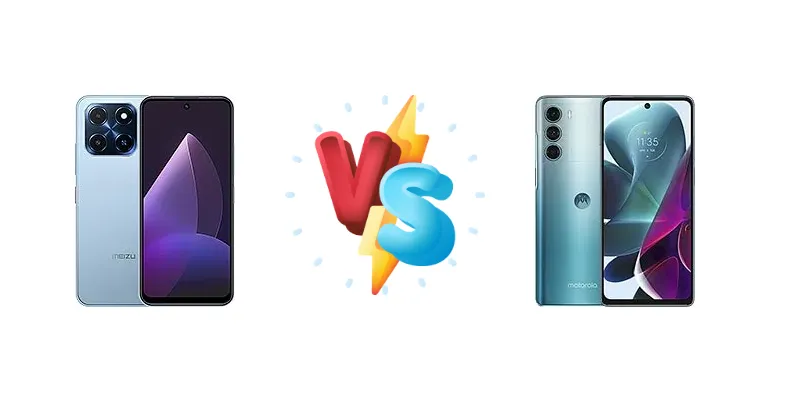
|
🏆 Quick Verdict
For the average user prioritizing responsiveness and future-proofing, the Motorola Moto G200 5G is the clear winner. Its Snapdragon 888+ chipset delivers a vastly superior experience, despite the Mblu 22's lower price point. However, the Mblu 22 may suffice for basic tasks and users on a very tight budget.
| PHONES | ||
|---|---|---|
| Phone Names | Meizu Mblu 22 | Motorola Moto G200 5G |
| Network | ||
|---|---|---|
| 2G bands | GSM 850 / 900 / 1800 / 1900 | GSM 850 / 900 / 1800 / 1900 |
| 3G bands | HSDPA 850 / 900 / 1700(AWS) / 1900 / 2100 | HSDPA 850 / 900 / 1700(AWS) / 1900 / 2100 |
| 4G bands | 1, 2, 3, 4, 5, 7, 8, 12, 17, 18, 19, 20, 26, 28, 38, 40, 41, 66 | 1, 2, 3, 4, 5, 7, 8, 12, 13, 17, 18, 19, 20, 26, 28, 32, 38, 39, 40, 41, 42, 43, 66 |
| 5G bands | - | 1, 3, 5, 7, 8, 20, 28, 38, 40, 41, 66, 77, 78 SA/NSA/Sub6 |
| Speed | HSPA, LTE | HSPA 42.2/5.76 Mbps, LTE Cat20 2000/150 Mbps, 5G |
| Technology | GSM / HSPA / LTE | GSM / HSPA / LTE / 5G |
| Launch | ||
|---|---|---|
| Announced | 2025, March 04 | 2021, November 18 |
| Status | Available. Released 2025, May 20 | Available. Released 2022, February 10 |
| Body | ||
|---|---|---|
| Build | - | Glass front, plastic frame, plastic back |
| Dimensions | 170.8 x 77.5 x 8.9 mm (6.72 x 3.05 x 0.35 in) | 168.1 x 75.5 x 8.9 mm (6.62 x 2.97 x 0.35 in) |
| SIM | Nano-SIM + Nano-SIM | · Nano-SIM· Nano-SIM + Nano-SIM |
| Weight | 200 g (7.05 oz) | 202 g (7.13 oz) |
| - | Water-repellent design | |
| Display | ||
|---|---|---|
| Resolution | 720 x 1640 pixels (~264 ppi density) | 1080 x 2460 pixels (~395 ppi density) |
| Size | 6.79 inches, 109.5 cm2 (~82.7% screen-to-body ratio) | 6.8 inches, 109.8 cm2 (~86.5% screen-to-body ratio) |
| Type | IPS LCD, 90Hz | LCD, 144Hz, HDR10 |
| Platform | ||
|---|---|---|
| CPU | Octa-core (4x1.6 GHz Cortex-A55 & 4x1.2 GHz Cortex-A55) | Octa-core (1x2.99 GHz Cortex-X1 & 3x2.42 GHz Cortex-A78 & 4x1.80 GHz Cortex-A55) |
| Chipset | Unisoc SC9863A (28 nm) | Qualcomm SM8350 Snapdragon 888+ 5G (5 nm) |
| GPU | IMG8322 | Adreno 660 |
| OS | Android 15 (Go edition) | Android 11, upgradable to Android 12 |
| Memory | ||
|---|---|---|
| Card slot | microSDXC | No |
| Internal | 64GB 3GB RAM, 64GB 4GB RAM, 128GB 4GB RAM | 128GB 8GB RAM, 256GB 8GB RAM |
| - | UFS 3.1 | |
| Main Camera | ||
|---|---|---|
| Features | LED flash, panorama, HDR | Dual-LED dual-tone flash, HDR, panorama |
| Single | 13 MP, f/1.8, 26mm (wide), AF auxiliary lens | - |
| Triple | - | 108 MP, f/1.9, (wide), 1/1.52", 0.7µm, PDAF 13 MP, f/2.2, 119˚ (ultrawide), 1.12µm, AF Auxiliary lens |
| Video | Yes | 8K@24fps, 4K@30fps, 1080p@30/60/120/240fps, 1080p@960fps, gyro-EIS |
| Selfie camera | ||
|---|---|---|
| Single | 5 MP, f/2.2 | 16 MP, f/2.2, (wide), 1.0µm |
| Video | Yes | 1080p@30fps |
| Sound | ||
|---|---|---|
| 3.5mm jack | - | No |
| 35mm jack | Yes | No |
| Loudspeaker | Yes, with stereo speakers | Yes |
| Comms | ||
|---|---|---|
| Bluetooth | 4.2, A2DP | 5.2, A2DP, LE, aptX HD, aptX Adaptive |
| NFC | No | Yes |
| Positioning | GPS, GALILEO, GLONASS, BDS | GPS, GLONASS, GALILEO |
| Radio | No | No |
| USB | USB Type-C, OTG | USB Type-C 3.1 |
| WLAN | Wi-Fi 802.11 b/g/n | Wi-Fi 802.11 a/b/g/n/ac/6e, dual-band, Wi-Fi Direct |
| Features | ||
|---|---|---|
| Sensors | Fingerprint (side-mounted), accelerometer, proximity | Fingerprint (side-mounted), accelerometer, gyro, proximity, compass |
| - | Ready For support | |
| Battery | ||
|---|---|---|
| Charging | 10W wired | 33W wired |
| Type | 5000 mAh | Li-Po 5000 mAh |
| Misc | ||
|---|---|---|
| Colors | Titan Black, Snow White, Sea Blue | Stellar Blue, Glacier Green |
| Models | M2511 | - |
| Price | About 80 EUR | About 290 EUR |
| Tests | ||
|---|---|---|
| Battery life | - | Endurance rating 102h |
| Camera | - | Photo / Video |
| Display | - | Contrast ratio: 1633:1 (nominal) |
| Loudspeaker | - | -26.7 LUFS (Good) |
| Performance | - | AnTuTu: 682346 (v8), 811124 (v9) GeekBench: 3319 (v5.1) GFXBench: 60fps (ES 3.1 onscreen) |
Meizu Mblu 22
- Extremely affordable price point
- Functional for basic smartphone tasks
- Potentially compact form factor (unconfirmed)
- Weak performance due to Unisoc SC9863A chipset
- Slow 10W charging
- Likely low-quality display and camera
Motorola Moto G200 5G
- Flagship-level Snapdragon 888+ performance
- Fast 33W wired charging
- Good battery life (102h endurance rating)
- Brighter display for outdoor visibility
- Older chipset (Snapdragon 888+)
- Potentially larger and heavier form factor
- Higher price compared to the Mblu 22
Display Comparison
Both devices share a contrast ratio of 1633:1, suggesting similar panel characteristics in terms of black levels. However, the Moto G200 5G’s measured peak brightness of 558 nits significantly outshines what we’d expect from the Mblu 22, making it more usable outdoors. The Mblu 22’s display specifications are not provided, implying a lower-quality panel likely with lower brightness and color accuracy. The G200’s larger display size (not specified, but generally larger in this class) also contributes to a more immersive viewing experience.
Camera Comparison
Both phones feature 'Photo / Video' capabilities, but the lack of detailed specifications makes a direct comparison difficult. Given the Mblu 22’s focus on cost reduction, its camera system is likely to be significantly inferior to the G200’s. While the G200’s sensor size and aperture are unknown, the Snapdragon 888+ ISP (Image Signal Processor) provides advanced image processing capabilities, potentially resulting in better image quality, especially in low-light conditions. The Mblu 22 likely relies on basic image processing, resulting in less detailed and dynamic photos.
Performance
The performance gap is the most significant differentiator. The Motorola Moto G200 5G’s Qualcomm Snapdragon 888+ 5G (5nm) is a flagship-level chipset featuring a Cortex-X1 prime core clocked at 2.99 GHz, alongside three Cortex-A78 cores and four Cortex-A55 cores. This contrasts sharply with the Meizu Mblu 22’s Unisoc SC9863A (28nm), which utilizes four Cortex-A55 cores at 1.6 GHz and another four at 1.2 GHz. The 5nm fabrication process of the Snapdragon 888+ offers superior power efficiency and thermal performance compared to the 28nm Unisoc chip, meaning less throttling under sustained load. The G200 will handle demanding games and applications with ease, while the Mblu 22 will struggle with anything beyond basic tasks.
Battery Life
The Motorola Moto G200 5G boasts an endurance rating of 102 hours, indicating solid battery life. Its 33W wired charging is considerably faster than the Meizu Mblu 22’s 10W charging. While the Mblu 22’s battery capacity is unknown, the slower charging speed suggests a smaller battery or less efficient power management. The G200 can replenish its battery quickly, minimizing downtime, while the Mblu 22 will require significantly longer to charge.
Buying Guide
Buy the Meizu Mblu 22 if you need a functional smartphone for essential tasks like calls, messaging, and light web browsing, and your budget is extremely limited. Buy the Motorola Moto G200 5G if you prioritize smooth multitasking, gaming, and a more responsive user experience, and are willing to spend a bit more for a significantly more capable device.