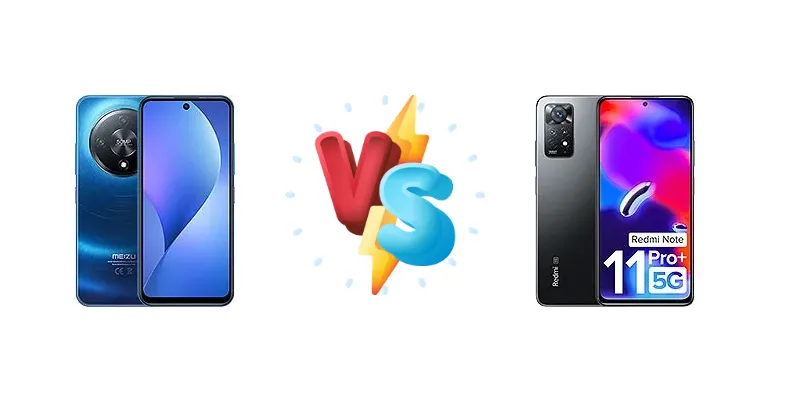
The Meizu Mblu 22 Pro and the Xiaomi Redmi Note 11 Pro+ 5G (India) represent compelling options in the increasingly competitive sub-$300 smartphone market. While both aim to deliver 5G connectivity and a modern feature set, they diverge significantly in their core hardware choices, particularly in chipset and charging technology. This comparison dissects these differences to determine which device offers the best overall experience.
🏆 Quick Verdict
For the average user prioritizing fast charging and a more efficient chipset, the Xiaomi Redmi Note 11 Pro+ 5G (India) is the clear winner. Its 67W charging dramatically reduces downtime, and the Snapdragon 695 offers a more modern and power-efficient architecture than the Meizu’s Helio G81.
| Network |
|---|
| 2G bands | GSM 850 / 900 / 1800 / 1900 | GSM 850 / 900 / 1800 / 1900 - SIM 1 & SIM 2 |
| 3G bands | HSDPA 850 / 900 / 1900 / 2100 | HSDPA 850 / 900 / 1900 / 2100 |
| 4G bands | 1, 2, 3, 4, 5, 7, 8, 12, 17, 18, 19, 20, 26, 28, 38, 40, 41, 66 | 1, 3, 5, 8, 40, 41 |
| 5G bands | - | 1, 3, 5, 8, 28, 40, 78 SA/NSA |
| Speed | HSPA, LTE | HSPA, LTE-A (CA), 5G |
| Technology | GSM / HSPA / LTE | GSM / HSPA / LTE / 5G |
| Launch |
|---|
| Announced | 2025, March 04 | 2022, March 09 |
| Status | Available. Released 2025, May 20 | Available. Released 2022, March 15 |
| Body |
|---|
| Build | - | Glass front (Gorilla Glass 5), glass back |
| Dimensions | 170.8 x 77.5 x 8.5 mm (6.72 x 3.05 x 0.33 in) | 164.2 x 76.1 x 8.1 mm (6.46 x 3.00 x 0.32 in) |
| SIM | Nano-SIM + Nano-SIM | Hybrid Dual SIM (Nano-SIM, dual stand-by) |
| Weight | 212 g (7.48 oz) | 202 g (7.13 oz) |
| | - | IP53, dust and splash resistant |
| Display |
|---|
| Protection | - | Corning Gorilla Glass 5 |
| Resolution | 720 x 1640 pixels (~264 ppi density) | 1080 x 2400 pixels, 20:9 ratio (~395 ppi density) |
| Size | 6.79 inches, 109.5 cm2 (~82.7% screen-to-body ratio) | 6.67 inches, 107.4 cm2 (~86.0% screen-to-body ratio) |
| Type | TFT LCD, 120Hz, 400 nits (HBM) | Super AMOLED, 120Hz, 700 nits, 1200 nits (peak) |
| Platform |
|---|
| CPU | Octa-core (2x2.0 GHz Cortex-A75 & 6x1.8 GHz Cortex-A55) | Octa-core (2x2.2 GHz Kryo 660 Gold & 6x1.7 GHz Kryo 660 Silver) |
| Chipset | Mediatek Helio G81 (12 nm) | Qualcomm SM6375 Snapdragon 695 5G (6 nm) |
| GPU | Mali-G52 MC2 | Adreno 619 |
| OS | Android 15 | Android 11, MIUI 13 |
| Memory |
|---|
| Card slot | microSDXC | microSDXC (uses shared SIM slot) |
| Internal | 128GB 4GB RAM, 256GB 6GB RAM, 256GB 8GB RAM | 64GB 6GB RAM, 128GB 6GB RAM, 128GB 8GB RAM, 256GB 8GB RAM |
| | - | UFS 2.2 |
| Main Camera |
|---|
| Dual | 50 MP, f/1.8, (wide), PDAF
2 MP (macro) | - |
| Features | LED flash, panorama, HDR | LED flash, HDR, panorama |
| Triple | - | 108 MP, f/1.9, 26mm (wide), 1/1.52", 0.7µm, PDAF
8 MP, f/2.2, 118˚ (ultrawide)
2 MP, f/2.4, (macro) |
| Video | Yes | 1080p@30fps |
| Selfie camera |
|---|
| Single | 8 MP, f/2.0 | 16 MP, f/2.5, (wide), 1/3.06" 1.0µm |
| Video | Yes | 1080p@30fps |
| Sound |
|---|
| 3.5mm jack | - | Yes |
| 35mm jack | Yes | - |
| Loudspeaker | Yes, with stereo speakers | Yes, with stereo speakers |
| | - | 24-bit/192kHz audio |
| Comms |
|---|
| Bluetooth | 5.0, A2DP, LE | 5.1, A2DP, LE |
| Infrared port | - | Yes |
| NFC | Yes (market/region dependent) | No |
| Positioning | GPS, GALILEO, GLONASS, BDS | GPS, GLONASS, BDS, GALILEO |
| Radio | Unspecified | Unspecified |
| USB | USB Type-C 2.0, OTG | USB Type-C 2.0, OTG |
| WLAN | Wi-Fi 802.11 a/b/g/n/ac, dual-band | Wi-Fi 802.11 a/b/g/n/ac, dual-band, Wi-Fi Direct |
| Features |
|---|
| Sensors | Fingerprint (side-mounted), accelerometer, proximity | Fingerprint (side-mounted), accelerometer, gyro, proximity, compass |
| Battery |
|---|
| Charging | 18W wired | 67W wired, PD3.0, QC3, 50% in 15 min, 100% in 42 min (advertised) |
| Type | Si/C Li-Ion 5000 mAh | Li-Po 5000 mAh, non-removable |
| Misc |
|---|
| Colors | Titan Black, Deep Sea Blue, Snow White | Mirage Blue, Phantom White, Stealth Black |
| Models | M2512 | 2201116SI |
| Price | About 120 EUR | About 250 EUR |
Meizu Mblu 22 Pro
- Potentially cleaner software experience (based on Meizu’s history)
- More affordable price point (likely)
- Compact form factor (potentially)
- Significantly slower charging (18W)
- Less efficient and powerful chipset (Helio G81)
- Likely inferior image processing
Xiaomi Redmi Note 11 Pro+ 5G (India)
- Ultra-fast 67W charging
- More efficient Snapdragon 695 chipset
- Superior ISP for better image processing
- Xiaomi’s MIUI software can be bloated
- Potentially higher price
- Larger form factor (potentially)
Display Comparison
Neither device boasts a standout display. Without specific display specs beyond resolution, we can infer both likely utilize IPS LCD panels common in this price bracket. However, the core difference lies elsewhere. The Redmi Note 11 Pro+’s Snapdragon 695’s ISP likely supports more advanced display calibration, potentially leading to slightly more accurate color reproduction. The absence of high refresh rate information suggests both are likely capped at 60Hz.
Camera Comparison
Without detailed camera specifications, a direct comparison is limited. However, the chipset plays a crucial role. The Snapdragon 695’s image signal processor (ISP) is more advanced than the Helio G81’s, enabling better noise reduction, dynamic range, and image processing capabilities. This doesn’t guarantee superior image quality, as lens quality and sensor size are also critical, but the Redmi Note 11 Pro+ has a clear advantage in computational photography. The prevalence of 2MP macro/depth sensors on both devices suggests these are largely marketing features and offer limited practical benefit.
Performance
The performance gap is the most significant differentiator. The Xiaomi Redmi Note 11 Pro+ 5G (India) utilizes the Qualcomm Snapdragon 695 5G, fabricated on a 6nm process. This translates to superior power efficiency and thermal management compared to the Meizu Mblu 22 Pro’s MediaTek Helio G81 (12nm). The Snapdragon 695’s Kryo 660 Gold cores, clocked at 2.2 GHz, offer a performance advantage over the Helio G81’s Cortex-A75 cores at 2.0 GHz. While both are octa-core CPUs, the architectural improvements and smaller node size of the Snapdragon 695 will result in smoother multitasking and better sustained performance during gaming. The 6nm process also means less heat generation, reducing the likelihood of performance throttling.
Battery Life
The Xiaomi Redmi Note 11 Pro+ 5G (India) dominates in charging speed with its 67W wired charging, capable of reaching 50% in 15 minutes and 100% in 42 minutes (advertised). The Meizu Mblu 22 Pro’s 18W charging is significantly slower, requiring considerably more time to fully charge. While battery capacity isn’t specified, the Snapdragon 695’s superior efficiency means the Redmi Note 11 Pro+ is likely to offer comparable or better battery life despite potentially having a similar capacity. The faster charging is a game-changer for users who need to quickly top up their phones.
Buying Guide
Buy the Meizu Mblu 22 Pro if you prioritize a potentially cleaner software experience (based on Meizu’s historical approach) and are less concerned with rapid charging or demanding gaming. Buy the Xiaomi Redmi Note 11 Pro+ 5G (India) if you value significantly faster charging speeds, a more efficient processor for sustained tasks, and broader 5G band support, making it ideal for users who frequently travel or rely on mobile data.
Frequently Asked Questions
❓ Does the Snapdragon 695 in the Redmi Note 11 Pro+ 5G handle demanding games like PUBG Mobile smoothly?
The Snapdragon 695 is capable of running PUBG Mobile, but likely at medium settings to maintain a stable frame rate. While not a flagship gaming chip, its improved efficiency and architecture compared to the Helio G81 will result in less throttling during extended gaming sessions. Expect playable performance, but don't anticipate ultra-high settings.
❓ How much slower is the 18W charging on the Meizu Mblu 22 Pro compared to the 67W charging on the Redmi Note 11 Pro+ 5G in real-world usage?
The difference is substantial. The Redmi Note 11 Pro+ 5G can go from 0-50% in just 15 minutes, while the Meizu Mblu 22 Pro will take well over an hour to reach the same level. This means you can quickly top up the Redmi Note 11 Pro+ during a short break, whereas the Meizu Mblu 22 Pro requires a much longer charging period.
❓ Is the software experience on the Meizu Mblu 22 Pro significantly different from Xiaomi's MIUI?
Historically, Meizu has offered a cleaner, less cluttered software experience compared to Xiaomi's MIUI. However, recent Meizu software updates have moved closer to other Android skins. While MIUI is feature-rich, it's often criticized for bloatware and aggressive battery management. The Meizu Mblu 22 Pro *may* offer a more streamlined experience, but this is not guaranteed.