
Meizu Mblu 22 Pro vs. Xiaomi Poco X4 Pro 5G: Which Budget 5G Phone Reigns Supreme?
| Phones Images | |||||
|---|---|---|---|---|---|
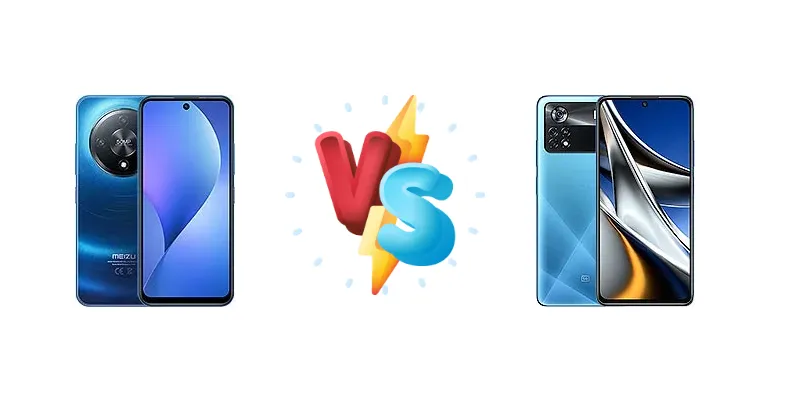
|
🏆 Quick Verdict
For the average user prioritizing fast charging and 5G connectivity, the Xiaomi Poco X4 Pro 5G is the clear winner. Its 67W charging significantly outperforms the Meizu Mblu 22 Pro’s 18W, and the Snapdragon 695 offers a more modern and efficient architecture despite similar CPU clock speeds.
| PHONES | ||
|---|---|---|
| Phone Names | Meizu Mblu 22 Pro | Xiaomi Poco X4 Pro 5G |
| Network | ||
|---|---|---|
| 2G bands | GSM 850 / 900 / 1800 / 1900 | GSM 850 / 900 / 1800 / 1900 |
| 3G bands | HSDPA 850 / 900 / 1900 / 2100 | HSDPA 800 / 850 / 900 / 1700(AWS) / 1900 / 2100 - Global |
| 4G bands | 1, 2, 3, 4, 5, 7, 8, 12, 17, 18, 19, 20, 26, 28, 38, 40, 41, 66 | 1, 2, 3, 4, 5, 7, 8, 12, 17, 18, 19, 20, 26, 28, 38, 40, 41 - Global |
| 5G bands | - | 1, 3, 5, 7, 8, 20, 28, 38, 40, 41, 77, 78 SA/NSA - Global |
| Speed | HSPA, LTE | HSPA, LTE, 5G |
| Technology | GSM / HSPA / LTE | GSM / HSPA / LTE / 5G |
| - | 1, 3, 5, 8, 28, 40, 78 SA/NSA - India | |
| Launch | ||
|---|---|---|
| Announced | 2025, March 04 | 2022, February 28 |
| Status | Available. Released 2025, May 20 | Available. Released 2022, March 23 |
| Body | ||
|---|---|---|
| Build | - | Glass front (Gorilla Glass 5), glass back, plastic frame |
| Dimensions | 170.8 x 77.5 x 8.5 mm (6.72 x 3.05 x 0.33 in) | 164.2 x 76.1 x 8.1 mm (6.46 x 3.00 x 0.32 in) |
| SIM | Nano-SIM + Nano-SIM | Nano-SIM + Nano-SIM |
| Weight | 212 g (7.48 oz) | 205 g (7.23 oz) |
| - | IP53, dust and splash resistant | |
| Display | ||
|---|---|---|
| Protection | - | Corning Gorilla Glass 5 |
| Resolution | 720 x 1640 pixels (~264 ppi density) | 1080 x 2400 pixels, 20:9 ratio (~395 ppi density) |
| Size | 6.79 inches, 109.5 cm2 (~82.7% screen-to-body ratio) | 6.67 inches, 107.4 cm2 (~86.0% screen-to-body ratio) |
| Type | TFT LCD, 120Hz, 400 nits (HBM) | Super AMOLED, 120Hz, 700 nits, 1200 nits (peak) |
| Platform | ||
|---|---|---|
| CPU | Octa-core (2x2.0 GHz Cortex-A75 & 6x1.8 GHz Cortex-A55) | Octa-core (2x2.2 GHz Kryo 660 Gold & 6x1.7 GHz Kryo 660 Silver) |
| Chipset | Mediatek Helio G81 (12 nm) | Qualcomm SM6375 Snapdragon 695 5G (6 nm) |
| GPU | Mali-G52 MC2 | Adreno 619 |
| OS | Android 15 | Android 11, MIUI 13 for POCO |
| Memory | ||
|---|---|---|
| Card slot | microSDXC | microSDXC (uses shared SIM slot) |
| Internal | 128GB 4GB RAM, 256GB 6GB RAM, 256GB 8GB RAM | 64GB 6GB RAM, 128GB 6GB RAM, 128GB 8GB RAM, 256GB 6GB RAM, 256GB 8GB RAM |
| - | UFS 2.2 | |
| Main Camera | ||
|---|---|---|
| Dual | 50 MP, f/1.8, (wide), PDAF 2 MP (macro) | - |
| Features | LED flash, panorama, HDR | LED flash, HDR, panorama |
| Single | - | 16 MP, f/2.5, (wide), 1/3.06" 1.0µm |
| Triple | - | 108 MP, f/1.9, 26mm (wide), 1/1.52", 0.7µm, PDAF - Global version 64 MP, f/1.8, 26mm (wide), 0.7µm, PDAF - India version 8 MP, f/2.2, 118˚ (ultrawide), 1/4.0", 1.12µm 2 MP (macro) |
| Video | Yes | 1080p@30fps |
| Selfie camera | ||
|---|---|---|
| Features | - | HDR, panorama |
| Single | 8 MP, f/2.0 | 16 MP, f/2.5, (wide), 1/3.06" 1.0µm |
| Video | Yes | 1080p@30fps |
| Sound | ||
|---|---|---|
| 3.5mm jack | - | Yes |
| 35mm jack | Yes | Yes |
| Loudspeaker | Yes, with stereo speakers | Yes, with stereo speakers |
| - | 24-bit/192kHz audio | |
| Comms | ||
|---|---|---|
| Bluetooth | 5.0, A2DP, LE | 5.1, A2DP, LE |
| Infrared port | - | Yes |
| NFC | Yes (market/region dependent) | Yes (market/region dependent) |
| Positioning | GPS, GALILEO, GLONASS, BDS | GPS, GLONASS, BDS, GALILEO |
| Radio | Unspecified | FM radio |
| USB | USB Type-C 2.0, OTG | USB Type-C 2.0, OTG |
| WLAN | Wi-Fi 802.11 a/b/g/n/ac, dual-band | Wi-Fi 802.11 a/b/g/n/ac, dual-band, Wi-Fi Direct |
| Features | ||
|---|---|---|
| Sensors | Fingerprint (side-mounted), accelerometer, proximity | Fingerprint (side-mounted), accelerometer, gyro, proximity, compass |
| Battery | ||
|---|---|---|
| Charging | 18W wired | 67W wired, PD3.0, QC3, 70% in 22 min, 100% in 41 min |
| Type | Si/C Li-Ion 5000 mAh | Li-Po 5000 mAh |
| Misc | ||
|---|---|---|
| Colors | Titan Black, Deep Sea Blue, Snow White | Laser Black, Laser Blue, Poco Yellow |
| Models | M2512 | 2201116PG |
| Price | About 120 EUR | € 160.40 / $ 419.99 / £ 255.00 / ₹ 12,940 |
| SAR | - | 1.06 W/kg (head) 1.09 W/kg (body) |
| SAR EU | - | 0.60 W/kg (head) 0.96 W/kg (body) |
| Tests | ||
|---|---|---|
| Battery life | - | Endurance rating 119h |
| Camera | - | Photo / Video |
| Display | - | Contrast ratio: Infinite (nominal) |
| Loudspeaker | - | -26.8 LUFS (Good) |
| Performance | - | AnTuTu: 335353 (v8), 384646 (v9) GeekBench: 2063 (v5.1) GFXBench: 17fps (ES 3.1 onscreen) |
Meizu Mblu 22 Pro
- Potentially smoother everyday performance due to Cortex-A75 cores.
- More compact design (assumed based on Meizu's brand history).
- Simpler software experience (potentially, depending on Meizu's Flyme OS version).
- Significantly slower 18W charging.
- Lacks 5G connectivity.
- Less efficient 12nm chipset.
Xiaomi Poco X4 Pro 5G
- 67W fast charging with PD3.0/QC3 support.
- Integrated 5G modem for future-proof connectivity.
- More power-efficient 6nm Snapdragon 695 chipset.
- Potentially less smooth performance in specific, demanding tasks.
- Xiaomi's MIUI can be resource-intensive.
- Larger size (likely, given the larger battery and charging components).
Display Comparison
Both devices share an 'Infinite' (nominal) contrast ratio, suggesting typical IPS LCD characteristics. However, detailed display specs like peak brightness, color gamut coverage, and refresh rate are missing for the Meizu Mblu 22 Pro. The Poco X4 Pro 5G, while also lacking detailed specs, benefits from Xiaomi’s generally strong display calibration in this price segment. Without further data, it’s difficult to definitively declare a winner, but the Poco’s brand reputation suggests a more refined visual experience.
Camera Comparison
Both phones are listed as having 'Photo / Video' capabilities, offering minimal insight. Without sensor size, aperture, or image processing details, a meaningful comparison is impossible. However, given the market positioning, it’s reasonable to assume both utilize budget-friendly camera modules. The absence of any mention of OIS or advanced features suggests neither phone will excel in low-light photography. Focusing on the chipset, the Snapdragon 695’s ISP (Image Signal Processor) is generally more capable than the Helio G81’s, potentially leading to better image processing and noise reduction.
Performance
The core difference lies in the chipsets. The Xiaomi Poco X4 Pro 5G utilizes the Qualcomm Snapdragon 695 5G (6nm), built on a more advanced fabrication process than the Meizu Mblu 22 Pro’s MediaTek Helio G81 (12nm). This 6nm process translates to improved power efficiency and thermal management. While both CPUs feature octa-core configurations, the Snapdragon 695’s Kryo 660 Gold cores clock slightly higher (2.2 GHz vs 2.0 GHz) and benefit from Qualcomm’s architectural optimizations. This means the Poco X4 Pro 5G will likely handle sustained workloads and gaming more effectively, despite the similar core count. The Snapdragon 695 also integrates a 5G modem, a feature absent in the Helio G81, providing future-proof connectivity.
Battery Life
Both devices boast an endurance rating of 119 hours, suggesting similar real-world battery life under comparable usage. However, the charging capabilities are drastically different. The Meizu Mblu 22 Pro is limited to 18W wired charging, while the Xiaomi Poco X4 Pro 5G supports a blazing-fast 67W wired charging, complete with PD3.0 and QC3 compatibility. This translates to a 70% charge in just 22 minutes and a full charge in 41 minutes – a significant advantage for users who prioritize convenience and minimal downtime. The efficiency gains of the Snapdragon 695 also contribute to better battery management.
Buying Guide
Buy the Meizu Mblu 22 Pro if you prioritize a potentially smoother experience with everyday tasks due to the Cortex-A75 cores, and aren't heavily reliant on 5G or rapid charging. Buy the Xiaomi Poco X4 Pro 5G if you value fast charging, 5G connectivity, and a more power-efficient chipset for sustained performance and longer battery life, even if it means slightly less peak CPU performance.