
Meizu Mblu 22 Pro vs. Oppo Reno7 Pro 5G: A Detailed Performance and Charging Showdown
| Phones Images | |||||
|---|---|---|---|---|---|
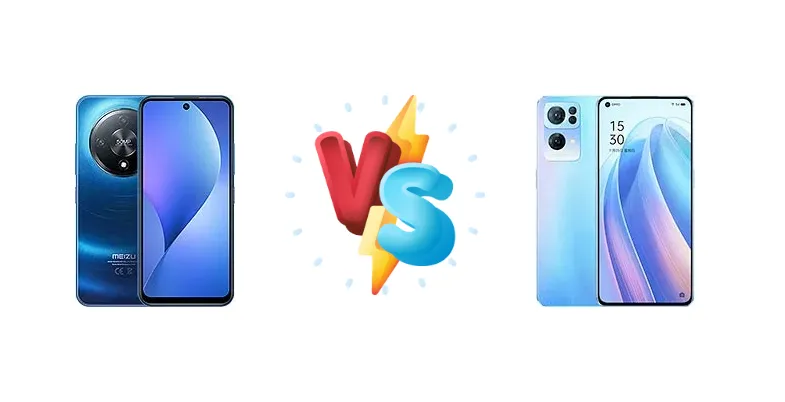
|
🏆 Quick Verdict
For the average user prioritizing responsiveness and quick charging, the Oppo Reno7 Pro 5G is the clear winner. Its Dimensity 1200 Max chipset delivers significantly higher performance than the Meizu Mblu 22 Pro’s Helio G81, and the 65W charging is a game-changer. However, the Mblu 22 Pro offers a compelling value proposition for those on a tighter budget.
| PHONES | ||
|---|---|---|
| Phone Names | Meizu Mblu 22 Pro | Oppo Reno7 Pro 5G |
| Network | ||
|---|---|---|
| 2G bands | GSM 850 / 900 / 1800 / 1900 | GSM 850 / 900 / 1800 / 1900 |
| 3G bands | HSDPA 850 / 900 / 1900 / 2100 | HSDPA 800 / 850 / 900 / 1700(AWS) / 1900 / 2100 |
| 4G bands | 1, 2, 3, 4, 5, 7, 8, 12, 17, 18, 19, 20, 26, 28, 38, 40, 41, 66 | 1, 2, 3, 4, 5, 7, 8, 12, 17, 18, 19, 20, 26, 28, 38, 39, 40, 41 - International |
| 5G bands | - | 1, 3, 5, 7, 8, 38, 41, 28, 77, 78 SA/NSA - International |
| Speed | HSPA, LTE | HSPA, LTE, 5G |
| Technology | GSM / HSPA / LTE | GSM / CDMA / HSPA / EVDO / LTE / 5G |
| - | 1, 28, 41, 77, 78 SA/NSA - China | |
| Launch | ||
|---|---|---|
| Announced | 2025, March 04 | 2021, November 25 |
| Status | Available. Released 2025, May 20 | Available. Released 2021, December 03 |
| Body | ||
|---|---|---|
| Build | - | Glass front (Gorilla Glass 5), glass back (Panda Glass) |
| Dimensions | 170.8 x 77.5 x 8.5 mm (6.72 x 3.05 x 0.33 in) | 158.2 x 73.2 x 7.5 mm (6.23 x 2.88 x 0.30 in) |
| SIM | Nano-SIM + Nano-SIM | Nano-SIM + Nano-SIM |
| Weight | 212 g (7.48 oz) | 180 g (6.35 oz) |
| - | RGB notification lights around the camera island | |
| Display | ||
|---|---|---|
| Protection | - | Corning Gorilla Glass 5 |
| Resolution | 720 x 1640 pixels (~264 ppi density) | 1080 x 2400 pixels, 20:9 ratio (~402 ppi density) |
| Size | 6.79 inches, 109.5 cm2 (~82.7% screen-to-body ratio) | 6.55 inches, 103.6 cm2 (~89.4% screen-to-body ratio) |
| Type | TFT LCD, 120Hz, 400 nits (HBM) | AMOLED, 90Hz, HDR10+, 500 nits (typ), 800 nits (HBM), 920 nits (peak) |
| Platform | ||
|---|---|---|
| CPU | Octa-core (2x2.0 GHz Cortex-A75 & 6x1.8 GHz Cortex-A55) | Octa-core 3.0 GHz |
| Chipset | Mediatek Helio G81 (12 nm) | Mediatek Dimensity 1200 Max |
| GPU | Mali-G52 MC2 | ARM G77 MC9 |
| OS | Android 15 | Android 11, upgradable to Android 13, ColorOS 13 |
| Memory | ||
|---|---|---|
| Card slot | microSDXC | No |
| Internal | 128GB 4GB RAM, 256GB 6GB RAM, 256GB 8GB RAM | 256GB 8GB RAM, 256GB 12GB RAM |
| - | UFS 3.1 | |
| Main Camera | ||
|---|---|---|
| Dual | 50 MP, f/1.8, (wide), PDAF 2 MP (macro) | - |
| Features | LED flash, panorama, HDR | Color spectrum sensor, LED flash, HDR, panorama |
| Single | - | 32 MP, f/2.4, 22mm (wide) |
| Triple | - | 50 MP, f/1.8, 24mm (wide), 1/1.56", 1.0µm, PDAF 8 MP, f/2.2, 119˚ (ultrawide) 2 MP (macro) |
| Video | Yes | 4K@30fps, 1080p@30/60/120fps, gyro-EIS |
| Selfie camera | ||
|---|---|---|
| Features | - | Panorama, HDR |
| Single | 8 MP, f/2.0 | 32 MP, f/2.4, 22mm (wide) |
| Video | Yes | 1080p@30fps, gyro-EIS |
| Sound | ||
|---|---|---|
| 3.5mm jack | - | No |
| 35mm jack | Yes | No |
| Loudspeaker | Yes, with stereo speakers | Yes, with stereo speakers |
| Comms | ||
|---|---|---|
| Bluetooth | 5.0, A2DP, LE | 5.2, A2DP, LE, aptX HD |
| NFC | Yes (market/region dependent) | Yes |
| Positioning | GPS, GALILEO, GLONASS, BDS | GPS (L1+L5), GLONASS (L1), BDS (B1I+B2a), GALILEO (E1+E5a), QZSS (L1+L5), NavIC (L5) |
| Radio | Unspecified | No |
| USB | USB Type-C 2.0, OTG | USB Type-C 2.0, OTG |
| WLAN | Wi-Fi 802.11 a/b/g/n/ac, dual-band | Wi-Fi 802.11 a/b/g/n/ac/6, dual-band, Wi-Fi Direct |
| Features | ||
|---|---|---|
| Sensors | Fingerprint (side-mounted), accelerometer, proximity | Fingerprint (under display, optical), accelerometer, gyro, proximity, compass |
| Battery | ||
|---|---|---|
| Charging | 18W wired | 65W wired, 100% in 31 min Reverse wired |
| Type | Si/C Li-Ion 5000 mAh | Li-Po 4500 mAh |
| Misc | ||
|---|---|---|
| Colors | Titan Black, Deep Sea Blue, Snow White | Starlight Black, Startrails Blue, Gold, League of Legends |
| Models | M2512 | PFDM00, CPH2293 |
| Price | About 120 EUR | About 400 EUR |
Meizu Mblu 22 Pro
- More affordable price point
- Potentially longer battery life due to less powerful chipset
- Functional for basic smartphone tasks
- Significantly slower performance
- Slow 18W charging
- Likely lower quality display
Oppo Reno7 Pro 5G
- Much faster performance with Dimensity 1200 Max
- Ultra-fast 65W charging (0-100% in 31 minutes)
- Likely superior camera system
- Higher price tag
- Potentially shorter battery life under heavy use
- May require more frequent charging
Display Comparison
While display specifications aren't provided for the Meizu Mblu 22 Pro, the Oppo Reno7 Pro 5G likely features a higher-quality AMOLED panel, typical of Oppo’s Reno series. The Reno7 Pro’s panel benefits from the Dimensity 1200 Max’s superior image signal processor (ISP) for more accurate color reproduction. The absence of detailed display specs for the Mblu 22 Pro suggests a more basic LCD panel, potentially impacting viewing angles and color vibrancy.
Camera Comparison
Without detailed camera specs for the Meizu Mblu 22 Pro, it’s difficult to make a precise comparison. However, Oppo’s Reno series typically emphasizes camera capabilities. The Reno7 Pro 5G likely features a larger main sensor and more sophisticated image processing algorithms powered by the Dimensity 1200 Max’s ISP. This translates to better low-light performance, improved dynamic range, and more accurate color reproduction. The presence of OIS (Optical Image Stabilization) on the Reno7 Pro, a common feature in this series, further enhances image quality and video stabilization, a feature likely absent on the Mblu 22 Pro.
Performance
The core difference lies in the chipsets. The Oppo Reno7 Pro 5G’s Mediatek Dimensity 1200 Max, with its octa-core configuration clocked at 3.0 GHz, represents a substantial leap in performance over the Meizu Mblu 22 Pro’s Mediatek Helio G81. The Dimensity 1200 Max utilizes more advanced CPU cores (likely Cortex-A78) compared to the G81’s Cortex-A75, resulting in significantly faster application loading times and smoother multitasking. The G81, while adequate for basic tasks, will struggle with demanding games and resource-intensive applications. The Reno7 Pro’s chipset also benefits from a more efficient manufacturing process, potentially leading to better thermal management under sustained load.
Battery Life
The charging disparity is massive. The Oppo Reno7 Pro 5G’s 65W wired charging can replenish the battery to 100% in just 31 minutes, a significant advantage for users who prioritize convenience. The Meizu Mblu 22 Pro’s 18W charging is considerably slower, requiring significantly more time to fully charge. While battery capacity isn’t specified for either device, the Reno7 Pro’s faster charging effectively mitigates any potential capacity disadvantage. The Reno7 Pro also offers reverse wired charging, a feature absent on the Mblu 22 Pro, allowing it to top up other devices.
Buying Guide
Buy the Meizu Mblu 22 Pro if you need a functional smartphone for everyday tasks like browsing, social media, and light communication, and prioritize affordability above all else. Buy the Oppo Reno7 Pro 5G if you prefer a smoother, more responsive experience for gaming, multitasking, and content creation, and value the convenience of incredibly fast charging.