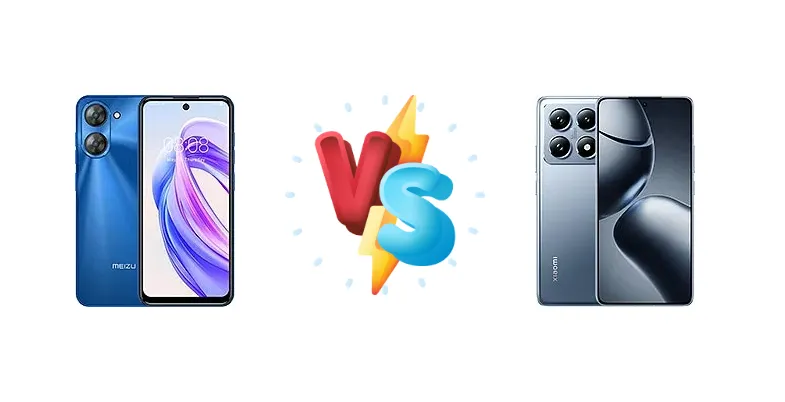
The Meizu mblu 21 and Xiaomi 14T Pro represent distinct approaches to the mid-range smartphone market. The mblu 21 aims for affordability, while the 14T Pro prioritizes performance with a flagship-level chipset. This comparison dissects their key differences to determine which device delivers the best experience for your needs.
🏆 Quick Verdict
For the average user prioritizing raw speed and future-proofing, the Xiaomi 14T Pro is the clear winner. Its Mediatek Dimensity 9300+ chipset offers a substantial performance leap over the Meizu mblu 21’s Unisoc T606. However, the mblu 21 presents a compelling value proposition for those on a tighter budget.
| Network |
|---|
| 2G bands | GSM 850 / 900 / 1800 / 1900 | GSM 850 / 900 / 1800 / 1900 |
| 3G bands | HSDPA 850 / 900 / 1900 / 2100 | HSDPA 800 / 850 / 900 / 1700(AWS) / 1900 / 2100 |
| 4G bands | LTE | 1, 2, 3, 4, 5, 7, 8, 12, 13, 17, 18, 19, 20, 25, 26, 28, 32, 38, 39, 40, 41, 42, 48, 66 |
| 5G bands | - | 1, 2, 3, 5, 7, 8, 12, 20, 25, 26, 28, 38, 40, 41, 48, 66, 75, 77, 78 SA/NSA |
| Speed | HSPA, LTE | HSPA, LTE, 5G |
| Technology | GSM / HSPA / LTE | GSM / HSPA / LTE / 5G |
| Launch |
|---|
| Announced | 2024, November 27 | 2024, September 26 |
| Status | Available. Released 2024, November | Available. Released 2024, September 26 |
| Body |
|---|
| Build | - | Glass front (Gorilla Glass 5), aluminum frame, glass back (Panda X) |
| Dimensions | - | 160.4 x 75.1 x 8.4 mm (6.31 x 2.96 x 0.33 in) |
| SIM | Nano-SIM + Nano-SIM | · Nano-SIM + eSIM· eSIM + eSIM· Nano-SIM + Nano-SIM |
| Weight | - | 209 g (7.37 oz) |
| Display |
|---|
| Protection | - | Corning Gorilla Glass 5 |
| Resolution | 720 x 1640 pixels (~264 ppi density) | 1220 x 2712 pixels, 20:9 ratio (~446 ppi density) |
| Size | 6.79 inches, 109.5 cm2 | 6.67 inches, 107.4 cm2 (~89.1% screen-to-body ratio) |
| Type | IPS LCD, 90Hz | AMOLED, 68B colors, 144Hz, 3840Hz PWM, Dolby Vision, HDR10+, 1600 nits (HBM), 4000 nits (peak) |
| Platform |
|---|
| CPU | Octa-core (2x1.6 GHz Cortex-A75 & 6x1.6 GHz Cortex-A55) | Octa-core (1x3.4 GHz Cortex-X4 & 3x2.85 GHz Cortex-X4 & 4x2.0 GHz Cortex-A720) |
| Chipset | Unisoc T606 (12 nm) | Mediatek Dimensity 9300+ (4 nm) |
| GPU | Mali-G57 MP1 | Immortalis-G720 MC12 |
| OS | Android 14 | Android 14, HyperOS |
| Memory |
|---|
| Card slot | Unspecified | No |
| Internal | 64GB 4GB RAM | 256GB 12GB RAM, 512GB 12GB RAM, 512GB 16GB RAM, 1TB 12GB RAM |
| Main Camera |
|---|
| Features | LED flash, panorama, HDR | Leica lens, Ultra HDR, LED flash, HDR, panorama |
| Single | 13 MP, AF
auxiliary lens | - |
| Triple | - | 50 MP, f/1.6, 23mm (wide), 1/1.31", 1.2µm, PDAF, OIS
50 MP, f/2.0, 60mm (telephoto), 1/2.88", 0.61µm, PDAF, 2.6x optical zoom
12 MP, f/2.2, 15mm (ultrawide), 1/3.06", 1.12µm |
| Video | Yes | 8K@24/30fps, 4K@24/30/60fps, 1080p@30/60/120/240/960fps, gyro-EIS, 10-bit Rec. 2020, HDR10+ |
| Selfie camera |
|---|
| Features | - | HDR |
| Single | 8 MP | 32 MP, f/2.0, 25mm (wide), 1/3.44", 0.64µm |
| Video | Yes | 4K@30fps, 1080p@30/60fps, HDR10+ |
| Sound |
|---|
| 35mm jack | Unspecified | No |
| Loudspeaker | Yes | Yes, with stereo speakers |
| Comms |
|---|
| Bluetooth | 5.0, A2DP | 5.4, A2DP, LE, LHDC |
| Infrared port | - | Yes |
| NFC | No | Yes (market/region dependent) |
| Positioning | GPS | GPS (L1+L5), BDS (B1I+B1C+B2a+B2b), GALILEO (E1+E5a+E5b), QZSS (L1+L5), NavIC (L5), GLONASS |
| Radio | No | No |
| USB | USB Type-C | USB Type-C 2.0, OTG |
| WLAN | Wi-Fi 802.11 a/b/g/n/ac, dual-band | Wi-Fi 802.11 a/b/g/n/ac/6e/7, dual-band, Wi-Fi Direct |
| Features |
|---|
| Sensors | Fingerprint (side-mounted); unspecified sensors | Fingerprint (under display, optical), accelerometer, gyro, proximity, compass |
| Battery |
|---|
| Charging | - | 120W wired, PD3.0, QC4, 100% in 19 min
50W wireless, 100% in 45 min |
| Type | 4900 mAh | Li-Po 5000 mAh |
| Misc |
|---|
| Colors | Black, Blue, White | Titan Gray, Titan Blue, Titan Black |
| Models | M2416 | 2407FPN8EG |
| Price | - | $ 550.00 / £ 498.00 / € 539.99 |
| SAR EU | - | 0.99 W/kg (head) 1.00 W/kg (body) |
Meizu mblu 21
- Highly affordable price point
- Decent performance for basic tasks
- Potentially longer software support (Meizu's Flyme OS)
- Significantly weaker processor compared to the 14T Pro
- Likely lower quality display
- Limited camera capabilities
Xiaomi 14T Pro
- Exceptional performance with Dimensity 9300+
- Ultra-fast 120W wired and 50W wireless charging
- Bright and vibrant display (1228 nits)
- Higher price tag
- Potentially more expensive repairs
- May run hotter under sustained load (though Dimensity 9300+ is efficient)
Display Comparison
The Xiaomi 14T Pro boasts a significantly brighter display, reaching a measured peak of 1228 nits, ensuring excellent visibility even in direct sunlight. While the mblu 21’s display specifications are not provided, it’s likely to be considerably dimmer. The 14T Pro’s brightness advantage is crucial for outdoor use and HDR content consumption. We can assume the 14T Pro uses a higher quality panel given its price point, potentially with a higher refresh rate, though this is unconfirmed. The lack of display details for the mblu 21 suggests a cost-cutting approach in this area.
Camera Comparison
Without detailed camera specifications for the Meizu mblu 21, a direct comparison is limited. However, given its price point, it’s likely to feature a more basic camera system. The Xiaomi 14T Pro, while details are missing, is expected to have a more advanced camera setup, potentially including a larger sensor and optical image stabilization (OIS). The Dimensity 9300+ also includes a powerful ISP (Image Signal Processor) capable of advanced image processing, resulting in better dynamic range and low-light performance. We can assume the 14T Pro will offer a more versatile and higher-quality camera experience.
Performance
The performance gap between these two devices is substantial. The Xiaomi 14T Pro’s Mediatek Dimensity 9300+ (4nm) features a Cortex-X4 prime core clocked at 3.4 GHz, alongside three additional Cortex-X4 cores and four Cortex-A720 efficiency cores. This architecture is designed for peak performance and sustained workloads. In contrast, the Meizu mblu 21 utilizes the Unisoc T606 (12nm), with a less powerful CPU configuration of two Cortex-A75 cores at 1.6 GHz and six Cortex-A55 cores. The 4nm process node of the Dimensity 9300+ also provides superior thermal efficiency, minimizing throttling during extended gaming or demanding tasks. The 14T Pro will deliver a far smoother experience in graphically intensive applications and multitasking.
Battery Life
The Xiaomi 14T Pro excels in charging speed, offering 120W wired charging, capable of reaching 100% in just 19 minutes, and 50W wireless charging at 100% in 45 minutes. This is a significant advantage for users who prioritize quick top-ups. While the mblu 21’s battery capacity is unknown, the 14T Pro’s active use score of 12:32h demonstrates strong battery life despite its powerful processor and fast charging capabilities. The 14T Pro’s charging standards (PD3.0, QC4) also offer broader compatibility with various chargers.
Buying Guide
Buy the Meizu mblu 21 if you need a reliable, everyday smartphone for basic tasks like browsing, social media, and light communication, and value affordability above all else. Buy the Xiaomi 14T Pro if you demand smooth multitasking, demanding gaming, and fast charging, and are willing to pay a premium for a significantly more powerful processor and enhanced features.
Frequently Asked Questions
❓ Is the Unisoc T606 in the Meizu mblu 21 sufficient for playing games like PUBG Mobile?
While the Unisoc T606 can run PUBG Mobile, expect to play at lower graphics settings and potentially experience frame drops during intense moments. It's suitable for casual gaming, but not ideal for demanding titles or competitive play.
❓ How does the thermal management of the Xiaomi 14T Pro handle prolonged gaming sessions?
The Mediatek Dimensity 9300+ is built on a 4nm process, which inherently offers better thermal efficiency than the 12nm Unisoc T606. While the 14T Pro may get warm during extended gaming, its advanced cooling system should prevent significant throttling and maintain consistent performance.
❓ Does the Xiaomi 14T Pro support multiple carrier aggregation for improved 5G speeds?
The Dimensity 9300+ chipset supports extensive carrier aggregation, enabling faster and more reliable 5G connectivity where available. This is a significant advantage for users in areas with strong 5G infrastructure.
❓ What kind of software updates can I expect on the Meizu mblu 21?
Meizu's Flyme OS has a history of providing consistent software updates, though the long-term support for the mblu 21 remains to be seen. Expect regular security patches and potentially a few major Android version updates.