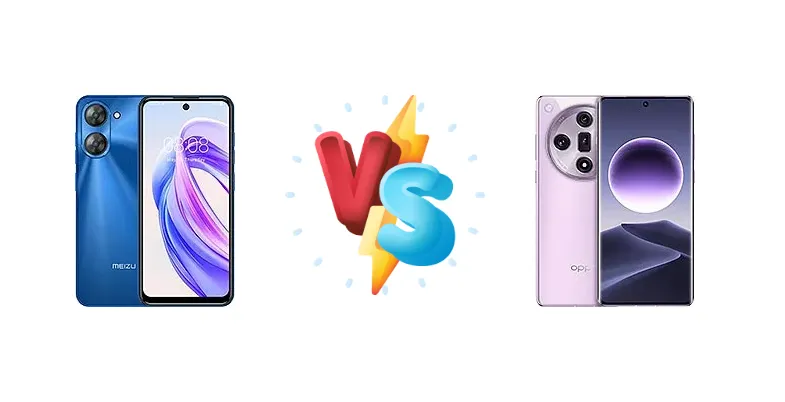
The Meizu mblu 21 and Oppo Find X7 represent vastly different approaches to the smartphone market. The mblu 21 aims for affordability, while the Find X7 targets a premium experience with cutting-edge hardware. This comparison dissects their key differences to determine which device best suits your needs and budget.
🏆 Quick Verdict
For the average user prioritizing raw performance and fast charging, the Oppo Find X7 is the clear winner. Its Mediatek Dimensity 9300 chipset offers a substantial leap in processing power compared to the Meizu mblu 21’s Unisoc T606. However, the mblu 21 remains a viable option for budget-conscious users with less demanding needs.
| Network |
|---|
| 2G bands | GSM 850 / 900 / 1800 / 1900 | GSM 850 / 900 / 1800 / 1900 |
| 3G bands | HSDPA 850 / 900 / 1900 / 2100 | HSDPA 800 / 850 / 900 / 1700(AWS) / 1900 / 2100 |
| 4G bands | LTE | 1, 3, 4, 5 , 7, 8, 18, 19, 20, 26, 28, 34, 38, 39, 40, 41, 66 |
| 5G bands | - | 1, 3, 5, 7, 8, 20, 28, 38, 40, 41, 66, 77, 78 SA/NSA |
| Speed | HSPA, LTE | HSPA, LTE, 5G |
| Technology | GSM / HSPA / LTE | GSM / CDMA / HSPA / CDMA2000 / LTE / 5G |
| Launch |
|---|
| Announced | 2024, November 27 | 2024, January 08 |
| Status | Available. Released 2024, November | Available. Released 2024, January 12 |
| Body |
|---|
| Build | - | Glass front (Gorilla Glass Victus 2), glass back or eco leather back, aluminum frame |
| Dimensions | - | 162.7 x 75.4 x 8.7 mm or 9.0 mm |
| SIM | Nano-SIM + Nano-SIM | Nano-SIM + Nano-SIM |
| Weight | - | 202 g or 206 g (7.13 oz) |
| Display |
|---|
| Protection | - | Corning Gorilla Glass Victus 2 |
| Resolution | 720 x 1640 pixels (~264 ppi density) | 1264 x 2780 pixels (~450 ppi density) |
| Size | 6.79 inches, 109.5 cm2 | 6.78 inches, 111.7 cm2 (~91.1% screen-to-body ratio) |
| Type | IPS LCD, 90Hz | LTPO AMOLED, 1B colors, 120Hz, Dolby Vision, HDR10+, 1600 nits (typ), 2300 nits (HBM), 4500 nits (peak) |
| Platform |
|---|
| CPU | Octa-core (2x1.6 GHz Cortex-A75 & 6x1.6 GHz Cortex-A55) | Octa-core (1x3.25 GHz Cortex-X4 & 3x2.85 GHz Cortex-X4 & 4x2.0 GHz Cortex-A720) |
| Chipset | Unisoc T606 (12 nm) | Mediatek Dimensity 9300 (4 nm) |
| GPU | Mali-G57 MP1 | Immortalis-G720 MC12 |
| OS | Android 14 | Android 14, ColorOS 14 |
| Memory |
|---|
| Card slot | Unspecified | No |
| Internal | 64GB 4GB RAM | 256GB 12GB RAM, 256GB 16GB RAM, 512GB 16GB RAM, 1TB 16GB RAM |
| Main Camera |
|---|
| Features | LED flash, panorama, HDR | Hasselblad Color Calibration, color spectrum sensor, LED flash, HDR, panorama |
| Single | 13 MP, AF
auxiliary lens | - |
| Triple | - | 50 MP, f/1.6, 23mm (wide), 1/1.56", PDAF, OIS
64 MP, f/2.6, 70mm (periscope telephoto), 1/2.0", 3x optical zoom, PDAF, OIS
50 MP, f/2.0, 15mm, 119˚ (ultrawide), PDAF |
| Video | Yes | 4K@30/60fps, 1080p@30/60/240fps; gyro-EIS; HDR, 10‑bit video, Dolby Vision |
| Selfie camera |
|---|
| Features | - | Panorama |
| Single | 8 MP | 32 MP, f/2.4, 21mm (wide), 1/2.74", 0.8µm, PDAF |
| Video | Yes | 4K@30fps, 1080p@30fps, gyro-EIS |
| Sound |
|---|
| 35mm jack | Unspecified | No |
| Loudspeaker | Yes | Yes, with stereo speakers |
| Comms |
|---|
| Bluetooth | 5.0, A2DP | 5.4, A2DP, LE, aptX HD, LHDC |
| Infrared port | - | Yes |
| NFC | No | Yes |
| Positioning | GPS | GPS (L1+L5), BDS (B1I+B1c+B2a+B2b), GALILEO (E1+E5a+E5b), QZSS (L1+L5), GLONASS |
| Radio | No | No |
| USB | USB Type-C | USB Type-C 2.0, OTG |
| WLAN | Wi-Fi 802.11 a/b/g/n/ac, dual-band | Wi-Fi 802.11 a/b/g/n/ac/6e/7, dual-band, Wi-Fi Direct |
| Features |
|---|
| Sensors | Fingerprint (side-mounted); unspecified sensors | Fingerprint (under display, optical), accelerometer, gyro, proximity, compass |
| Battery |
|---|
| Charging | - | 100W wired, PD, 50% in 10 min, 100% in 26 min |
| Type | 4900 mAh | 5000 mAh |
| Misc |
|---|
| Colors | Black, Blue, White | Black, Dark Blue, Light Brown, Purple |
| Models | M2416 | PHZ110 |
| Price | - | About 520 EUR |
Meizu mblu 21
- Significantly more affordable
- Potentially longer battery life due to less powerful chipset (depending on battery capacity)
- Functional for basic smartphone tasks
- Substantially slower performance
- Inferior camera quality
- Slower charging speeds
Oppo Find X7
- Exceptional performance with Dimensity 9300
- Ultra-fast 100W charging
- Superior camera system
- Higher price point
- Potentially shorter battery life compared to a similarly sized battery in a less powerful phone
- May be overkill for basic users
Display Comparison
Context data lacks display specifics for both devices. However, given the mblu 21’s positioning, it likely features an LCD panel with a standard 60Hz refresh rate. The Find X7, as a flagship, is expected to boast a high-resolution AMOLED display with an adaptive refresh rate (likely 120Hz or higher) for smoother scrolling and animations. The Find X7’s panel will also benefit from superior color accuracy and brightness, crucial for outdoor visibility.
Camera Comparison
Without detailed camera specs, we can infer differences based on the devices’ positioning. The Oppo Find X7 is expected to feature a more sophisticated camera system with a larger main sensor, optical image stabilization (OIS), and advanced image processing algorithms. The mblu 21 likely utilizes a more basic camera setup, potentially lacking OIS and offering limited low-light performance. While both may include multiple lenses, the Find X7’s image quality will be noticeably superior, particularly in challenging conditions. We can expect the Find X7 to offer more versatile shooting modes and better video recording capabilities.
Performance
The performance disparity is stark. The Oppo Find X7’s Mediatek Dimensity 9300, fabricated on a 4nm process, is in a different league than the Meizu mblu 21’s 12nm Unisoc T606. The Dimensity 9300’s Cortex-X4 prime core clocked at 3.25 GHz, coupled with three additional X4 cores, delivers significantly faster CPU performance. This translates to quicker app launches, smoother multitasking, and a far superior gaming experience. The Unisoc T606, while adequate for basic tasks, will struggle with demanding applications and graphically intensive games. The Find X7’s LPDDR5x RAM further enhances performance, offering faster data transfer speeds compared to the likely LPDDR4X RAM in the mblu 21.
Battery Life
The Oppo Find X7’s 100W wired charging is a game-changer. The ability to charge from 0% to 50% in just 10 minutes and fully charge in 26 minutes provides exceptional convenience. While the mblu 21’s battery capacity is unknown, it’s unlikely to support such rapid charging. Even if the mblu 21 had a larger battery capacity, the Find X7’s more efficient 4nm chipset would likely result in comparable or even better real-world battery life due to reduced power consumption.
Buying Guide
Buy the Meizu mblu 21 if you need a functional smartphone for basic tasks like calling, texting, and light social media use, and prioritize affordability above all else. Buy the Oppo Find X7 if you demand a smooth, responsive experience for gaming, content creation, and multitasking, and are willing to invest in a flagship-level device with significantly faster charging capabilities.
Frequently Asked Questions
❓ Is the Unisoc T606 in the Meizu mblu 21 capable of running demanding games like Genshin Impact?
While the Unisoc T606 can technically launch Genshin Impact, expect very low frame rates and significant graphical compromises. The chipset simply lacks the processing power and GPU performance to deliver a smooth gaming experience in demanding titles. It's best suited for less intensive games.
❓ How does the 100W charging on the Oppo Find X7 impact long-term battery health?
Oppo employs intelligent charging algorithms and safety mechanisms to mitigate the potential impact of fast charging on battery health. While all batteries degrade over time, the Find X7’s charging system optimizes the process to minimize heat and stress, extending the battery’s lifespan. The phone also likely supports battery health management features within the software.
❓ Does the Oppo Find X7 support 5G connectivity?
Given the Dimensity 9300 chipset, the Oppo Find X7 almost certainly supports 5G connectivity. The Dimensity 9300 includes an integrated 5G modem, enabling faster download and upload speeds where 5G networks are available. The Meizu mblu 21's 4G capabilities will be significantly slower.