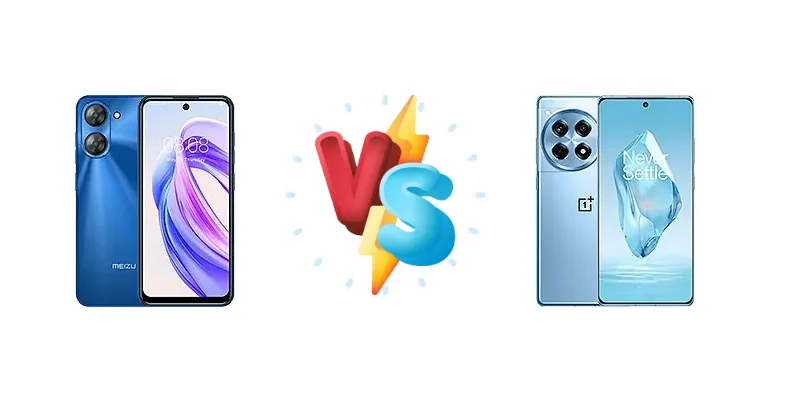
The smartphone landscape is increasingly segmented, with options ranging from ultra-premium flagships to aggressively priced mid-rangers. The Meizu mblu 21 and OnePlus 12R represent opposite ends of this spectrum – the mblu 21 aiming for affordability, while the 12R brings near-flagship performance down to a more accessible price point. This comparison dissects their key differences to determine which device best suits your needs.
🏆 Quick Verdict
For most users, the OnePlus 12R is the clear winner. Its Snapdragon 8 Gen 2 chipset delivers significantly superior performance, and the 100W charging is a game-changer. While the Meizu mblu 21 offers a budget-friendly entry point, the performance gap is too substantial to ignore for power users.
| Network |
|---|
| 2G bands | GSM 850 / 900 / 1800 / 1900 | GSM 850 / 900 / 1800 / 1900 |
| 3G bands | HSDPA 850 / 900 / 1900 / 2100 | HSDPA 850 / 900 / 1700(AWS) / 1900 / 2100 |
| 4G bands | LTE | 1, 2, 3, 4, 5, 7, 8, 12, 17, 18, 19, 20, 26, 28, 32, 38, 39, 40, 41, 66 |
| 5G bands | - | 1, 2, 3, 5, 7, 8, 12, 20, 28, 38, 40, 41, 66, 77, 78 SA/NSA |
| Speed | HSPA, LTE | HSPA, LTE, 5G |
| Technology | GSM / HSPA / LTE | GSM / CDMA / HSPA / LTE / 5G |
| Launch |
|---|
| Announced | 2024, November 27 | 2024, January 23 |
| Status | Available. Released 2024, November | Available. Released 2024, February 06 |
| Body |
|---|
| Build | - | Glass front (Gorilla Glass Victus 2), aluminum frame, glass back |
| Dimensions | - | 163.3 x 75.3 x 8.8 mm (6.43 x 2.96 x 0.35 in) |
| SIM | Nano-SIM + Nano-SIM | · Nano-SIM + Nano-SIM + eSIM (max 2 at a time)· Nano-SIM + Nano-SIM |
| Weight | - | 207 g (7.30 oz) |
| Display |
|---|
| Protection | - | Corning Gorilla Glass Victus 2 |
| Resolution | 720 x 1640 pixels (~264 ppi density) | 1264 x 2780 pixels (~450 ppi density) |
| Size | 6.79 inches, 109.5 cm2 | 6.78 inches, 111.7 cm2 (~90.9% screen-to-body ratio) |
| Type | IPS LCD, 90Hz | LTPO4 AMOLED, 1B colors, 120Hz, HDR10+, Dolby Vision, 1600 nits (HBM), 4500 nits (peak) |
| Platform |
|---|
| CPU | Octa-core (2x1.6 GHz Cortex-A75 & 6x1.6 GHz Cortex-A55) | Octa-core (1x3.2 GHz Cortex-X3 & 2x2.8 GHz Cortex-A715 & 2x2.8 GHz Cortex-A710 & 3x2.0 GHz Cortex-A510) |
| Chipset | Unisoc T606 (12 nm) | Qualcomm SM8550-AB Snapdragon 8 Gen 2 (4 nm) |
| GPU | Mali-G57 MP1 | Adreno 740 |
| OS | Android 14 | Android 14, up to 3 major Android upgrades, OxygenOS 15 |
| Memory |
|---|
| Card slot | Unspecified | No |
| Internal | 64GB 4GB RAM | 128GB 8GB RAM, 256GB 8GB RAM, 256GB 12GB RAM, 256GB 16GB RAM |
| Main Camera |
|---|
| Features | LED flash, panorama, HDR | Laser AF, color spectrum sensor, LED flash, HDR, panorama |
| Single | 13 MP, AF
auxiliary lens | - |
| Triple | - | 50 MP, f/1.8, 24mm (wide), 1/1.56", 1.0µm, multi-directional PDAF, OIS
8 MP, f/2.2, 16mm, 112˚ (ultrawide), 1/4.0", 1.12µm
2 MP (macro) |
| Video | Yes | 4K@30/60fps, 1080p@30/60/120/240fps, gyro-EIS, OIS |
| Selfie camera |
|---|
| Features | - | HDR, panorama |
| Single | 8 MP | 16 MP, f/2.4, 26mm (wide), 1/3", 1.0µm |
| Video | Yes | 1080p@30fps, gyro-EIS |
| Sound |
|---|
| 35mm jack | Unspecified | No |
| Loudspeaker | Yes | Yes, with stereo speakers |
| Comms |
|---|
| Bluetooth | 5.0, A2DP | 5.3, A2DP, LE, aptX HD |
| Infrared port | - | Yes |
| NFC | No | Yes |
| Positioning | GPS | GPS, GALILEO, GLONASS, BDS, QZSS |
| Radio | No | No |
| USB | USB Type-C | USB Type-C 2.0 |
| WLAN | Wi-Fi 802.11 a/b/g/n/ac, dual-band | Wi-Fi 802.11 a/b/g/n/ac/6/7, dual-band |
| Features |
|---|
| Sensors | Fingerprint (side-mounted); unspecified sensors | Fingerprint (under display, optical), accelerometer, gyro, proximity, compass |
| Battery |
|---|
| Charging | - | 100W wired, 100% in 26 min |
| Type | 4900 mAh | Li-Ion 5500 mAh |
| Misc |
|---|
| Colors | Black, Blue, White | Iron Gray, Cool Blue, Electric Violet, Sunset Dune |
| Models | M2416 | CPH2609, CPH2585, CPH2611 |
| Price | - | € 410.84 / $ 399.95 / £ 649.00 |
| SAR | - | 1.19 W/kg (head) 0.82 W/kg (body) |
Meizu mblu 21
- Extremely affordable price point
- Potentially more compact form factor (speculation)
- Acceptable for basic smartphone tasks
- Significantly weaker performance
- Likely inferior camera quality
- Slower charging speeds (assumed)
OnePlus 12R
- Flagship-level Snapdragon 8 Gen 2 performance
- 100W SuperVOOC charging
- Bright and potentially LTPO display
- Higher price tag
- May be larger and heavier
- OxygenOS software preferences vary
Display Comparison
The OnePlus 12R boasts a significantly brighter display, reaching a measured peak of 1181 nits. This translates to superior visibility outdoors under direct sunlight, a crucial advantage for many users. While the Meizu mblu 21’s display specifications are not provided, it’s reasonable to assume it falls considerably short of this brightness level given its price point. The 12R’s panel likely utilizes LTPO technology, enabling variable refresh rates for improved power efficiency, a feature likely absent on the mblu 21. The 12R’s higher brightness and potential for adaptive refresh rates provide a more visually engaging and power-efficient experience.
Camera Comparison
Without detailed camera specifications for the Meizu mblu 21, a direct comparison is challenging. However, given its price point, it’s unlikely to feature a flagship-level camera system. The OnePlus 12R, while not boasting the highest megapixel count, benefits from Qualcomm’s image signal processor (ISP) within the Snapdragon 8 Gen 2, delivering excellent image processing capabilities. The 12R likely features optical image stabilization (OIS) on its main sensor, resulting in sharper images and smoother videos, a feature likely missing on the mblu 21. Focusing on the main sensor performance is key, as the inclusion of low-resolution auxiliary lenses (like a 2MP macro) often adds little practical value.
Performance
The performance disparity is the most significant difference between these two phones. The OnePlus 12R’s Snapdragon 8 Gen 2 (4nm) is a powerhouse, featuring a prime Cortex-X3 core clocked at 3.2 GHz, alongside high-performance Cortex-A715 and A710 cores. This architecture, built on a 4nm process, offers substantial performance and efficiency gains over the Meizu mblu 21’s Unisoc T606 (12nm). The T606, with its Cortex-A75 and A55 cores, is designed for basic tasks and will struggle with demanding games or heavy multitasking. The 12R’s LPDDR5x RAM further enhances performance, providing faster data access compared to the likely LPDDR4X found in the mblu 21. The 4nm node of the Snapdragon 8 Gen 2 also means significantly better thermal management, reducing the likelihood of performance throttling during extended use.
Battery Life
The OnePlus 12R excels in charging speed, offering 100W wired charging that replenishes the battery to 100% in just 26 minutes. This is a significant convenience factor for users who need a quick power boost. While the Meizu mblu 21’s battery capacity is unknown, the 12R’s active use score of 14:32h demonstrates excellent battery life despite its powerful processor and bright display. The combination of efficient hardware and fast charging makes the 12R a compelling choice for users who prioritize all-day battery life and minimal downtime.
Buying Guide
Buy the Meizu mblu 21 if you prioritize extreme affordability and basic smartphone functionality, and your usage primarily revolves around calls, texts, and light social media. You're willing to accept compromises in performance and camera quality to stay within a tight budget. Buy the OnePlus 12R if you demand smooth multitasking, responsive gaming, and fast charging, and are willing to spend a bit more for a significantly enhanced user experience. This is the phone for those who want flagship-level performance without the flagship price tag.
Frequently Asked Questions
❓ Is the Unisoc T606 in the Meizu mblu 21 sufficient for playing modern mobile games?
The Unisoc T606 is a budget-oriented processor and will struggle with graphically demanding games. You'll likely experience low frame rates and significant lag, even on lower settings. It's best suited for casual gaming or older titles.
❓ How does the 100W charging on the OnePlus 12R compare to standard charging speeds?
100W charging is significantly faster than standard charging. The OnePlus 12R can go from 0% to 100% in approximately 26 minutes, whereas a typical 30W charger might take over an hour. This is a major convenience for users who need to quickly top up their battery.
❓ Will the Snapdragon 8 Gen 2 in the OnePlus 12R overheat during prolonged gaming sessions?
The Snapdragon 8 Gen 2 is a thermally efficient chip, and the OnePlus 12R incorporates cooling solutions to mitigate heat. While some warming is expected during extended gaming, it's unlikely to experience significant throttling that severely impacts performance, unlike older generation chips.