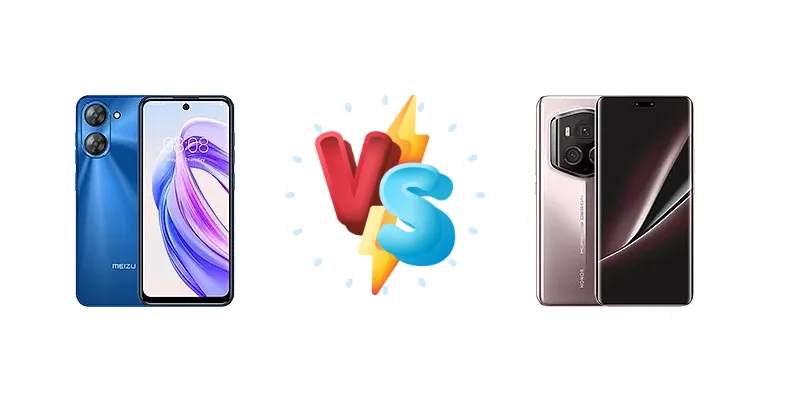
The smartphone landscape is increasingly segmented. The Meizu mblu 21 represents a focus on affordability, while the Honor Magic6 RSR Porsche Design aims for the premium end with cutting-edge technology and a luxury brand association. This comparison dissects the core differences between these two devices, focusing on performance, battery, and display to help you determine which best fits your priorities.
🏆 Quick Verdict
For the average user prioritizing performance and future-proofing, the Honor Magic6 RSR Porsche Design is the clear winner. Its Snapdragon 8 Gen 3 chipset and 80W charging significantly outperform the Meizu mblu 21. However, the mblu 21 offers a compelling value for budget-conscious users who don't demand top-tier specs.
| Network |
|---|
| 2G bands | GSM 850 / 900 / 1800 / 1900 | GSM 850 / 900 / 1800 / 1900 |
| 3G bands | HSDPA 850 / 900 / 1900 / 2100 | HSDPA 800 / 850 / 900 / 1700(AWS) / 1900 / 2100 |
| 4G bands | LTE | LTE |
| 5G bands | - | SA/NSA |
| Speed | HSPA, LTE | HSPA, LTE, 5G |
| Technology | GSM / HSPA / LTE | GSM / CDMA / HSPA / CDMA2000 / LTE / 5G |
| Launch |
|---|
| Announced | 2024, November 27 | 2024, March 18 |
| Status | Available. Released 2024, November | Available. Released 2024, March 22 |
| Body |
|---|
| Build | - | Glass front (NanoCrystal Shield), glass back (NanoCrystal Shield), titanium frame |
| Dimensions | - | 162.5 x 75.8 x 8.9 mm (6.40 x 2.98 x 0.35 in) |
| SIM | Nano-SIM + Nano-SIM | · Nano-SIM + eSIM· Nano-SIM + Nano-SIM |
| Weight | - | 237 g (8.36 oz) |
| Display |
|---|
| Protection | - | NanoCrystal Shield |
| Resolution | 720 x 1640 pixels (~264 ppi density) | 1280 x 2800 pixels, 19.5:9 ratio (~453 ppi density) |
| Size | 6.79 inches, 109.5 cm2 | 6.8 inches, 112.8 cm2 (~91.6% screen-to-body ratio) |
| Type | IPS LCD, 90Hz | LTPO OLED, 1B colors, 120Hz, Dolby Vision, HDR, 1800 nits (HBM), 5000 nits (peak) |
| Platform |
|---|
| CPU | Octa-core (2x1.6 GHz Cortex-A75 & 6x1.6 GHz Cortex-A55) | Octa-core (1x3.3 GHz Cortex-X4 & 3x3.2 GHz Cortex-A720 & 2x3.0 GHz Cortex-A720 & 2x2.3 GHz Cortex-A520) |
| Chipset | Unisoc T606 (12 nm) | Qualcomm SM8650-AB Snapdragon 8 Gen 3 (4 nm) |
| GPU | Mali-G57 MP1 | Adreno 750 |
| OS | Android 14 | Android 14, MagicOS 8 |
| Memory |
|---|
| Card slot | Unspecified | No |
| Internal | 64GB 4GB RAM | 1TB 24GB RAM |
| Main Camera |
|---|
| Features | LED flash, panorama, HDR | Color spectrum sensor, LED flash, HDR, panorama |
| Single | 13 MP, AF
auxiliary lens | - |
| Triple | - | 50 MP, f/1.4-2.0, 23mm (wide), 1/1.3", LiDAR AF, PDAF, OIS
180 MP, f/2.6, (periscope telephoto), 1/1.49", 0.56µm, PDAF, OIS, 2.5x optical zoom
50 MP, f/2.0, 13mm, 122˚ (ultrawide), 1/2.88", AF |
| Video | Yes | 4K@24/30/60fps, 1080p@30/60/120/240fps, gyro-EIS, OIS, HDR, 10-bit video |
| Selfie camera |
|---|
| Single | 8 MP | 50 MP, f/2.0, 22mm (wide), 1/2.93", AF
TOF 3D, (depth/biometrics sensor) |
| Video | Yes | 4K@30fps, 1080p@30/60fps, gyro-EIS |
| Sound |
|---|
| 35mm jack | Unspecified | No |
| Loudspeaker | Yes | Yes, with stereo speakers |
| Comms |
|---|
| Bluetooth | 5.0, A2DP | 5.3, A2DP, LE, aptX HD |
| Infrared port | - | Yes |
| NFC | No | Yes |
| Positioning | GPS | GPS (L1+L5), GLONASS, BDS (B1I+B1c+B2a), GALILEO (E1+E5a) |
| Radio | No | No |
| USB | USB Type-C | USB Type-C 3.2, DisplayPort 1.2, OTG |
| WLAN | Wi-Fi 802.11 a/b/g/n/ac, dual-band | Wi-Fi 802.11 a/b/g/n/ac/6/7, dual-band, Wi-Fi Direct |
| Features |
|---|
| Sensors | Fingerprint (side-mounted); unspecified sensors | Fingerprint (under display, optical), Face ID, accelerometer, gyro, proximity, compass |
| Battery |
|---|
| Charging | - | 80W wired
66W wireless
Reverse wireless
5W reverse wired |
| Type | 4900 mAh | Si/C Li-Ion 5600 mAh |
| Misc |
|---|
| Colors | Black, Blue, White | Agate Grey, Frozen Berry |
| Models | M2416 | BVL-N59, BVL-AN20 |
| Price | - | About 3020 EUR |
Meizu mblu 21
- Significantly lower price point
- Potentially more compact form factor (speculation)
- Acceptable for basic smartphone tasks
- Weak processor performance
- Inferior camera capabilities
- Slower charging speeds
Honor Magic6 RSR Porsche Design
- Flagship-level performance with Snapdragon 8 Gen 3
- Exceptional battery life and fast charging (80W wired, 66W wireless)
- Bright and likely high-quality display
- High price tag
- Porsche Design branding may not appeal to all
- Larger size and weight compared to budget options
Display Comparison
The Honor Magic6 RSR boasts a significantly brighter display, reaching a measured 1731 nits, making it exceptionally usable in direct sunlight. While the Meizu mblu 21’s display specifications are not provided, it’s reasonable to assume a lower peak brightness given its price point. The Magic6 RSR likely utilizes an LTPO panel for adaptive refresh rates, contributing to battery efficiency, a feature absent in the mblu 21. The Porsche Design branding suggests a focus on display quality and color accuracy, likely exceeding the mblu 21’s capabilities.
Camera Comparison
Without detailed camera specifications for the Meizu mblu 21, a direct comparison is limited. However, the Honor Magic6 RSR, being a flagship, likely features a more sophisticated camera system with a larger sensor, optical image stabilization (OIS), and advanced image processing algorithms. The Snapdragon 8 Gen 3’s ISP (Image Signal Processor) is also far superior, enabling better low-light performance and dynamic range. While the mblu 21 may offer acceptable image quality in good lighting conditions, the Magic6 RSR will deliver consistently better results across a wider range of scenarios.
Performance
The performance gap is substantial. The Honor Magic6 RSR’s Qualcomm Snapdragon 8 Gen 3 (4nm) is a current-generation flagship chipset, featuring a Cortex-X4 prime core clocked at 3.3 GHz. This contrasts sharply with the Meizu mblu 21’s Unisoc T606 (12nm), an entry-level processor with a Cortex-A75 based architecture. The Snapdragon 8 Gen 3’s advanced architecture and smaller node size translate to significantly higher processing power, improved graphics performance, and better thermal efficiency. Gamers and power users will find the Magic6 RSR far more capable of handling demanding tasks. The T606 is adequate for basic use but will struggle with graphically intensive games or multitasking.
Battery Life
The Honor Magic6 RSR excels in battery and charging. Its active use score of 14:14h demonstrates excellent endurance. Furthermore, the 80W wired charging and 66W wireless charging are significantly faster than what the Meizu mblu 21 likely offers. The inclusion of reverse wireless and wired charging adds convenience. While the mblu 21’s battery capacity is unknown, the faster charging speeds of the Magic6 RSR mitigate the impact of a potentially smaller battery, allowing for quicker top-ups and reduced downtime.
Buying Guide
Buy the Meizu mblu 21 if you need a functional smartphone for everyday tasks like browsing, social media, and light communication, and are unwilling to spend more than $300. Buy the Honor Magic6 RSR Porsche Design if you prioritize flagship-level performance for demanding applications, gaming, and fast charging, and are willing to invest in a premium experience.
Frequently Asked Questions
❓ Is the Unisoc T606 in the Meizu mblu 21 capable of running modern mobile games?
While the Unisoc T606 can run some mobile games, it will likely struggle with graphically demanding titles at higher settings. Expect lower frame rates and potentially longer loading times. It's best suited for casual gaming or older, less intensive games.
❓ How long does it realistically take to fully charge the Honor Magic6 RSR Porsche Design from 0% to 100%?
With 80W wired charging, the Honor Magic6 RSR Porsche Design can likely charge from 0% to 100% in approximately 30-40 minutes. The 66W wireless charging will take longer, around 50-60 minutes, but is still significantly faster than most wireless charging solutions.
❓ Does the Honor Magic6 RSR Porsche Design support 5G connectivity?
Given the Snapdragon 8 Gen 3 chipset, the Honor Magic6 RSR Porsche Design fully supports 5G connectivity, enabling faster download and upload speeds where available. The Meizu mblu 21's 5G capabilities are unknown, but likely limited given its chipset.
❓ What are the potential downsides of the Porsche Design branding on the Honor Magic6 RSR?
The Porsche Design branding adds a premium cost to the device. While it may appeal to some, others may find the aesthetic or association unnecessary and prefer a more understated design. The branding doesn't inherently improve performance, so the added cost is primarily for the design and exclusivity.