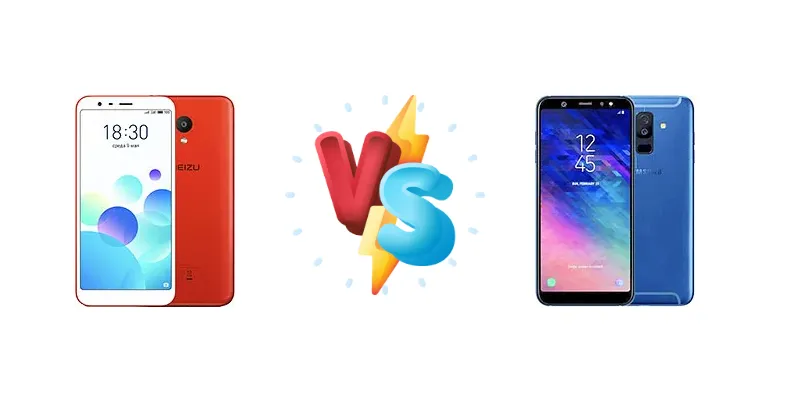
The Meizu M8c and Samsung Galaxy A6+ (2018) represent distinct approaches to the budget smartphone market. The M8c, with its focus on affordability, clashes with the A6+'s attempt to offer a more refined experience. This comparison dissects their core components to determine which device delivers the best value for your money.
🏆 Quick Verdict
For most users, the Samsung Galaxy A6+ (2018) is the better choice. While both phones offer similar battery endurance, the A6+'s more powerful Snapdragon 450 chipset provides a noticeably smoother experience, especially for multitasking and moderately demanding apps. The M8c remains a viable option for extremely budget-conscious users.
| Network |
|---|
| 2G bands | GSM 850 / 900 / 1800 / 1900 | GSM 850 / 900 / 1800 / 1900 |
| 3G bands | HSDPA 850 / 900 / 1900 / 2100 | HSDPA 850 / 900 / 1700(AWS) / 1900 / 2100 |
| 4G bands | 1, 3, 5, 7, 8, 20, 40 | 1, 2, 3, 4, 5, 7, 8, 12, 13, 17, 20, 28, 38, 40, 41, 66 - A605G/DS |
| Speed | HSPA 42.2/5.76 Mbps, LTE Cat4 150/50 Mbps | HSPA 42.2/5.76 Mbps, LTE (2CA) Cat6 300/50 Mbps |
| Technology | GSM / HSPA / LTE | GSM / HSPA / LTE |
| Launch |
|---|
| Announced | 2018, May. Released 2018, June | 2018, May. Released 2018, May |
| Status | Discontinued | Discontinued |
| Body |
|---|
| Build | - | Glass front, aluminum back, aluminum frame |
| Dimensions | 146.4 x 70 x 8.5 mm (5.76 x 2.76 x 0.33 in) | 160.2 x 75.7 x 7.9 mm (6.31 x 2.98 x 0.31 in) |
| SIM | Nano-SIM + Nano-SIM | · Nano-SIM· Nano-SIM + Nano-SIM |
| Weight | 140 g (4.94 oz) | 186 g (6.56 oz) |
| Display |
|---|
| Resolution | 720 x 1440 pixels, 18:9 ratio (~295 ppi density) | 1080 x 2220 pixels, 18.5:9 ratio (~411 ppi density) |
| Size | 5.45 inches, 76.7 cm2 (~74.8% screen-to-body ratio) | 6.0 inches, 91.4 cm2 (~75.3% screen-to-body ratio) |
| Type | IPS LCD | Super AMOLED |
| | - | Always-on display |
| Platform |
|---|
| CPU | Quad-core 1.4 GHz Cortex-A53 | Octa-core 1.8 GHz Cortex-A53 |
| Chipset | Qualcomm MSM8917 Snapdragon 425 (28 nm) | Qualcomm SDM450 Snapdragon 450 (14 nm) |
| GPU | Adreno 308 | Adreno 506 |
| OS | Android 7.0 (Nougat), Flyme UI | Android 8.0 (Oreo), upgradable to Android 9.0 (Pie), One UI |
| Memory |
|---|
| Card slot | microSDXC (uses shared SIM slot) | microSDXC (dedicated slot) |
| Internal | 16GB 2GB RAM, 32GB 2GB RAM | 32GB 3GB RAM, 32GB 4GB RAM, 64GB 4GB RAM |
| | eMMC 5.1 | eMMC 5.1 |
| Main Camera |
|---|
| Dual | - | 16 MP, f/1.7, 26mm (wide), PDAF
Auxiliary lens |
| Features | LED flash | LED flash, panorama, HDR |
| Single | 13 MP, f/2.2, PDAF | - |
| Video | 1080p@30fps | 1080p@30fps |
| Selfie camera |
|---|
| Features | - | LED flash |
| Single | 8 MP, f/2.0 | 24 MP, f/1.9, 27mm (wide), 1/2.8", 0.9µm |
| Video | - | 1080p@30fps, HDR |
| Sound |
|---|
| 3.5mm jack | Yes | Yes |
| 35mm jack | Yes | Yes |
| Loudspeaker | Yes | Yes |
| Comms |
|---|
| Bluetooth | 4.1, A2DP, LE | 4.2, A2DP, LE |
| NFC | No | Yes (optional) |
| Positioning | GPS | GPS, GLONASS, BDS |
| Radio | FM radio | Stereo FM radio, RDS, recording |
| USB | microUSB 2.0 | microUSB 2.0 |
| WLAN | Wi-Fi 802.11 a/b/g/n | Wi-Fi 802.11 a/b/g/n, Wi-Fi Direct |
| Features |
|---|
| Sensors | Accelerometer, proximity | Fingerprint (rear-mounted), accelerometer, gyro, proximity, compass |
| | - | ANT+
Samsung Pay |
| Battery |
|---|
| Music play | - | Up to 60 h |
| Talk time | - | Up to 21 h (3G) |
| Type | Li-Ion 3070 mAh, non-removable | Li-Ion 3500 mAh, non-removable |
| Misc |
|---|
| Colors | Black, Gold, Blue, Red | Black, Gold, Blue, Lavender |
| Models | - | SM-A605FN, SM-A605G, SM-A605F, SM-A605GN, SM-A6050, SM-A605K, SM-A605X, SM-A6058 |
| Price | About 140 EUR | About 230 EUR |
| SAR | - | 0.36 W/kg (head) 1.39 W/kg (body) |
| Tests |
|---|
| Audio quality | - |
Noise -89.7dB / Crosstalk -91.7dB |
| Battery life | - | Endurance rating 106h |
| Camera | - |
Photo / Video |
| Display | - |
Contrast ratio: Infinite (nominal), 3.834 (sunlight) |
| Loudspeaker | - |
Voice 76dB / Noise 73dB / Ring 81dB |
| Performance | - |
AnTuTu: 69899 (v7)
GeekBench: 3905 (v4.4)
GFXBench: 3.1fps (ES 3.1 onscreen) |
Meizu M8c
- Lower price point makes it extremely accessible.
- Decent battery life for basic usage.
- Compact and lightweight design (assumed based on market positioning).
- Significantly weaker processor limits performance.
- Likely inferior camera quality.
- Older chipset technology.
Samsung Galaxy A6+ (2018)
- More powerful Snapdragon 450 processor.
- Better multitasking capabilities.
- Potentially superior camera performance.
- Higher price compared to the Meizu M8c.
- Similar battery life to the M8c despite a more efficient chipset.
- May not offer significant upgrades for users with very basic needs.
Display Comparison
Both devices share an 'Infinite' contrast ratio (nominal) and a sunlight contrast ratio of 3.834, suggesting similar outdoor visibility. However, detailed display specs like resolution and panel type are missing. Given the price points, both likely utilize IPS LCD panels. The A6+ likely benefits from Samsung’s display tuning, potentially offering more accurate colors, while the M8c’s display is likely optimized for power efficiency. Without specific nit brightness data, it’s difficult to definitively say which display is superior.
Camera Comparison
Both phones are listed as having 'Photo / Video' capabilities, but lack specific details. Given the market segment, expect basic camera performance. The A6+ likely has a more sophisticated image signal processor (ISP) integrated into the Snapdragon 450, potentially leading to better image quality, especially in low-light conditions. The presence of a dedicated camera app with features like HDR and scene optimization is more probable on the Samsung device. The M8c likely relies on simpler software processing. Without sensor size or aperture information, a detailed camera comparison is impossible, but the A6+ has a clear advantage due to its chipset.
Performance
The core difference lies in the chipsets. The Samsung Galaxy A6+ (2018) boasts the Qualcomm SDM450 Snapdragon 450, an octa-core processor built on a 14nm process. This contrasts with the Meizu M8c’s Qualcomm MSM8917 Snapdragon 425, a quad-core chip fabricated on a larger 28nm node. The 14nm process of the SDM450 translates to better power efficiency and thermal performance, allowing for sustained performance under load. The eight Cortex-A53 cores in the A6+ also provide a significant advantage in multitasking compared to the M8c’s four cores. This means smoother app switching and a more responsive user interface on the Samsung device.
Battery Life
Interestingly, both devices share an endurance rating of 106 hours. This suggests similar real-world battery life despite the differing chipsets. The Snapdragon 450’s efficiency gains are likely offset by the A6+'s potentially more demanding display and software features. Neither device is specified with fast charging capabilities, implying standard charging speeds. The similar endurance ratings mean battery life isn’t a deciding factor, but the A6+'s more efficient chipset could translate to slightly longer standby times.
Buying Guide
Buy the Meizu M8c if you prioritize absolute affordability and basic smartphone functionality – calls, texts, and light social media use. It's ideal for first-time smartphone owners or as a reliable backup device. Buy the Samsung Galaxy A6+ (2018) if you value a more responsive user experience, better performance for everyday tasks, and a slightly more polished design. It's suited for users who want a phone that can handle a wider range of apps and activities without significant lag.
Frequently Asked Questions
❓ Is the Snapdragon 425 in the Meizu M8c sufficient for running popular apps like WhatsApp and Facebook?
Yes, the Snapdragon 425 is capable of running basic apps like WhatsApp and Facebook without significant issues. However, expect slower loading times and potential lag when switching between apps or using more demanding features within those apps. It's suitable for light usage but will struggle with resource-intensive tasks.
❓ Does the Samsung Galaxy A6+ (2018) support gaming? If so, what kind of gaming performance can I expect?
The Galaxy A6+ can handle casual gaming, but it's not a gaming powerhouse. Games like PUBG Mobile can be played at lower settings (balanced graphics, medium frame rate) for a playable experience. More demanding titles may require significant compromises in graphics settings or may not run smoothly. The Snapdragon 450 provides a noticeable improvement over the M8c for gaming, but don't expect flagship-level performance.
❓ What type of charging port do both phones use?
Both the Meizu M8c and Samsung Galaxy A6+ (2018) utilize a micro-USB port for charging and data transfer. Neither device supports USB-C, which is becoming increasingly common in modern smartphones.