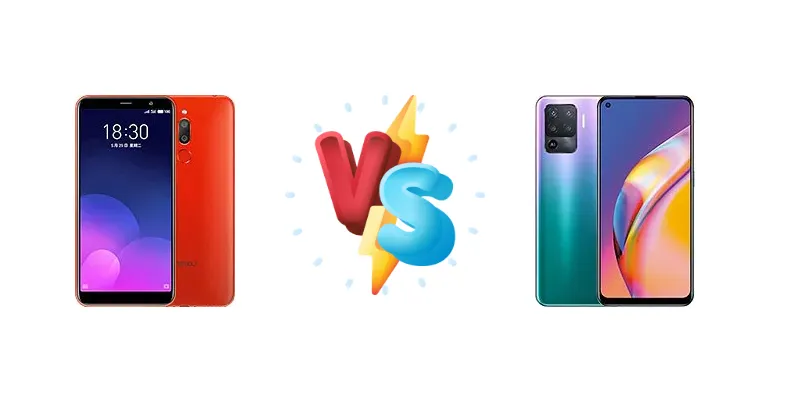
The Meizu M6T and Oppo A94 represent distinct approaches to the budget smartphone market. The M6T, leveraging an older but proven Mediatek chipset, aims for affordability. The A94, with its newer Helio P95, prioritizes performance and faster charging, albeit at a potentially higher price point. This comparison dissects their key differences to determine which device offers the best value.
🏆 Quick Verdict
For the average user prioritizing responsiveness and future-proofing, the Oppo A94 is the clear winner. Its Helio P95 chipset, built on a 12nm process, delivers significantly better performance than the Meizu M6T’s older 28nm MT6750. While the M6T offers a potentially lower entry price, the A94’s 30W charging and improved CPU architecture justify the investment.
| Network |
|---|
| 2G bands | GSM 850 / 900 / 1800 / 1900 | GSM 850 / 900 / 1800 / 1900 |
| 3G bands | HSDPA 850 / 900 / 1900 / 2100 | HSDPA 850 / 900 / 2100 |
| 4G bands | 1, 3, 8, 34, 38, 39, 40, 41 | 1, 3, 5, 7, 8, 20, 28, 38, 40, 41 |
| Speed | HSPA 42.2/5.76 Mbps, LTE Cat4 150/50 Mbps | HSPA, LTE |
| Technology | GSM / CDMA / HSPA / LTE | GSM / HSPA / LTE |
| | CDMA 800 & TD-SCDMA | - |
| Launch |
|---|
| Announced | 2018, May. Released 2018, June | 2021, March 05 |
| Status | Discontinued | Available. Released 2021, March 11 |
| Body |
|---|
| Build | Glass front, plastic back, plastic frame | - |
| Dimensions | 152.3 x 73 x 8.4 mm (6.00 x 2.87 x 0.33 in) | 160.1 x 73.2 x 7.8 mm (6.30 x 2.88 x 0.31 in) |
| SIM | Nano-SIM + Nano-SIM | Nano-SIM + Nano-SIM |
| Weight | 145 g (5.11 oz) | 172 g (6.07 oz) |
| Display |
|---|
| Resolution | 720 x 1440 pixels, 18:9 ratio (~282 ppi density) | 1080 x 2400 pixels, 20:9 ratio (~409 ppi density) |
| Size | 5.7 inches, 83.8 cm2 (~75.4% screen-to-body ratio) | 6.43 inches, 99.8 cm2 (~85.2% screen-to-body ratio) |
| Type | IPS LCD | AMOLED, 430 nits (typ), 800 nits (peak) |
| Platform |
|---|
| CPU | Octa-core (4x1.5 GHz Cortex-A53 & 4x1.0 GHz Cortex-A53) | Octa-core (2x2.2 GHz Cortex-A75 & 6x2.0 GHz Cortex-A55) |
| Chipset | Mediatek MT6750 (28 nm) | Mediatek MT6779V Helio P95 (12 nm) |
| GPU | Mali-T860MP2 | PowerVR GM9446 |
| OS | Android 7.0 (Nougat), Flyme UI | Android 11, ColorOS 11.1 |
| Memory |
|---|
| Card slot | microSDXC (uses shared SIM slot) | microSDXC |
| Internal | 32GB 3GB RAM, 32GB 4GB RAM, 64GB 4GB RAM | 128GB 8GB RAM |
| | eMMC 5.1 | - |
| Main Camera |
|---|
| Dual | 13 MP, f/2.2, PDAF
Auxiliary lens | - |
| Features | LED flash, panorama | LED flash, HDR, panorama |
| Quad | - | 48 MP, f/1.7, 26mm (wide), 1/2.0", 0.8µm, PDAF
8 MP, f/2.2, 16mm, 119˚ (ultrawide), 1/4.0", 1.12µm
2 MP (macro)
Auxiliary lens |
| Single | - | 32 MP, f/2.4, 24mm (wide) |
| Video | 1080p@30fps | 4K@30fps, 1080p@30/120fps; gyro-EIS |
| Selfie camera |
|---|
| Features | - | HDR |
| Single | 8 MP, f/2.0 | 32 MP, f/2.4, 24mm (wide) |
| Video | - | 1080p@30fps |
| Sound |
|---|
| 3.5mm jack | Yes | Yes |
| 35mm jack | Yes | Yes |
| Loudspeaker | Yes | Yes |
| Comms |
|---|
| Bluetooth | 4.1, A2DP, LE | 5.1, A2DP, LE, aptX HD |
| NFC | No | No |
| Positioning | GPS, GLONASS | GPS, GLONASS, GALILEO, BDS, QZSS |
| Radio | FM radio | Unspecified |
| USB | microUSB 2.0 | USB Type-C 2.0, OTG |
| WLAN | Wi-Fi 802.11 a/b/g/n, dual-band, Wi-Fi Direct | Wi-Fi 802.11 a/b/g/n/ac, dual-band, Wi-Fi Direct |
| Features |
|---|
| Sensors | Fingerprint (rear-mounted), accelerometer, proximity, compass | Fingerprint (under display, optical), accelerometer, gyro, proximity, compass |
| Battery |
|---|
| Charging | - | 30W wired |
| Type | Li-Ion 3300 mAh, non-removable | Li-Po 4310 mAh |
| Misc |
|---|
| Colors | Black, Champagne Gold, Coral Red | Fluid Black, Fantastic Purple |
| Models | M6T | CPH2203 |
| Price | About 130 EUR | About 160 EUR |
Meizu M6T
- Potentially lower price point
- Reliable for basic tasks
- Simple and straightforward user experience
- Outdated chipset performance
- Slower charging speeds
- Likely to struggle with demanding apps
Oppo A94
- Significantly faster processor
- 30W fast charging
- Improved multitasking and gaming performance
- Potentially higher price
- May experience some thermal throttling under heavy load
- Software updates may be less frequent than flagship models
Display Comparison
Neither device's display specifications are provided, so a direct comparison is limited. However, given the market positioning, both likely utilize IPS LCD panels. The A94, being a newer model, *may* benefit from improved color calibration and viewing angles. The absence of high refresh rate support on either device suggests a focus on battery life over visual fluidity. Bezels are likely comparable, typical of phones in this price bracket.
Camera Comparison
Without detailed camera specifications, a precise comparison is difficult. However, it’s reasonable to assume the Oppo A94 benefits from more advanced image processing capabilities due to its newer chipset. The A94 likely features a higher-resolution main sensor, enabling better detail capture. While both phones likely include multiple rear cameras, the presence of a 2MP macro lens on either device is unlikely to provide a significant photographic advantage. Image quality will likely be superior on the A94, particularly in low-light conditions.
Performance
The core difference lies in the chipsets. The Oppo A94’s Mediatek Helio P95 (MT6779V) built on a 12nm process, represents a substantial upgrade over the Meizu M6T’s Mediatek MT6750 (28nm). The P95 features a more modern CPU configuration – 2x2.2 GHz Cortex-A75 cores and 6x2.0 GHz Cortex-A55 cores – compared to the M6T’s 4x1.5 GHz Cortex-A53 and 4x1.0 GHz Cortex-A53. This translates to significantly faster application loading times, smoother multitasking, and improved gaming performance on the A94. The 12nm process also contributes to better thermal efficiency, reducing the likelihood of throttling under sustained load. The M6T’s older architecture will struggle with demanding applications and may exhibit noticeable lag.
Battery Life
Battery capacity isn't specified for either device. However, the Oppo A94’s 30W wired charging is a major advantage. This allows for a significantly faster 0-100% charge compared to the M6T, which likely supports a much slower charging rate. Even if the M6T has a slightly larger battery capacity, the A94’s faster charging mitigates the impact of any capacity difference, providing more convenient top-ups throughout the day.
Buying Guide
Buy the Meizu M6T if you need a basic, reliable smartphone for essential tasks like calling, texting, and light social media use, and are on a very tight budget. Its older chipset is sufficient for these workloads. Buy the Oppo A94 if you prefer a smoother, more responsive experience for multitasking, gaming, and content consumption, and value the convenience of significantly faster 30W charging. The A94 is the better choice for users who anticipate using their phone for more than just basic communication.
Frequently Asked Questions
❓ Will the Helio P95 in the Oppo A94 handle demanding games like PUBG Mobile smoothly?
The Helio P95 is capable of running PUBG Mobile, but expect to use medium graphics settings for a consistently smooth experience. The Cortex-A75 cores provide a significant performance boost over the M6T’s chipset, but it’s not a flagship-level processor. The M6T will likely struggle to maintain a playable framerate even on low settings.
❓ Is the difference in chipset architecture (28nm vs 12nm) noticeable in everyday use?
Yes, the difference is significant. The 12nm process used in the Helio P95 is more efficient, generating less heat and consuming less power than the 28nm process in the MT6750. This translates to better battery life and sustained performance under load. You'll notice this in faster app loading times and smoother multitasking on the Oppo A94.
❓ How long will it take to fully charge the Oppo A94 with the 30W charger?
While a precise time requires testing, the Oppo A94 should fully charge from 0% to 100% in approximately 60-75 minutes with the included 30W charger. This is considerably faster than the Meizu M6T, which likely takes over 2 hours with a standard charger.