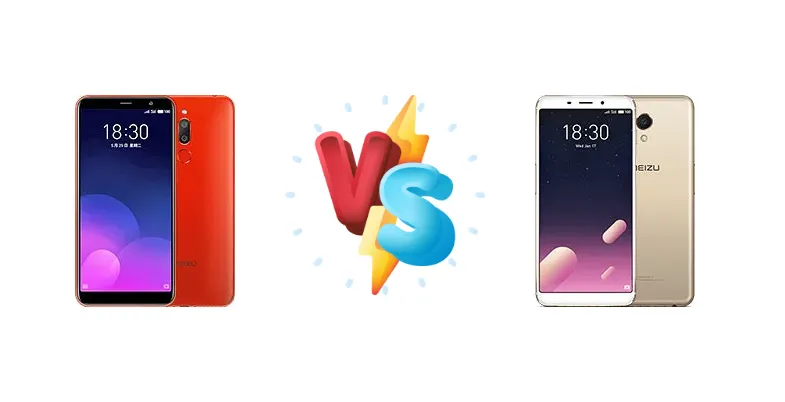
The Meizu M6T and M6s represent a fascinating point in the budget smartphone landscape. Both devices aimed to deliver a solid experience at an accessible price, but they took different approaches to achieving that goal. The M6T prioritized cost optimization with the Mediatek MT6750, while the M6s opted for the more advanced, though potentially power-hungry, Exynos 7872. This comparison will dissect the key differences to determine which phone offers the best value.
🏆 Quick Verdict
For the average user prioritizing sustained performance and faster charging, the Meizu M6s is the better choice. The Exynos 7872’s more modern architecture and 18W charging significantly outweigh the M6T’s cost savings. However, users on a very tight budget who prioritize efficiency and don't need demanding performance will find the M6T adequate.
| Network |
|---|
| 2G bands | GSM 850 / 900 / 1800 / 1900 | GSM 850 / 900 / 1800 / 1900 - SIM 1 & SIM 2 |
| 3G bands | HSDPA 850 / 900 / 1900 / 2100 | HSDPA 850 / 900 / 1900 / 2100 |
| 4G bands | 1, 3, 8, 34, 38, 39, 40, 41 | 1, 3, 5, 7, 8, 20, 40 |
| Speed | HSPA 42.2/5.76 Mbps, LTE Cat4 150/50 Mbps | HSPA 42.2/5.76 Mbps, LTE (2CA) Cat6 300/50 Mbps |
| Technology | GSM / CDMA / HSPA / LTE | GSM / HSPA / LTE |
| | CDMA 800 & TD-SCDMA | - |
| Launch |
|---|
| Announced | 2018, May. Released 2018, June | 2018, January. Released 2018, January |
| Status | Discontinued | Discontinued |
| Body |
|---|
| Build | Glass front, plastic back, plastic frame | Glass front, aluminum back, aluminum frame |
| Dimensions | 152.3 x 73 x 8.4 mm (6.00 x 2.87 x 0.33 in) | 152 x 72.5 x 8 mm (5.98 x 2.85 x 0.31 in) |
| SIM | Nano-SIM + Nano-SIM | Nano-SIM + Nano-SIM |
| Weight | 145 g (5.11 oz) | 160 g (5.64 oz) |
| Display |
|---|
| Resolution | 720 x 1440 pixels, 18:9 ratio (~282 ppi density) | 720 x 1440 pixels, 18:9 ratio (~282 ppi density) |
| Size | 5.7 inches, 83.8 cm2 (~75.4% screen-to-body ratio) | 5.7 inches, 83.8 cm2 (~76.1% screen-to-body ratio) |
| Type | IPS LCD | IPS LCD |
| Platform |
|---|
| CPU | Octa-core (4x1.5 GHz Cortex-A53 & 4x1.0 GHz Cortex-A53) | Hexa-core (4x1.6 GHz Cortex-A53 & 2x2.0 GHz Cortex-A73) |
| Chipset | Mediatek MT6750 (28 nm) | Exynos 7872 (14 nm) |
| GPU | Mali-T860MP2 | Mali-G71 MP1 |
| OS | Android 7.0 (Nougat), Flyme UI | Android 7.0 (Nougat), Flyme 6.2 |
| Memory |
|---|
| Card slot | microSDXC (uses shared SIM slot) | microSDXC (uses shared SIM slot) |
| Internal | 32GB 3GB RAM, 32GB 4GB RAM, 64GB 4GB RAM | 32GB 3GB RAM, 64GB 3GB RAM |
| | eMMC 5.1 | eMMC 5.1 |
| Main Camera |
|---|
| Dual | 13 MP, f/2.2, PDAF
Auxiliary lens | - |
| Features | LED flash, panorama | Dual-LED dual-tone flash |
| Single | - | 16 MP, f/2.0, PDAF |
| Video | 1080p@30fps | 1080p@30fps |
| Selfie camera |
|---|
| Single | 8 MP, f/2.0 | 8 MP, f/2.0 |
| Sound |
|---|
| 3.5mm jack | Yes | Yes |
| 35mm jack | Yes | Yes |
| Loudspeaker | Yes | Yes |
| Comms |
|---|
| Bluetooth | 4.1, A2DP, LE | 4.2, A2DP, LE |
| NFC | No | No |
| Positioning | GPS, GLONASS | GPS, GLONASS |
| Radio | FM radio | No |
| USB | microUSB 2.0 | microUSB 2.0 |
| WLAN | Wi-Fi 802.11 a/b/g/n, dual-band, Wi-Fi Direct | Wi-Fi 802.11 a/b/g/n, dual-band, Wi-Fi Direct |
| Features |
|---|
| Sensors | Fingerprint (rear-mounted), accelerometer, proximity, compass | Fingerprint (side-mounted), accelerometer, gyro, proximity, compass |
| Battery |
|---|
| Charging | - | 18W wired |
| Type | Li-Ion 3300 mAh, non-removable | Li-Ion 3000 mAh, non-removable |
| Misc |
|---|
| Colors | Black, Champagne Gold, Coral Red | Black, Silver, Gold, Blue |
| Models | M6T | M6s |
| Price | About 130 EUR | About 150 EUR |
Meizu M6T
- Potentially longer battery life due to efficient chipset.
- Lower price point, making it more accessible.
- Reliable performance for basic tasks.
- Slower performance in demanding applications.
- Slower charging speeds.
- Older chipset architecture.
Meizu M6s
- Faster performance thanks to the Exynos 7872.
- 18W fast charging for quicker top-ups.
- More efficient chipset architecture.
- Potentially shorter battery life under heavy load.
- Higher price compared to the M6T.
- May experience more heat during intensive tasks.
Display Comparison
Neither Meizu provided detailed display specifications in the provided data. However, given their market positioning, both likely featured 720p LCD panels. The M6s’s advantage isn’t in display quality, but in the chipset’s ability to drive the display more efficiently, potentially resulting in smoother animations. Without knowing the PWM dimming rates, it’s impossible to assess flicker-related eye strain differences.
Camera Comparison
Without detailed camera specs, a direct comparison is difficult. Both phones likely featured a primary camera and a depth sensor. However, the Exynos 7872’s image signal processor (ISP) is more advanced than the MT6750’s, potentially leading to better image processing, dynamic range, and low-light performance. The M6s’s chipset could also support more advanced camera features, even with similar sensor hardware. The presence of a 2MP macro camera on either device is largely a marketing gimmick and unlikely to significantly impact image quality.
Performance
The core difference lies in the chipsets. The Meizu M6T’s Mediatek MT6750, built on a 28nm process, utilizes an older big.LITTLE architecture with Cortex-A53 cores. The M6s’s Exynos 7872, fabricated on a more efficient 14nm process, features a hybrid configuration with both Cortex-A53 and the more powerful Cortex-A73 cores. This architectural leap translates to a noticeable performance advantage for the M6s in multitasking and demanding applications. The A73 cores provide a significant boost in single-core performance, impacting app launch speeds and responsiveness. While both have 4GB of RAM (assumed based on market segment), the Exynos 7872’s superior processing power will utilize it more effectively.
Battery Life
Battery capacity isn’t specified, but both likely featured batteries around 3000-3300mAh, typical for this price range. The M6T’s MT6750, being less powerful, will consume less energy during typical usage, potentially resulting in longer battery life. However, the M6s compensates with 18W wired charging, significantly reducing charging times compared to the M6T’s likely 10W or 12W charging. This faster charging is a substantial convenience factor, allowing users to quickly top up their battery when needed.
Buying Guide
Buy the Meizu M6T if you need a reliably functional smartphone for basic tasks like calling, texting, and light social media use, and your budget is extremely limited. You'll benefit from potentially longer battery life due to the less power-hungry chipset. Buy the Meizu M6s if you prefer a smoother user experience, faster app loading times, and the convenience of 18W fast charging, even if it means slightly reduced battery longevity.
Frequently Asked Questions
❓ Does the Exynos 7872 in the M6s tend to overheat during prolonged gaming sessions?
While the Exynos 7872 is more powerful, its 14nm process isn't cutting-edge. Expect some heat buildup during extended gaming, but it's unlikely to cause significant throttling given the phone's overall thermal design. The M6T's MT6750 will run cooler, but at the cost of performance.
❓ Is the 18W charging on the M6s a significant improvement over the M6T's charging speed?
Yes, it is. 18W charging will drastically reduce charging times compared to the M6T’s likely 10W or 12W charging. Expect to go from 0% to 50% in around 30-45 minutes with the M6s, while the M6T could take over 90 minutes for the same charge level.
❓ Will I notice a difference in app loading times between the two phones?
Absolutely. The Exynos 7872’s Cortex-A73 cores provide a substantial boost in single-core performance, directly impacting app launch speeds. Apps will open noticeably faster on the M6s, leading to a smoother overall user experience.