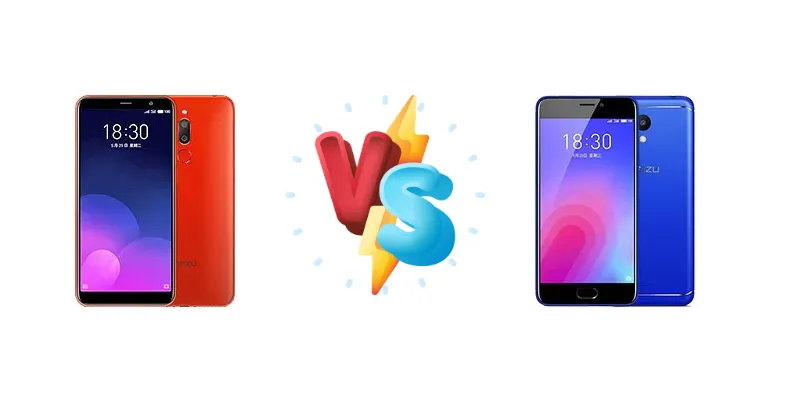
The Meizu M6 and M6T represent a period where Meizu focused on delivering solid, budget-friendly smartphones. While appearing similar on the surface, a closer look reveals key differences in charging capabilities and potential sustained performance, making one a better fit for specific user needs.
🏆 Quick Verdict
For the average user prioritizing consistent performance during extended use, the Meizu M6T is the better choice. Despite both phones utilizing the same Mediatek MT6750 chipset, the M6T's design likely allows for better thermal dissipation. However, the Meizu M6’s 24W charging is a significant advantage for those needing quick top-ups.
| Network |
|---|
| 2G bands | GSM 850 / 900 / 1800 / 1900 | GSM 850 / 900 / 1800 / 1900 - SIM 1 & SIM 2 |
| 3G bands | HSDPA 850 / 900 / 1900 / 2100 | HSDPA 900 / 1900 / 2100 |
| 4G bands | 1, 3, 8, 34, 38, 39, 40, 41 | LTE |
| Speed | HSPA 42.2/5.76 Mbps, LTE Cat4 150/50 Mbps | HSPA, LTE |
| Technology | GSM / CDMA / HSPA / LTE | GSM / HSPA / LTE |
| | CDMA 800 & TD-SCDMA | - |
| Launch |
|---|
| Announced | 2018, May. Released 2018, June | 2017, September. Released 2017, September |
| Status | Discontinued | Discontinued |
| Body |
|---|
| Build | Glass front, plastic back, plastic frame | - |
| Dimensions | 152.3 x 73 x 8.4 mm (6.00 x 2.87 x 0.33 in) | 148.2 x 72.8 x 8.3 mm (5.83 x 2.87 x 0.33 in) |
| SIM | Nano-SIM + Nano-SIM | Nano-SIM + Nano-SIM |
| Weight | 145 g (5.11 oz) | 143 g (5.04 oz) |
| Display |
|---|
| Resolution | 720 x 1440 pixels, 18:9 ratio (~282 ppi density) | 720 x 1280 pixels, 16:9 ratio (~282 ppi density) |
| Size | 5.7 inches, 83.8 cm2 (~75.4% screen-to-body ratio) | 5.2 inches, 74.5 cm2 (~69.1% screen-to-body ratio) |
| Type | IPS LCD | IPS LCD |
| Platform |
|---|
| CPU | Octa-core (4x1.5 GHz Cortex-A53 & 4x1.0 GHz Cortex-A53) | Octa-core (4x1.5 GHz Cortex-A53 & 4x1.0 GHz Cortex-A53) |
| Chipset | Mediatek MT6750 (28 nm) | Mediatek MT6750 (28 nm) |
| GPU | Mali-T860MP2 | Mali-T860MP2 |
| OS | Android 7.0 (Nougat), Flyme UI | Android 7 (Nougat), Flyme 7.3 |
| Memory |
|---|
| Card slot | microSDXC (uses shared SIM slot) | microSDXC (uses shared SIM slot) |
| Internal | 32GB 3GB RAM, 32GB 4GB RAM, 64GB 4GB RAM | 16GB 2GB RAM, 32GB 3GB RAM |
| | eMMC 5.1 | eMMC 5.1 |
| Main Camera |
|---|
| Dual | 13 MP, f/2.2, PDAF
Auxiliary lens | - |
| Features | LED flash, panorama | Dual-LED dual-tone flash |
| Single | - | 13 MP, f/2.2, PDAF |
| Video | 1080p@30fps | 1080p@30fps |
| Selfie camera |
|---|
| Single | 8 MP, f/2.0 | 8 MP, f/2.0 |
| Sound |
|---|
| 3.5mm jack | Yes | Yes |
| 35mm jack | Yes | Yes |
| Loudspeaker | Yes | Yes |
| Comms |
|---|
| Bluetooth | 4.1, A2DP, LE | 4.0, A2DP, LE |
| NFC | No | No |
| Positioning | GPS, GLONASS | GPS, GLONASS |
| Radio | FM radio | No |
| USB | microUSB 2.0 | microUSB 2.0 |
| WLAN | Wi-Fi 802.11 a/b/g/n, dual-band, Wi-Fi Direct | Wi-Fi 802.11 a/b/g/n, dual-band |
| Features |
|---|
| Sensors | Fingerprint (rear-mounted), accelerometer, proximity, compass | Fingerprint (front-mounted), accelerometer, gyro, proximity, compass |
| Battery |
|---|
| Charging | - | 24W wired |
| Type | Li-Ion 3300 mAh, non-removable | Li-Ion 3070 mAh, non-removable |
| Misc |
|---|
| Colors | Black, Champagne Gold, Coral Red | Moonlight Silver, Champagne Gold, Matte Black, Electric Light Blue |
| Models | M6T | M6, MZ-MEIZU M6 |
| Price | About 130 EUR | About 130 EUR |
Meizu M6T
- Potential for better sustained performance due to improved thermal management.
- Similar CPU performance to the M6.
- Likely comparable display quality to the M6.
- Lacks the 24W fast charging of the M6.
- Battery charging will be slower.
Meizu M6
- 24W fast charging for quick top-ups.
- Similar CPU performance to the M6T.
- Convenient for users who frequently need to charge their phone.
- May experience more throttling under sustained load.
- Potential for lower sustained performance compared to the M6T.
Display Comparison
Both the Meizu M6 and M6T are expected to feature similar LCD panels, given their market positioning. Specific details like resolution and brightness are not provided, but we can assume they target the standard for budget phones of the time. The absence of information regarding PWM dimming rates makes it difficult to assess potential eye strain for sensitive users. Bezels are likely comparable, reflecting the design trends of 2018.
Camera Comparison
Without detailed sensor specifications, a direct camera comparison is challenging. Both phones likely feature a primary camera alongside supporting lenses, but the quality will heavily depend on the sensor size and image processing algorithms. The presence of a 2MP macro camera on either device is unlikely to provide significant photographic value. Image quality will likely be similar in good lighting conditions, but low-light performance will be a key differentiator, dependent on sensor size and software optimization.
Performance
Both devices are powered by the Mediatek MT6750, a 28nm octa-core processor with a Cortex-A53 configuration (4x1.5 GHz & 4x1.0 GHz). This means raw CPU performance will be nearly identical. However, the M6T’s internal design *may* offer improved thermal dissipation. The MT6750 is known to throttle under sustained load, and even minor improvements in heat management can translate to more consistent frame rates in games or smoother multitasking. The lack of information on RAM type and speed prevents a deeper analysis of multitasking capabilities.
Battery Life
While battery capacity isn't specified, the Meizu M6’s 24W wired charging is a clear advantage. This significantly reduces charging times compared to the standard charging speeds typically found in phones of this era. The M6T, lacking this feature, will require a longer time to reach a full charge. The actual battery life will depend on usage patterns, but the faster charging of the M6 offers convenience for users who frequently need to top up their battery.
Buying Guide
Buy the Meizu M6T if you need a phone for moderate gaming, multitasking, and general daily use where sustained performance is important. The M6T’s potential for better thermal management will prevent significant throttling. Buy the Meizu M6 if you prioritize fast charging above all else, frequently find yourself needing to quickly replenish battery life, and don't engage in prolonged, demanding tasks.
Frequently Asked Questions
❓ Will the Mediatek MT6750 in the Meizu M6 overheat during gaming?
The MT6750 is known to throttle under sustained load. The Meizu M6 may experience more noticeable performance drops during extended gaming sessions compared to the M6T, which potentially has better thermal management. Lowering graphics settings can mitigate this.
❓ How long does it take to fully charge the Meizu M6 with the 24W charger?
While a precise time isn't available, the 24W charging on the Meizu M6 should significantly reduce charging times compared to standard 5W or 10W chargers. Expect a full charge in approximately 1.5 to 2 hours, depending on the battery capacity (which is not specified).
❓ Is the difference in performance between the M6T and M6 noticeable in everyday tasks?
For basic tasks like browsing, social media, and messaging, the performance difference will be minimal. The advantage of the M6T becomes apparent during more demanding tasks like gaming or multitasking with several apps open simultaneously.