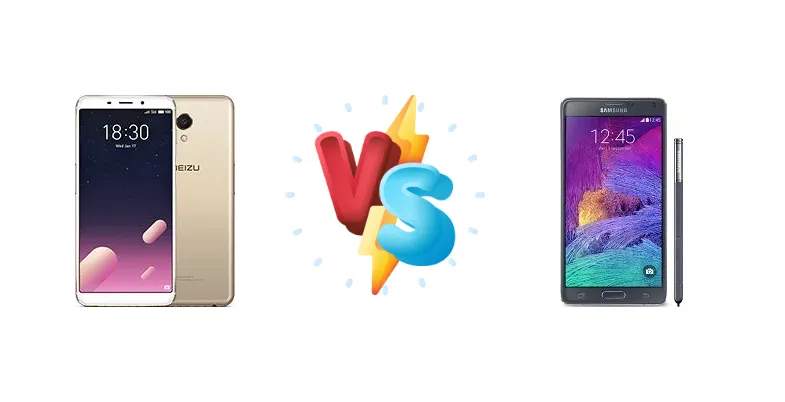
The Samsung Galaxy Note 4, a 2014 flagship, once represented the pinnacle of Android innovation. Now, years later, it faces a challenge from the Meizu M6s, a device representing a shift towards efficient mid-range performance. This comparison isn't about raw power, but about how these phones stack up in today's usage scenarios, considering advancements in chipset technology and user expectations.
🏆 Quick Verdict
For the average user in 2024, the Meizu M6s is the more sensible choice. While the Note 4 boasts a larger display and a historically premium brand, the M6s’s more efficient Exynos 7872 chipset and faster 18W charging offer a better overall experience, especially considering the Note 4’s aging battery and potential for thermal throttling.
| Network |
|---|
| 2G bands | GSM 850 / 900 / 1800 / 1900 - SIM 1 & SIM 2 | GSM 850 / 900 / 1800 / 1900 |
| 3G bands | HSDPA 850 / 900 / 1900 / 2100 | HSDPA 850 / 900 / 1900 / 2100 |
| 4G bands | 1, 3, 5, 7, 8, 20, 40 | 1, 2, 3, 4, 5, 7, 8, 17, 20 - N910F, N910C |
| Speed | HSPA 42.2/5.76 Mbps, LTE (2CA) Cat6 300/50 Mbps | HSPA 42.2/5.76 Mbps, LTE Cat4 150/50 Mbps (Exynos 5433)HSPA 42.2/5.76 Mbps, LTE Cat6 300/50 Mbps (Snapdragon 805) |
| Technology | GSM / HSPA / LTE | GSM / HSPA / LTE |
| | - | 1, 2, 3, 4, 5, 7, 8, 28 - N910U |
| Launch |
|---|
| Announced | 2018, January. Released 2018, January | 2014, September 03. Released 2014, October |
| Status | Discontinued | Discontinued |
| Body |
|---|
| Build | Glass front, aluminum back, aluminum frame | Glass front (Gorilla Glass 4), plastic back, aluminum frame |
| Dimensions | 152 x 72.5 x 8 mm (5.98 x 2.85 x 0.31 in) | 153.5 x 78.6 x 8.5 mm (6.04 x 3.09 x 0.33 in) |
| SIM | Nano-SIM + Nano-SIM | Micro-SIM |
| Weight | 160 g (5.64 oz) | 176 g (6.21 oz) |
| | - | Stylus |
| Display |
|---|
| Protection | - | Corning Gorilla Glass 4 |
| Resolution | 720 x 1440 pixels, 18:9 ratio (~282 ppi density) | 1440 x 2560 pixels, 16:9 ratio (~518 ppi density) |
| Size | 5.7 inches, 83.8 cm2 (~76.1% screen-to-body ratio) | 5.7 inches, 88.5 cm2 (~73.4% screen-to-body ratio) |
| Type | IPS LCD | Super AMOLED |
| Platform |
|---|
| CPU | Hexa-core (4x1.6 GHz Cortex-A53 & 2x2.0 GHz Cortex-A73) | Quad-core 2.7 GHz Krait 450 - Snapdragon 805Octa-core (4x1.3 GHz Cortex-A53 & 4x1.9 GHz Cortex-A57) - Exynos 5433 |
| Chipset | Exynos 7872 (14 nm) | Qualcomm APQ8084 Snapdragon 805 (28 nm)Exynos 5433 |
| GPU | Mali-G71 MP1 | Adreno 420 (Snapdragon 805)Mali-T760 MP6 (Exynos 5433) |
| OS | Android 7.0 (Nougat), Flyme 6.2 | Android 4.4.4 (KitKat), upgradable to 6.0.1 (Marshmallow) |
| Memory |
|---|
| Card slot | microSDXC (uses shared SIM slot) | microSDXC (dedicated slot) |
| Internal | 32GB 3GB RAM, 64GB 3GB RAM | 32GB 3GB RAM |
| | eMMC 5.1 | eMMC 5.0 |
| Main Camera |
|---|
| Features | Dual-LED dual-tone flash | LED flash, panorama, HDR |
| Single | 16 MP, f/2.0, PDAF | 16 MP, f/2.2, 31mm (standard), 1/2.6", 1.12µm, AF, OIS |
| Video | 1080p@30fps | 4K@30fps, 1080p@30/60fps, stereo sound rec. |
| Selfie camera |
|---|
| Features | - | HDR |
| Single | 8 MP, f/2.0 | 3.7 MP, f/1.9, 22mm (wide) |
| Video | - | 1440p@30fps |
| Sound |
|---|
| 3.5mm jack | Yes | Yes |
| 35mm jack | Yes | Yes |
| Loudspeaker | Yes | Yes |
| | - | 24-bit/192kHz audio
|
| Comms |
|---|
| Bluetooth | 4.2, A2DP, LE | 4.1, A2DP, EDR, LE |
| Infrared port | - | Yes |
| NFC | No | Yes |
| Positioning | GPS, GLONASS | GPS, GLONASS, BDS |
| Radio | No | No |
| USB | microUSB 2.0 | microUSB 2.0 (MHL 3 TV-out), OTG |
| WLAN | Wi-Fi 802.11 a/b/g/n, dual-band, Wi-Fi Direct | Wi-Fi 802.11 a/b/g/n/ac, dual-band, Wi-Fi Direct, hotspot |
| Features |
|---|
| Sensors | Fingerprint (side-mounted), accelerometer, gyro, proximity, compass | Fingerprint (front-mounted), accelerometer, gyro, proximity, compass, barometer, gesture, UV, heart rate, SpO2 |
| | - | ANT+
S-Voice natural language commands and dictation
Air gestures |
| Battery |
|---|
| Charging | 18W wired | 15W wired, QC2 |
| Music play | - | Up to 82 h |
| Talk time | - | Up to 20 h (3G) |
| Type | Li-Ion 3000 mAh, non-removable | Li-Ion 3220 mAh, removable |
| Misc |
|---|
| Colors | Black, Silver, Gold, Blue | Frosted white, Charcoal black, Bronze Gold, Blossom Pink |
| Models | M6s | SM-N910C, SM-N910S, SM-N910H, SM-N910F, SM-N910G, SM-N910U, SM-N910K, SM-N916S, SM-N910L, SM-N916L, SM-N916K, SM-N910T3 |
| Price | About 150 EUR | About 350 EUR |
| SAR | - | 0.37 W/kg (head) 0.88 W/kg (body) |
| SAR EU | - | 0.37 W/kg (head) 0.38 W/kg (body) |
| Tests |
|---|
| Audio quality | - |
Noise -96.6dB / Crosstalk -94.2dB |
| Battery life | - |
Endurance rating 90h
|
| Camera | - |
Photo / Video |
| Display | - |
Contrast ratio: Infinity (nominal), 4.033 (sunlight) |
| Loudspeaker | - |
Voice 79dB / Noise 74dB / Ring 89dB
|
| Performance | - |
Basemark OS II 2.0: 1328Basemark X: 18684 |
Meizu M6s
- More efficient chipset (Exynos 7872, 14nm)
- Faster charging (18W)
- Modern software experience (potentially)
- Likely smaller display
- Potentially lower camera resolution
Samsung Galaxy Note 4
- Larger display
- S Pen functionality
- Historically premium build quality
- Aging battery
- Less efficient chipset (Snapdragon 805/Exynos 5433, 28nm)
- Potential for thermal throttling
- Slower charging (15W)
Display Comparison
Both devices share a similar 'Infinity' contrast ratio (nominal), and 4.033 sunlight contrast, suggesting comparable outdoor visibility. However, the Note 4’s larger display size is a significant advantage for multimedia. The M6s’s display specifications are not provided, but given its market segment, it likely features a lower resolution and smaller size. The Note 4’s panel technology, while excellent for its time, lacks the advancements found in modern displays like LTPO, which dynamically adjusts refresh rates for improved efficiency.
Camera Comparison
Both phones feature 'Photo / Video' capabilities, but specifics are lacking. The Note 4 likely boasts a higher-resolution main sensor and more advanced image processing for its time. However, the M6s benefits from advancements in computational photography, potentially delivering better image quality in challenging conditions despite potentially having a smaller sensor. The Note 4’s camera system, while capable, is limited by the technology of 2014. We can assume the Note 4 has more advanced camera features at launch, but the M6s may have better software optimization.
Performance
The core difference lies in the chipsets. The Samsung Galaxy Note 4 offers a choice between the Qualcomm Snapdragon 805 (28nm) and the Exynos 5433. The Snapdragon 805’s quad-core Krait 450 at 2.7 GHz delivers strong single-core performance, but its 28nm process is significantly less efficient than the Meizu M6s’s Exynos 7872 (14nm). The Exynos 7872’s hexa-core configuration (4x1.6 GHz Cortex-A53 & 2x2.0 GHz Cortex-A73) prioritizes efficiency, offering a balance between performance and power consumption. The older Snapdragon 805 is prone to thermal throttling under sustained load, while the M6s’s chipset should maintain more consistent performance. The Exynos 5433, with its octa-core setup, offers a similar trade-off to the 7872, but is still built on an older process.
Battery Life
Both devices achieve an endurance rating of 90h, suggesting similar battery life under comparable usage. However, this rating was relevant when the Note 4 was new. Years of battery degradation mean a used Note 4 will likely fall short of that figure. The M6s’s 18W wired charging is significantly faster than the Note 4’s 15W charging with QC2, allowing for quicker top-ups. The Exynos 7872’s efficiency also contributes to longer real-world battery life, even with a potentially smaller battery capacity (not specified).
Buying Guide
Buy the Meizu M6s if you prioritize battery efficiency, faster charging, and a more modern software experience, even if it means sacrificing some raw processing power. Buy the Samsung Galaxy Note 4 if you specifically need the S Pen functionality, a larger screen for media consumption, and are comfortable with the limitations of an older device, including potential battery degradation and slower software updates.
Frequently Asked Questions
❓ Does the Snapdragon 805 in the Note 4 overheat during demanding tasks like gaming?
Yes, the Snapdragon 805 is known to suffer from thermal throttling under sustained load. While powerful, its 28nm process generates significant heat, leading to performance drops during extended gaming sessions or video recording. The Meizu M6s’s Exynos 7872, built on a 14nm process, is much more efficient and less prone to overheating.
❓ How does the battery life of a used Samsung Galaxy Note 4 compare to the Meizu M6s?
A used Samsung Galaxy Note 4 will almost certainly have degraded battery capacity compared to its original 90h endurance rating. The Meizu M6s, with its more efficient chipset and faster charging, will likely offer longer real-world battery life and quicker top-ups, even if its battery capacity is smaller.
❓ Is the S Pen functionality on the Note 4 worth considering in 2024?
If you heavily rely on stylus input for note-taking, drawing, or precise navigation, the S Pen is a unique feature the M6s cannot match. However, for casual users, the benefits may not outweigh the Note 4’s other limitations.
❓ What kind of software updates can I expect on the Meizu M6s compared to the Note 4?
The Samsung Galaxy Note 4 is no longer receiving official software updates. The Meizu M6s, while also an older device, may still have community-driven custom ROM support, offering a more secure and feature-rich software experience than the outdated software on the Note 4.