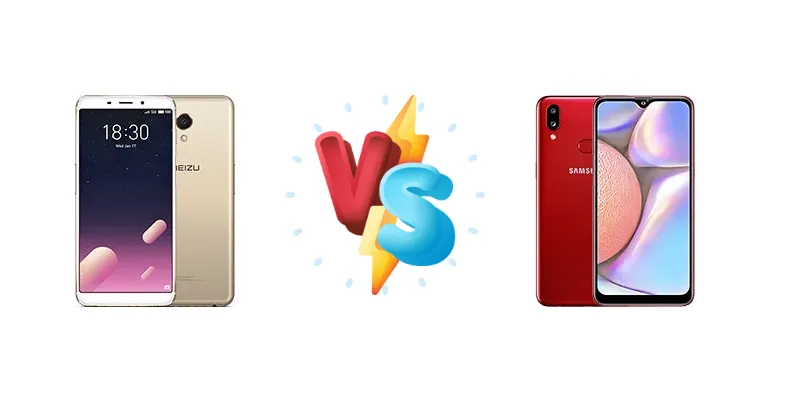
The Meizu M6s and Samsung Galaxy A10s represent compelling options in the ultra-budget smartphone segment. While both aim to deliver essential smartphone functionality at a low price point, they take different approaches to achieving this, primarily through their chipset choices. This comparison dissects those differences to determine which device offers the best value.
🏆 Quick Verdict
For the average user prioritizing sustained performance and efficiency, the Samsung Galaxy A10s emerges as the better choice. Its 12nm Helio P22 chipset offers superior power efficiency compared to the Meizu M6s’ 14nm Exynos 7872, translating to longer battery life and less thermal throttling during extended use.
| Network |
|---|
| 2G bands | GSM 850 / 900 / 1800 / 1900 - SIM 1 & SIM 2 | GSM 850 / 900 / 1800 / 1900 |
| 3G bands | HSDPA 850 / 900 / 1900 / 2100 | HSDPA 850 / 900 / 1900 / 2100 |
| 4G bands | 1, 3, 5, 7, 8, 20, 40 | 1, 2, 3, 5, 7, 8, 20, 38, 40, 41 |
| Speed | HSPA 42.2/5.76 Mbps, LTE (2CA) Cat6 300/50 Mbps | HSPA 42.2/5.76 Mbps, LTE Cat4 150/50 Mbps |
| Technology | GSM / HSPA / LTE | GSM / HSPA / LTE |
| | - | 1, 2, 3, 5, 7, 8, 12, 17, 28 - SM-A107M/DS |
| Launch |
|---|
| Announced | 2018, January. Released 2018, January | 2019, August 12. Released 2019, August 27 |
| Status | Discontinued | Discontinued |
| Body |
|---|
| Build | Glass front, aluminum back, aluminum frame | Glass front, plastic back, plastic frame |
| Dimensions | 152 x 72.5 x 8 mm (5.98 x 2.85 x 0.31 in) | 156.9 x 75.8 x 7.8 mm (6.18 x 2.98 x 0.31 in) |
| SIM | Nano-SIM + Nano-SIM | · Nano-SIM· Nano-SIM + Nano-SIM |
| Weight | 160 g (5.64 oz) | 168 g (5.93 oz) |
| Display |
|---|
| Resolution | 720 x 1440 pixels, 18:9 ratio (~282 ppi density) | 720 x 1520 pixels, 19:9 ratio (~271 ppi density) |
| Size | 5.7 inches, 83.8 cm2 (~76.1% screen-to-body ratio) | 6.2 inches, 95.9 cm2 (~80.7% screen-to-body ratio) |
| Type | IPS LCD | PLS LCD |
| Platform |
|---|
| CPU | Hexa-core (4x1.6 GHz Cortex-A53 & 2x2.0 GHz Cortex-A73) | Octa-core 2.0 GHz Cortex-A53 |
| Chipset | Exynos 7872 (14 nm) | Mediatek MT6762 Helio P22 (12 nm) |
| GPU | Mali-G71 MP1 | PowerVR GE8320 |
| OS | Android 7.0 (Nougat), Flyme 6.2 | Android 9.0 (Pie), upgradable to Android 11, One UI 3.1 |
| Memory |
|---|
| Card slot | microSDXC (uses shared SIM slot) | microSDXC (dedicated slot) |
| Internal | 32GB 3GB RAM, 64GB 3GB RAM | 32GB 2GB RAM, 32GB 3GB RAM |
| | eMMC 5.1 | eMMC 5.1 |
| Main Camera |
|---|
| Dual | - | 13 MP, f/1.8, 28mm (wide), AF
Auxiliary lens |
| Features | Dual-LED dual-tone flash | LED flash, panorama, HDR |
| Single | 16 MP, f/2.0, PDAF | - |
| Video | 1080p@30fps | 1080p@30fps |
| Selfie camera |
|---|
| Single | 8 MP, f/2.0 | 8 MP, f/2.0 |
| Video | - | 1080p@30fps |
| Sound |
|---|
| 3.5mm jack | Yes | Yes |
| 35mm jack | Yes | Yes |
| Loudspeaker | Yes | Yes |
| Comms |
|---|
| Bluetooth | 4.2, A2DP, LE | 4.2, A2DP, LE |
| NFC | No | No |
| Positioning | GPS, GLONASS | GPS, GLONASS, GALILEO |
| Radio | No | FM radio |
| USB | microUSB 2.0 | microUSB 2.0, OTG |
| WLAN | Wi-Fi 802.11 a/b/g/n, dual-band, Wi-Fi Direct | Wi-Fi 802.11 b/g/n, Wi-Fi Direct |
| Features |
|---|
| Sensors | Fingerprint (side-mounted), accelerometer, gyro, proximity, compass | Fingerprint (rear-mounted), accelerometer, proximity |
| Battery |
|---|
| Charging | 18W wired | - |
| Type | Li-Ion 3000 mAh, non-removable | Li-Po 4000 mAh, non-removable |
| Misc |
|---|
| Colors | Black, Silver, Gold, Blue | Blue, Green, Red, Black |
| Models | M6s | SM-A107F, SM-A107M |
| Price | About 150 EUR | About 180 EUR |
| SAR | - | 0.25 W/kg (head) 1.06 W/kg (body) |
Meizu M6s
- Potentially faster CPU peak performance due to A73 cores
- Faster 18W charging
- Meizu’s Flyme OS offers customization options
- Less efficient 14nm Exynos 7872 chipset
- Likely more thermal throttling under sustained load
- Potentially shorter battery life
Samsung Galaxy A10s
- More efficient 12nm Helio P22 chipset
- Better sustained performance and thermal management
- Samsung’s refined software experience
- Slower charging speeds (likely)
- Octa-core A53 configuration may not match peak performance of Exynos 7872
- 2MP macro camera is largely ineffective
Display Comparison
Neither device boasts a standout display. Both likely feature LCD panels, typical for this price bracket. Specifics like resolution and brightness are not provided, but the focus here is on internal components. The absence of information on PWM dimming rates makes it difficult to assess potential eye strain, but given the market segment, it's unlikely either phone prioritizes high-frequency dimming.
Camera Comparison
Without detailed sensor information, a direct camera comparison is challenging. Both phones likely feature basic camera setups geared towards casual photography. The presence of a 2MP macro camera on the A10s is largely a marketing gimmick, offering minimal practical benefit. The image processing capabilities of Samsung’s software are generally more refined than Meizu’s, potentially leading to more pleasing results in auto mode, but this is speculative without sample images. The aperture and sensor size of the main cameras would be the key differentiators, but this data is unavailable.
Performance
The core difference lies in the chipsets. The Meizu M6s utilizes the Exynos 7872, a hexa-core processor with a mix of Cortex-A53 and A73 cores. The Samsung Galaxy A10s, however, employs the MediaTek Helio P22, an octa-core processor comprised entirely of Cortex-A53 cores. While the Exynos 7872 has two higher-performance A73 cores, the Helio P22’s eight A53 cores, coupled with its more efficient 12nm manufacturing process, provide a more consistent and sustained performance profile. The 14nm process of the Exynos 7872 will likely result in more heat generation under load. This impacts sustained performance, making the A10s better for longer gaming sessions or multitasking.
Battery Life
Battery capacity is not specified for either device. However, the Helio P22’s 12nm process gives the Galaxy A10s a significant advantage in power efficiency. The Meizu M6s supports 18W wired charging, which is faster than the likely 10W or 15W charging on the A10s. This means the M6s can replenish its battery more quickly, but the A10s will likely last longer on a single charge due to its more efficient chipset.
Buying Guide
Buy the Meizu M6s if you prioritize a slightly more powerful CPU for short bursts of demanding tasks and appreciate the potential for faster charging speeds. Buy the Samsung Galaxy A10s if you value all-day battery life, consistent performance under load, and a more modern manufacturing process that contributes to better thermal management. The A10s is the better daily driver.
Frequently Asked Questions
❓ Does the Exynos 7872 in the Meizu M6s overheat during gaming?
The Exynos 7872, built on a 14nm process, is prone to thermal throttling under sustained load, such as prolonged gaming sessions. While it can deliver peak performance for short bursts, it will likely reduce clock speeds to manage heat, resulting in a less consistent gaming experience compared to the A10s.
❓ Is the MediaTek Helio P22 in the Samsung Galaxy A10s powerful enough for everyday tasks?
The Helio P22 is more than capable of handling everyday tasks like browsing, social media, and messaging. While it doesn't offer the highest peak performance, its eight Cortex-A53 cores and efficient 12nm process provide a smooth and responsive user experience for typical smartphone usage.
❓ Which phone is better for watching videos?
Without specific display details, it's difficult to say definitively. However, the more efficient power management of the A10s could translate to longer video playback times on a single charge. Both phones likely have LCD panels, so expect standard color reproduction.
❓ Will I notice a significant difference in performance between the two phones?
You'll likely notice a difference in *sustained* performance. The A10s will maintain a more consistent level of performance over time, while the M6s may experience throttling during extended use. For short, infrequent tasks, the difference will be less noticeable.