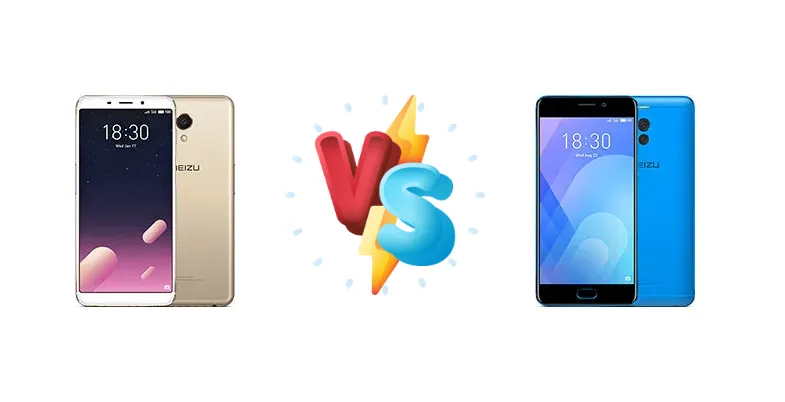
The Meizu M6s and M6 Note represent a fascinating point in Meizu’s history, offering compelling features at accessible price points. While both phones target the budget-conscious consumer, they diverge significantly in their core hardware, specifically the chipset. This comparison dissects the differences between the Exynos 7872-powered M6s and the Snapdragon 625-equipped M6 Note, helping you determine which device best suits your needs.
🏆 Quick Verdict
For the average user prioritizing sustained performance and battery efficiency, the Meizu M6 Note with its Snapdragon 625 is the superior choice. While the M6s boasts faster 18W charging, the Snapdragon 625’s architecture delivers a smoother, more consistent experience, especially during prolonged use.
| Network |
|---|
| 2G bands | GSM 850 / 900 / 1800 / 1900 - SIM 1 & SIM 2 | GSM 850 / 900 / 1800 / 1900 - SIM 1 & SIM 2 |
| 3G bands | HSDPA 850 / 900 / 1900 / 2100 | HSDPA 850 / 900 / 1900 / 2100 |
| 4G bands | 1, 3, 5, 7, 8, 20, 40 | 1, 3, 5, 7, 8, 20, 38, 40 |
| Speed | HSPA 42.2/5.76 Mbps, LTE (2CA) Cat6 300/50 Mbps | HSPA, LTE |
| Technology | GSM / HSPA / LTE | GSM / CDMA / HSPA / LTE |
| | - | CDMA 800 |
| Launch |
|---|
| Announced | 2018, January. Released 2018, January | 2017, August. Released 2017, September |
| Status | Discontinued | Discontinued |
| Body |
|---|
| Build | Glass front, aluminum back, aluminum frame | Glass front, aluminum back, aluminum frame |
| Dimensions | 152 x 72.5 x 8 mm (5.98 x 2.85 x 0.31 in) | 154.6 x 75.2 x 8.4 mm (6.09 x 2.96 x 0.33 in) |
| SIM | Nano-SIM + Nano-SIM | Nano-SIM + Nano-SIM |
| Weight | 160 g (5.64 oz) | 173 g (6.10 oz) |
| Display |
|---|
| Resolution | 720 x 1440 pixels, 18:9 ratio (~282 ppi density) | 1080 x 1920 pixels, 16:9 ratio (~403 ppi density) |
| Size | 5.7 inches, 83.8 cm2 (~76.1% screen-to-body ratio) | 5.5 inches, 82.6 cm2 (~71.0% screen-to-body ratio) |
| Type | IPS LCD | IPS LCD |
| Platform |
|---|
| CPU | Hexa-core (4x1.6 GHz Cortex-A53 & 2x2.0 GHz Cortex-A73) | Octa-core 2.0 GHz Cortex-A53 |
| Chipset | Exynos 7872 (14 nm) | Qualcomm MSM8953 Snapdragon 625 (14 nm) |
| GPU | Mali-G71 MP1 | Adreno 506 |
| OS | Android 7.0 (Nougat), Flyme 6.2 | Android 7.1.2 (Nougat), Flyme 7.3 |
| Memory |
|---|
| Card slot | microSDXC (uses shared SIM slot) | microSDXC |
| Internal | 32GB 3GB RAM, 64GB 3GB RAM | 16GB 4GB RAM, 32GB 3GB RAM, 64GB 4GB RAM |
| | eMMC 5.1 | eMMC 5.1 |
| Main Camera |
|---|
| Dual | - | 12 MP, f/1.9, 1/2.55", 1.4µm, dual pixel PDAF
5 MP, f/2.0, AF |
| Features | Dual-LED dual-tone flash | quad-LED dual-tone flash, HDR, panorama |
| Single | 16 MP, f/2.0, PDAF | - |
| Video | 1080p@30fps | 1080p@30fps |
| Selfie camera |
|---|
| Single | 8 MP, f/2.0 | 16 MP, f/2.0, 26mm (wide), 1/3.06", 1.0µm |
| Video | - | 1080p@30fps |
| Sound |
|---|
| 3.5mm jack | Yes | Yes |
| 35mm jack | Yes | Yes |
| Loudspeaker | Yes | Yes |
| Comms |
|---|
| Bluetooth | 4.2, A2DP, LE | 4.2, A2DP, LE |
| NFC | No | No |
| Positioning | GPS, GLONASS | GPS, GLONASS |
| Radio | No | No |
| USB | microUSB 2.0 | microUSB 2.0 |
| WLAN | Wi-Fi 802.11 a/b/g/n, dual-band, Wi-Fi Direct | Wi-Fi 802.11 a/b/g/n, dual-band |
| Features |
|---|
| Sensors | Fingerprint (side-mounted), accelerometer, gyro, proximity, compass | Fingerprint (front-mounted), accelerometer, gyro, proximity, compass |
| Battery |
|---|
| Charging | 18W wired | 24W wired |
| Type | Li-Ion 3000 mAh, non-removable | Li-Ion 4000 mAh, non-removable |
| Misc |
|---|
| Colors | Black, Silver, Gold, Blue | Black, Blue, Gold |
| Models | M6s | M6 Note, MZ-M6 Note |
| Price | About 150 EUR | About 170 EUR |
Meizu M6s
- Faster 18W wired charging
- Potentially higher peak CPU performance in short bursts
- Exynos chipset offers a different software optimization experience
- Exynos 7872 prone to thermal throttling
- Less efficient CPU architecture compared to Snapdragon 625
- Potentially shorter battery life
Meizu M6 Note
- Superior power efficiency with Snapdragon 625
- More consistent performance under sustained load
- Faster 24W wired charging
- Qualcomm’s optimized ISP for potentially better image processing
- Octa-core Cortex-A53 cores may feel less responsive in peak tasks compared to the Exynos' A73 cores
- May not charge as quickly initially as the M6s
Display Comparison
Neither device boasts a standout display. Given the context data focuses on internals, we can infer both likely utilize IPS LCD panels common in this price bracket. The real-world difference in display quality will likely be minimal, focusing on color calibration rather than inherent panel technology. Bezels were also a key design element in this era, and likely similar between the two.
Camera Comparison
Without detailed camera specs, a direct comparison is difficult. However, given the market segment, both phones likely feature similar primary camera sensors. The Snapdragon 625’s ISP (Image Signal Processor) is generally known for its efficient image processing, potentially leading to slightly better dynamic range and noise reduction in the M6 Note. The presence of a 2MP macro camera on either device is largely a marketing gimmick and unlikely to significantly impact image quality.
Performance
The core difference lies in the chipsets. The Meizu M6s utilizes the Exynos 7872, a hexa-core processor with a big.LITTLE architecture featuring two 2.0 GHz Cortex-A73 cores for performance and four 1.6 GHz Cortex-A53 cores for efficiency. The M6 Note, however, employs the Qualcomm Snapdragon 625, an octa-core processor comprised entirely of 2.0 GHz Cortex-A53 cores. While the Exynos has higher-clocked 'performance' cores, the Snapdragon 625’s eight cores and Qualcomm’s optimized architecture provide a more consistent experience. The Snapdragon 625’s 14nm process, shared by the Exynos, is well-regarded for its efficiency, meaning less thermal throttling under sustained load. This translates to smoother multitasking and longer gaming sessions on the M6 Note.
Battery Life
While battery capacity isn't specified, the Snapdragon 625’s inherent power efficiency gives the M6 Note a significant advantage in battery life. The M6s compensates with 18W wired charging, allowing for faster top-ups. However, the M6 Note counters with 24W wired charging, further solidifying its advantage in overall charging speed despite potentially having a similar or slightly smaller battery capacity. The Snapdragon 625’s efficiency means you’ll likely spend less time plugged in, even with a slower initial charge.
Buying Guide
Buy the Meizu M6s if you prioritize faster charging speeds and occasionally engage in short bursts of demanding tasks. Its 18W charging can top up the battery quickly when you're in a hurry. Buy the Meizu M6 Note if you value consistent performance, excellent battery life, and a cooler operating temperature, making it ideal for everyday use, media consumption, and moderate gaming.
Frequently Asked Questions
❓ Does the Exynos 7872 in the M6s overheat during gaming?
The Exynos 7872 is known to generate more heat under sustained load compared to the Snapdragon 625. While it can handle short gaming sessions, prolonged gaming on the M6s may lead to noticeable thermal throttling, resulting in reduced performance and potentially discomfort.
❓ Is the 24W charging on the M6 Note significantly faster than the M6s' 18W charging?
Yes, the 24W charging on the M6 Note will noticeably reduce charging times. While both phones support fast charging, the higher wattage of the M6 Note allows it to replenish the battery more quickly, minimizing downtime.
❓ Will I notice a difference in app loading times between the two phones?
While both phones have adequate RAM, the Snapdragon 625’s optimized architecture in the M6 Note generally results in slightly faster app loading times and smoother multitasking, especially when running multiple applications simultaneously.
❓ Which phone is better for long-term reliability?
The Snapdragon 625 is renowned for its stability and longevity. Its efficient design generates less heat, which can contribute to a longer lifespan for the device's internal components. The M6 Note is therefore likely to exhibit better long-term reliability.