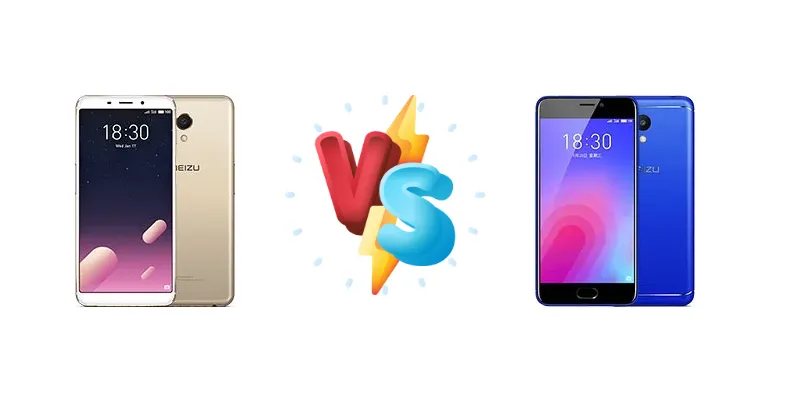
The Meizu M6 and M6s represent a fascinating point in the budget smartphone landscape. The M6, released initially, offered a solid entry-level experience. The M6s arrived as a refinement, swapping the Mediatek chipset for Samsung’s Exynos 7872. This comparison dissects the core differences between these two devices, focusing on how the chipset change impacts performance, battery life, and the overall user experience.
🏆 Quick Verdict
For most users, the Meizu M6s is the better choice. The Exynos 7872 provides a noticeable performance uplift over the Mediatek MT6750, making it more responsive for everyday tasks and capable of handling moderately demanding games. While the M6 boasts faster 24W charging, the M6s’s more efficient chipset and improved performance outweigh this advantage.
| Network |
|---|
| 2G bands | GSM 850 / 900 / 1800 / 1900 - SIM 1 & SIM 2 | GSM 850 / 900 / 1800 / 1900 - SIM 1 & SIM 2 |
| 3G bands | HSDPA 850 / 900 / 1900 / 2100 | HSDPA 900 / 1900 / 2100 |
| 4G bands | 1, 3, 5, 7, 8, 20, 40 | LTE |
| Speed | HSPA 42.2/5.76 Mbps, LTE (2CA) Cat6 300/50 Mbps | HSPA, LTE |
| Technology | GSM / HSPA / LTE | GSM / HSPA / LTE |
| Launch |
|---|
| Announced | 2018, January. Released 2018, January | 2017, September. Released 2017, September |
| Status | Discontinued | Discontinued |
| Body |
|---|
| Build | Glass front, aluminum back, aluminum frame | - |
| Dimensions | 152 x 72.5 x 8 mm (5.98 x 2.85 x 0.31 in) | 148.2 x 72.8 x 8.3 mm (5.83 x 2.87 x 0.33 in) |
| SIM | Nano-SIM + Nano-SIM | Nano-SIM + Nano-SIM |
| Weight | 160 g (5.64 oz) | 143 g (5.04 oz) |
| Display |
|---|
| Resolution | 720 x 1440 pixels, 18:9 ratio (~282 ppi density) | 720 x 1280 pixels, 16:9 ratio (~282 ppi density) |
| Size | 5.7 inches, 83.8 cm2 (~76.1% screen-to-body ratio) | 5.2 inches, 74.5 cm2 (~69.1% screen-to-body ratio) |
| Type | IPS LCD | IPS LCD |
| Platform |
|---|
| CPU | Hexa-core (4x1.6 GHz Cortex-A53 & 2x2.0 GHz Cortex-A73) | Octa-core (4x1.5 GHz Cortex-A53 & 4x1.0 GHz Cortex-A53) |
| Chipset | Exynos 7872 (14 nm) | Mediatek MT6750 (28 nm) |
| GPU | Mali-G71 MP1 | Mali-T860MP2 |
| OS | Android 7.0 (Nougat), Flyme 6.2 | Android 7 (Nougat), Flyme 7.3 |
| Memory |
|---|
| Card slot | microSDXC (uses shared SIM slot) | microSDXC (uses shared SIM slot) |
| Internal | 32GB 3GB RAM, 64GB 3GB RAM | 16GB 2GB RAM, 32GB 3GB RAM |
| | eMMC 5.1 | eMMC 5.1 |
| Main Camera |
|---|
| Features | Dual-LED dual-tone flash | Dual-LED dual-tone flash |
| Single | 16 MP, f/2.0, PDAF | 13 MP, f/2.2, PDAF |
| Video | 1080p@30fps | 1080p@30fps |
| Selfie camera |
|---|
| Single | 8 MP, f/2.0 | 8 MP, f/2.0 |
| Sound |
|---|
| 3.5mm jack | Yes | Yes |
| 35mm jack | Yes | Yes |
| Loudspeaker | Yes | Yes |
| Comms |
|---|
| Bluetooth | 4.2, A2DP, LE | 4.0, A2DP, LE |
| NFC | No | No |
| Positioning | GPS, GLONASS | GPS, GLONASS |
| Radio | No | No |
| USB | microUSB 2.0 | microUSB 2.0 |
| WLAN | Wi-Fi 802.11 a/b/g/n, dual-band, Wi-Fi Direct | Wi-Fi 802.11 a/b/g/n, dual-band |
| Features |
|---|
| Sensors | Fingerprint (side-mounted), accelerometer, gyro, proximity, compass | Fingerprint (front-mounted), accelerometer, gyro, proximity, compass |
| Battery |
|---|
| Charging | 18W wired | 24W wired |
| Type | Li-Ion 3000 mAh, non-removable | Li-Ion 3070 mAh, non-removable |
| Misc |
|---|
| Colors | Black, Silver, Gold, Blue | Moonlight Silver, Champagne Gold, Matte Black, Electric Light Blue |
| Models | M6s | M6, MZ-MEIZU M6 |
| Price | About 150 EUR | About 130 EUR |
Meizu M6s
- Faster overall performance thanks to the Exynos 7872 chipset.
- More efficient chipset leading to potentially better battery life.
- Improved image processing capabilities.
- Slower charging speed (18W vs 24W).
- Potentially higher price point at launch.
Meizu M6
- Faster 24W wired charging.
- Potentially lower price point.
- Adequate performance for basic tasks.
- Less powerful chipset resulting in slower performance.
- Less efficient chipset leading to potentially shorter battery life.
- Limited gaming capabilities.
Display Comparison
Neither Meizu provided detailed display specifications in the context data. However, given their market positioning, both likely feature 720p LCD panels. The difference in display quality will likely be minimal, focusing on color calibration and viewing angles rather than resolution or refresh rate. Bezels were a common design element in this price range at the time, so expect similar sizes on both devices.
Camera Comparison
Without detailed camera specs, a direct comparison is difficult. Both phones likely featured a primary camera around 13MP. The M6s’s image processing benefits from the more powerful ISP within the Exynos 7872, potentially leading to better dynamic range and noise reduction. The inclusion of a 2MP depth sensor on either device is unlikely to significantly impact image quality, serving primarily for portrait mode effects. The aperture size and sensor size would be the key differentiators, but this information is unavailable.
Performance
The core difference lies in the chipsets. The Meizu M6s’s Exynos 7872, built on a 14nm process, features a hexa-core configuration with two 2.0 GHz Cortex-A73 cores and four 1.6 GHz Cortex-A53 cores. This architecture provides a significant advantage in multi-core performance compared to the M6’s Mediatek MT6750. The MT6750, fabricated on a larger 28nm node, utilizes an octa-core setup of four 1.5 GHz Cortex-A53 cores and four 1.0 GHz Cortex-A53 cores. While the MT6750 has more cores, the A73 cores in the Exynos 7872 are significantly more powerful, resulting in faster application loading and smoother multitasking. The 14nm process also contributes to better thermal efficiency, potentially reducing throttling during sustained workloads.
Battery Life
The Meizu M6 boasts 24W wired charging, while the M6s supports 18W. This means the M6 can theoretically charge faster from 0-100%. However, the Exynos 7872 in the M6s is more power-efficient due to its 14nm manufacturing process. This efficiency translates to lower power consumption during typical usage, potentially offsetting the slower charging speed. Real-world battery life will depend heavily on usage patterns, but the M6s is likely to offer comparable, if not better, endurance despite the lower charging wattage.
Buying Guide
Buy the Meizu M6s if you prioritize a smoother, more responsive user experience and occasional gaming. The Exynos 7872’s Cortex-A73 cores deliver a tangible performance boost. Buy the Meizu M6 if you absolutely need the fastest possible charging speeds and are primarily focused on basic smartphone functions like calls, texts, and light social media use. The MT6750 is adequate for these tasks, and the 24W charging is a plus for those who frequently need to top up quickly.
Frequently Asked Questions
❓ Does the Exynos 7872 in the M6s overheat during prolonged gaming sessions?
The Exynos 7872, built on a 14nm process, is generally more thermally efficient than the Mediatek MT6750. While it can still get warm during extended gaming, it’s less prone to significant throttling compared to the M6. Expect playable frame rates for moderately demanding games, but don’t expect flagship-level performance.
❓ Is the 24W charging on the Meizu M6 a significant advantage in real-world use?
While 24W charging is faster on paper, the M6s’s more efficient Exynos 7872 chipset consumes less power overall. This means you might not notice a huge difference in daily usage. The M6 will charge faster from 0%, but the M6s might maintain its charge for longer between top-ups.
❓ Will I notice a difference in app loading times between the M6 and M6s?
Yes, you will. The Exynos 7872’s Cortex-A73 cores are significantly faster than the Cortex-A53 cores in the Mediatek MT6750. This translates to noticeably quicker app launch times and smoother multitasking on the M6s.