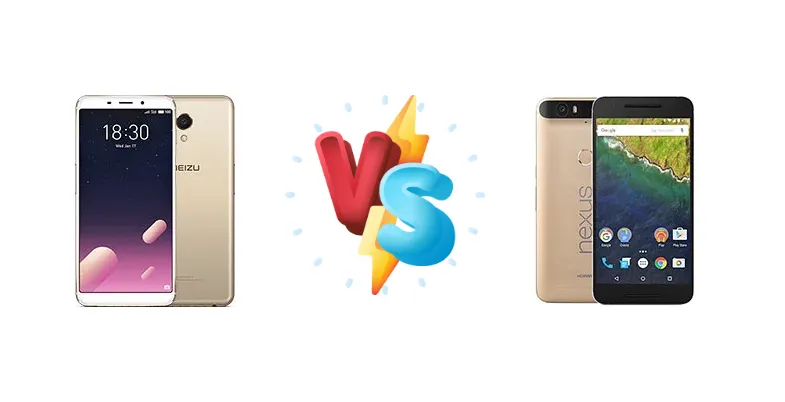
The Meizu M6s and Huawei Nexus 6P represent different eras of smartphone design and philosophy. The Nexus 6P, a former flagship, now finds itself in the budget-friendly category, while the Meizu M6s aimed for a competitive mid-range experience. This comparison examines how these two devices stack up in 2024, focusing on performance, battery life, and overall usability.
🏆 Quick Verdict
For the average user in 2024, the Meizu M6s offers a more balanced experience. While the Nexus 6P boasts a comparable endurance rating, the newer Exynos 7872 chipset provides a more efficient architecture and faster charging, making it the better daily driver despite the older flagship status of the Nexus 6P.
| Network |
|---|
| 2G bands | GSM 850 / 900 / 1800 / 1900 - SIM 1 & SIM 2 | GSM 850 / 900 / 1800 / 1900 - all models |
| 3G bands | HSDPA 850 / 900 / 1900 / 2100 | HSDPA 800 / 850 / 900 / 1700 / 1800 / 1900 / 2100 - Global model |
| 4G bands | 1, 3, 5, 7, 8, 20, 40 | 1, 2, 3, 4, 5, 7, 8, 9, 17, 19, 20, 28, 38, 39, 40, 41 - Global model |
| Speed | HSPA 42.2/5.76 Mbps, LTE (2CA) Cat6 300/50 Mbps | HSPA 42.2/5.76 Mbps, LTE (2CA) Cat6 300/50 Mbps |
| Technology | GSM / HSPA / LTE | GSM / CDMA / HSPA / LTE |
| | - | 2, 3, 4, 5, 7, 12, 13, 17, 25, 26, 29, 30, 41 - American model |
| Launch |
|---|
| Announced | 2018, January. Released 2018, January | 2015, September. Released 2015, September |
| Status | Discontinued | Discontinued |
| Body |
|---|
| Build | Glass front, aluminum back, aluminum frame | Glass front (Gorilla Glass 4), aluminum back, aluminum frame |
| Dimensions | 152 x 72.5 x 8 mm (5.98 x 2.85 x 0.31 in) | 159.3 x 77.8 x 7.3 mm (6.27 x 3.06 x 0.29 in) |
| SIM | Nano-SIM + Nano-SIM | Nano-SIM |
| Weight | 160 g (5.64 oz) | 178 g (6.28 oz) |
| Display |
|---|
| Protection | - | Corning Gorilla Glass 4, oleophobic coating |
| Resolution | 720 x 1440 pixels, 18:9 ratio (~282 ppi density) | 1440 x 2560 pixels, 16:9 ratio (~518 ppi density) |
| Size | 5.7 inches, 83.8 cm2 (~76.1% screen-to-body ratio) | 5.7 inches, 88.5 cm2 (~71.4% screen-to-body ratio) |
| Type | IPS LCD | OLED |
| Platform |
|---|
| CPU | Hexa-core (4x1.6 GHz Cortex-A53 & 2x2.0 GHz Cortex-A73) | Octa-core (4x1.55 GHz Cortex-A53 & 4x2.0 GHz Cortex-A57) |
| Chipset | Exynos 7872 (14 nm) | Qualcomm MSM8994 Snapdragon 810 (20 nm) |
| GPU | Mali-G71 MP1 | Adreno 430 |
| OS | Android 7.0 (Nougat), Flyme 6.2 | Android 6.0 (Marshmallow), upgradable to Android 8.0 (Oreo) |
| Memory |
|---|
| Card slot | microSDXC (uses shared SIM slot) | No |
| Internal | 32GB 3GB RAM, 64GB 3GB RAM | 32GB 3GB RAM, 64GB 3GB RAM, 128GB 3GB RAM |
| | eMMC 5.1 | eMMC 5.0 |
| Main Camera |
|---|
| Features | Dual-LED dual-tone flash | Laser AF, Dual-LED dual-tone flash, HDR, panorama |
| Single | 16 MP, f/2.0, PDAF | 12.3 MP, f/2.0, 1/2.3", 1.55µm |
| Video | 1080p@30fps | 4K@30fps, 720p@240fps |
| Selfie camera |
|---|
| Single | 8 MP, f/2.0 | 8 MP, f/2.4 |
| Video | - | 1080p@30fps |
| Sound |
|---|
| 3.5mm jack | Yes | Yes |
| 35mm jack | Yes | Yes |
| Loudspeaker | Yes | Yes, with front stereo speakers |
| | - | 24-bit/96kHz
|
| Comms |
|---|
| Bluetooth | 4.2, A2DP, LE | 4.2, A2DP, LE |
| NFC | No | Yes |
| Positioning | GPS, GLONASS | GPS, GLONASS |
| Radio | No | No |
| USB | microUSB 2.0 | USB Type-C 2.0 |
| WLAN | Wi-Fi 802.11 a/b/g/n, dual-band, Wi-Fi Direct | Wi-Fi 802.11 a/b/g/n/ac, dual-band, Wi-Fi Direct, DLNA |
| Features |
|---|
| Sensors | Fingerprint (side-mounted), accelerometer, gyro, proximity, compass | Fingerprint (rear-mounted), accelerometer, gyro, proximity, compass, barometer |
| Battery |
|---|
| Charging | 18W wired | 15W wired |
| Music play | - | Up to 100 h |
| Stand-by | - | Up to 440 h (3G) |
| Talk time | - | Up to 23 h (3G) |
| Type | Li-Ion 3000 mAh, non-removable | Li-Po 3450 mAh, non-removable |
| Misc |
|---|
| Colors | Black, Silver, Gold, Blue | Aluminium, Graphite, Frost |
| Models | M6s | H1511, H1512 |
| Price | About 150 EUR | About 300 EUR |
| SAR | - | 1.49 W/kg (head) 0.81 W/kg (body) |
| SAR EU | - | 1.17 W/kg (head) 0.54 W/kg (body) |
| Tests |
|---|
| Battery life | - |
Endurance rating 74h
|
| Camera | - |
Photo / Video |
| Performance | - |
Basemark OS II 2.0: 1374Basemark X: 22825 |
Meizu M6s
- More efficient Exynos 7872 chipset
- Faster 18W charging
- Likely more modern software support
- Potentially less capable camera system
- May have a lower-resolution display
Huawei Nexus 6P
- Potentially superior camera hardware
- Larger display size (likely)
- Flagship build quality
- Snapdragon 810 prone to throttling
- Slower 15W charging
- Outdated software and security patches
Display Comparison
Neither device's display specifications are provided, so a direct comparison is limited. However, the Nexus 6P, being a flagship from 2015, likely featured a higher-resolution AMOLED display with excellent color accuracy. The Meizu M6s, targeting the mid-range, likely used an IPS LCD panel. The Nexus 6P’s larger size would be beneficial for media consumption, while the M6s would likely be more compact and pocketable. Without specific nit brightness or color gamut data, it’s difficult to definitively declare a winner.
Camera Comparison
Both devices are listed as having Photo/Video capabilities, but specific details are absent. The Nexus 6P, as a flagship, likely featured a more advanced camera system with a larger sensor and potentially optical image stabilization (OIS). However, software processing plays a crucial role, and the age of the Nexus 6P means its image processing algorithms are outdated. The Meizu M6s, while likely having a less sophisticated camera system, benefits from more modern image processing techniques. Without sensor size or aperture information, it’s difficult to assess the image quality definitively, but the Nexus 6P likely holds an advantage in ideal lighting conditions.
Performance
The core difference lies in the chipsets. The Huawei Nexus 6P’s Snapdragon 810 (20nm) utilizes older Cortex-A57 cores alongside A53s, while the Meizu M6s’ Exynos 7872 (14nm) employs newer Cortex-A73 cores alongside A53s. The 14nm process node of the Exynos 7872 offers significantly better power efficiency than the 20nm Snapdragon 810. This translates to less heat generation and reduced throttling during prolonged use. While the Snapdragon 810 has eight cores versus the Exynos’ six, the architectural improvements in the Exynos chipset likely result in comparable, if not superior, real-world performance for most tasks. The Snapdragon 810 is known to have thermal throttling issues, a problem the Exynos 7872 is less prone to.
Battery Life
Both phones share an endurance rating of 74 hours, suggesting similar real-world battery life. However, the Meizu M6s boasts 18W wired charging, significantly faster than the Nexus 6P’s 15W charging. This means the M6s can replenish its battery more quickly, reducing downtime. The more efficient Exynos 7872 chipset also contributes to better battery life under load, as it generates less heat and consumes less power. While the initial battery capacity isn't specified, the faster charging and more efficient chipset give the Meizu M6s an edge.
Buying Guide
Buy the Meizu M6s if you prioritize efficient performance for everyday tasks, faster charging speeds, and a more modern chipset architecture. It’s ideal for users who want a reliable phone for communication, social media, and light gaming. Buy the Huawei Nexus 6P if you value a larger display, a potentially better camera experience (depending on software support), and are comfortable with an older chipset that may exhibit throttling under sustained load. It’s best suited for users who prioritize media consumption and are willing to accept some performance trade-offs.
Frequently Asked Questions
❓ Does the Snapdragon 810 in the Nexus 6P overheat during demanding tasks like gaming?
Yes, the Snapdragon 810 is known for its thermal throttling issues. Under sustained load, such as prolonged gaming sessions, the chip can overheat, leading to reduced performance to prevent damage. The Meizu M6s' Exynos 7872, with its 14nm process, is significantly more efficient and less prone to overheating.
❓ How does the software support compare between the Meizu M6s and the Huawei Nexus 6P?
The Nexus 6P, despite its initial promise of timely updates, is no longer receiving official software updates from Google. This poses a security risk and limits access to new features. The Meizu M6s, while also likely past its prime update cycle, may still have a more active community providing custom ROMs and security patches.
❓ Is the 74-hour endurance rating accurate for both phones in real-world usage?
The 74-hour endurance rating is a standardized test result. Real-world usage will vary significantly based on individual usage patterns. However, the Meizu M6s' more efficient chipset is likely to translate to longer battery life in typical use cases, especially with moderate to heavy usage.