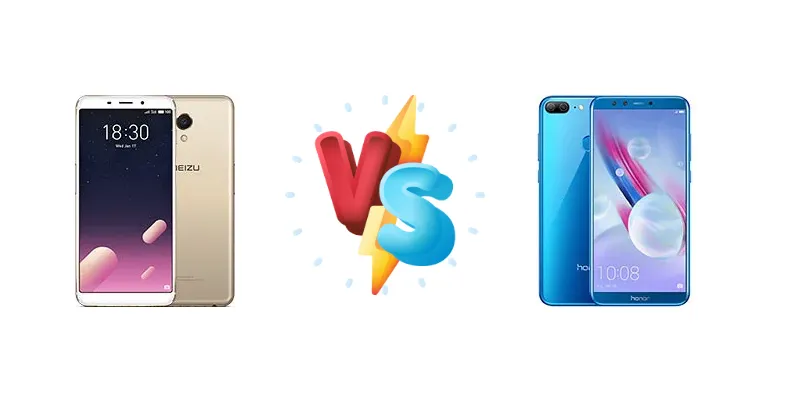
The Meizu M6s and Honor 9 Lite represent a fascinating intersection of budget-friendly smartphones from the mid-2010s. Both devices aimed to deliver a compelling experience without breaking the bank, but they took different approaches to achieving this. This comparison dissects their core components – the Exynos 7872 and Kirin 659 chipsets – to determine which phone offers the best value for users prioritizing performance and efficiency.
🏆 Quick Verdict
For the average user, the Honor 9 Lite emerges as the slightly better choice. While the Meizu M6s boasts faster charging, the Honor 9 Lite’s octa-core Kirin 659 provides a more consistent multitasking experience and potentially better sustained performance due to its 16nm process, making it more suitable for everyday tasks and light gaming.
| Network |
|---|
| 2G bands | GSM 850 / 900 / 1800 / 1900 - SIM 1 & SIM 2 | GSM 900 / 1800 / 1900 - SIM 1 & SIM 2 |
| 3G bands | HSDPA 850 / 900 / 1900 / 2100 | HSDPA 850 / 900 / 1900 / 2100 - Global |
| 4G bands | 1, 3, 5, 7, 8, 20, 40 | 1, 3, 7, 8, 20 - Global |
| Speed | HSPA 42.2/5.76 Mbps, LTE (2CA) Cat6 300/50 Mbps | HSPA 42.2/5.76 Mbps, LTE (2CA) Cat6 300/50 Mbps |
| Technology | GSM / HSPA / LTE | GSM / HSPA / LTE |
| | - | 1, 3, 5, 40, 41 - India |
| Launch |
|---|
| Announced | 2018, January. Released 2018, January | 2017, December. Released 2017, December |
| Status | Discontinued | Discontinued |
| Body |
|---|
| Build | Glass front, aluminum back, aluminum frame | Glass front, glass back, aluminum frame |
| Dimensions | 152 x 72.5 x 8 mm (5.98 x 2.85 x 0.31 in) | 151 x 71.9 x 7.6 mm (5.94 x 2.83 x 0.30 in) |
| SIM | Nano-SIM + Nano-SIM | Nano-SIM + Nano-SIM |
| Weight | 160 g (5.64 oz) | 149 g (5.26 oz) |
| Display |
|---|
| Resolution | 720 x 1440 pixels, 18:9 ratio (~282 ppi density) | 1080 x 2160 pixels, 18:9 ratio (~428 ppi density) |
| Size | 5.7 inches, 83.8 cm2 (~76.1% screen-to-body ratio) | 5.65 inches, 82.0 cm2 (~75.5% screen-to-body ratio) |
| Type | IPS LCD | IPS LCD |
| Platform |
|---|
| CPU | Hexa-core (4x1.6 GHz Cortex-A53 & 2x2.0 GHz Cortex-A73) | Octa-core (4x2.36 GHz Cortex-A53 & 4x1.7 GHz Cortex-A53) |
| Chipset | Exynos 7872 (14 nm) | Kirin 659 (16 nm) |
| GPU | Mali-G71 MP1 | Mali-T830 MP2 |
| OS | Android 7.0 (Nougat), Flyme 6.2 | Android 8.0 (Oreo), upgradable to Android 9.0 (Pie), EMUI 9.1 |
| Memory |
|---|
| Card slot | microSDXC (uses shared SIM slot) | microSDXC (uses shared SIM slot) |
| Internal | 32GB 3GB RAM, 64GB 3GB RAM | 32GB 3GB RAM, 32GB 4GB RAM, 64GB 4GB RAM |
| | eMMC 5.1 | eMMC 5.1 |
| Main Camera |
|---|
| Dual | - | 13 MP, PDAF
Auxiliary lens |
| Features | Dual-LED dual-tone flash | LED flash, HDR, panorama |
| Single | 16 MP, f/2.0, PDAF | - |
| Video | 1080p@30fps | 1080p@30fps |
| Selfie camera |
|---|
| Dual | - | 13 MP
2 MP, depth sensor |
| Single | 8 MP, f/2.0 | - |
| Video | - | 1080p@30fps |
| Sound |
|---|
| 3.5mm jack | Yes | Yes |
| 35mm jack | Yes | Yes |
| Loudspeaker | Yes | Yes |
| Comms |
|---|
| Bluetooth | 4.2, A2DP, LE | 4.2, A2DP, LE |
| NFC | No | Yes (market/region dependent) |
| Positioning | GPS, GLONASS | GPS, GLONASS, BDS |
| Radio | No | FM radio |
| USB | microUSB 2.0 | microUSB 2.0, OTG |
| WLAN | Wi-Fi 802.11 a/b/g/n, dual-band, Wi-Fi Direct | Wi-Fi 802.11 b/g/n, Wi-Fi Direct |
| Features |
|---|
| Sensors | Fingerprint (side-mounted), accelerometer, gyro, proximity, compass | Fingerprint (rear-mounted), accelerometer, proximity, compass |
| Battery |
|---|
| Charging | 18W wired | - |
| Type | Li-Ion 3000 mAh, non-removable | Li-Po 3000 mAh, non-removable |
| Misc |
|---|
| Colors | Black, Silver, Gold, Blue | Midnight Black, Sapphire Blue, Glacier Gray, Navy, Seagull Gray, Magic Nightfall, Pearl White |
| Models | M6s | LLD-AL00, LLD-AL10, LLD-TL10, LLD-L31, LLD-L21, LLD-L11 |
| Price | About 150 EUR | About 190 EUR |
Meizu M6s
- Faster 18W charging for quick top-ups
- Potentially higher single-core performance with Exynos 7872's A73 cores
- Compact form factor (likely)
- Hexa-core CPU may struggle with heavy multitasking
- 14nm process potentially leads to more heat under load
Honor 9 Lite
- Octa-core CPU provides smoother multitasking
- 16nm process offers potentially better thermal efficiency
- Generally more readily available software updates (Honor's ecosystem)
- Slower charging speeds
- Lower single-core performance compared to the M6s
Display Comparison
Neither device is known for a standout display. Both likely featured LCD panels, typical for this price point. However, detailed specs are unavailable. The focus here is on internal performance, as display quality was not a key differentiator. Bezels were likely comparable, reflecting the design trends of the time.
Camera Comparison
Without detailed sensor information, a direct camera comparison is difficult. Both phones likely featured a primary camera and a depth sensor for portrait mode effects. The image processing style would have differed between the brands, with Meizu potentially leaning towards more saturated colors and Honor aiming for a more natural look. The absence of optical image stabilization (OIS) on either device suggests reliance on software-based stabilization, which is less effective in low-light conditions. Any 2MP auxiliary cameras are likely of limited utility, primarily for marketing purposes.
Performance
The core difference lies in the chipsets. The Meizu M6s utilizes the Exynos 7872, a hexa-core processor built on a 14nm process. This configuration features two Cortex-A73 cores clocked at 2.0 GHz for performance and four Cortex-A53 cores at 1.6 GHz for efficiency. The Honor 9 Lite, conversely, employs the Kirin 659, an octa-core chip fabricated on a 16nm process. It consists of four Cortex-A53 cores at 2.36 GHz and another four at 1.7 GHz. While the Exynos 7872 has fewer cores, its A73 cores offer higher single-core performance. However, the Kirin 659’s eight A53 cores provide better multitasking capabilities. The 16nm process of the Kirin 659 also suggests potentially better thermal efficiency, reducing the likelihood of throttling under sustained load. This benefits users who engage in prolonged gaming or video recording.
Battery Life
Battery capacity is not specified, but both phones likely featured batteries in the 3000-3500 mAh range, typical for the era. The Meizu M6s’s 18W wired charging is a clear advantage, allowing for significantly faster charging times compared to the Honor 9 Lite, which likely supported standard 10W charging. This means users of the M6s can quickly top up their battery, even if the overall battery life is comparable.
Buying Guide
Buy the Meizu M6s if you prioritize quick top-ups and frequently find yourself needing to rapidly recharge your device. Its 18W charging is a significant advantage in a pinch. Buy the Honor 9 Lite if you value smoother multitasking and a more balanced performance profile for everyday use. The Kirin 659’s eight cores offer a more responsive experience when switching between apps and handling multiple tasks simultaneously.
Frequently Asked Questions
❓ Does the Exynos 7872 in the Meizu M6s overheat during prolonged gaming sessions?
The Exynos 7872, built on a 14nm process, is more prone to thermal throttling than the Kirin 659’s 16nm counterpart. While it can handle casual gaming, extended gaming sessions may lead to noticeable performance drops as the chip heats up. The Honor 9 Lite is likely to maintain more consistent performance over longer periods.
❓ Is the Honor 9 Lite’s Kirin 659 chipset sufficient for modern app usage?
While the Kirin 659 is an older chipset, its octa-core configuration and efficient design are still capable of handling most everyday tasks, including social media, web browsing, and video streaming. However, it may struggle with demanding applications or graphically intensive games at higher settings. It's best suited for users with moderate smartphone usage needs.
❓ How does the charging speed difference impact daily use between the two phones?
The Meizu M6s’s 18W charging is a game-changer for users who frequently need to top up their battery. A quick 30-minute charge can provide a significant boost in battery life, whereas the Honor 9 Lite will require considerably longer to achieve the same level of charge. This makes the M6s ideal for those with busy lifestyles.