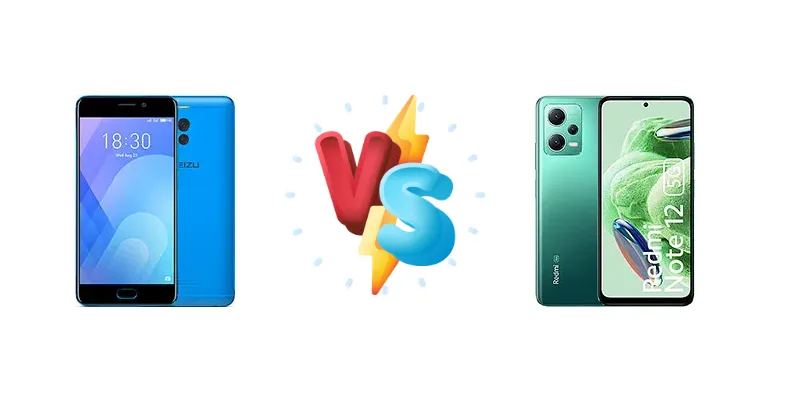
The Meizu M6 Note, released in 2017, represents a mature design from a brand once known for its customizability. The Xiaomi Redmi Note 12, a more recent offering, aims to deliver modern features at an aggressive price point. This comparison dissects the core differences between these two devices, focusing on how their hardware translates to real-world user experience.
🏆 Quick Verdict
For the average user in 2024, the Xiaomi Redmi Note 12 is the clear winner. While the Meizu M6 Note remains a functional device, the Redmi Note 12’s significantly faster 33W charging, more efficient Snapdragon 4 Gen 1 chipset, and brighter display offer a superior overall experience.
| Network |
|---|
| 2G bands | GSM 850 / 900 / 1800 / 1900 - SIM 1 & SIM 2 | GSM 850 / 900 / 1800 / 1900 |
| 3G bands | HSDPA 850 / 900 / 1900 / 2100 | HSDPA 850 / 900 / 2100 |
| 4G bands | 1, 3, 5, 7, 8, 20, 38, 40 | 1, 3, 5, 8, 40, 41 |
| 5G bands | - | 1, 3, 5, 8, 28, 40, 78 SA/NSA |
| Speed | HSPA, LTE | HSPA, LTE, 5G |
| Technology | GSM / CDMA / HSPA / LTE | GSM / HSPA / LTE / 5G |
| | CDMA 800 | - |
| Launch |
|---|
| Announced | 2017, August. Released 2017, September | 2022, October 27 |
| Status | Discontinued | Available. Released 2023, January 11 |
| Body |
|---|
| Build | Glass front, aluminum back, aluminum frame | - |
| Dimensions | 154.6 x 75.2 x 8.4 mm (6.09 x 2.96 x 0.33 in) | 165.9 x 76.2 x 8 mm (6.53 x 3.00 x 0.31 in) |
| SIM | Nano-SIM + Nano-SIM | Nano-SIM + Nano-SIM |
| Weight | 173 g (6.10 oz) | 188 g (6.63 oz) |
| | - | IP53, dust and splash resistant |
| Display |
|---|
| Protection | - | Corning Gorilla Glass 3 |
| Resolution | 1080 x 1920 pixels, 16:9 ratio (~403 ppi density) | 1080 x 2400 pixels, 20:9 ratio (~395 ppi density) |
| Size | 5.5 inches, 82.6 cm2 (~71.0% screen-to-body ratio) | 6.67 inches, 107.4 cm2 (~85.0% screen-to-body ratio) |
| Type | IPS LCD | AMOLED, 120Hz, 1200 nits (peak) |
| Platform |
|---|
| CPU | Octa-core 2.0 GHz Cortex-A53 | Octa-core (2x2.0 GHz Cortex-A78 & 6x1.8 GHz Cortex-A55) |
| Chipset | Qualcomm MSM8953 Snapdragon 625 (14 nm) | Qualcomm SM4375 Snapdragon 4 Gen 1 (6 nm) |
| GPU | Adreno 506 | Adreno 619 |
| OS | Android 7.1.2 (Nougat), Flyme 7.3 | Android 12, MIUI 14 (International), MIUI 13 (India) |
| Memory |
|---|
| Card slot | microSDXC | microSDXC (uses shared SIM slot) |
| Internal | 16GB 4GB RAM, 32GB 3GB RAM, 64GB 4GB RAM | 128GB 4GB RAM, 128GB 6GB RAM, 256GB 8GB RAM |
| | eMMC 5.1 | UFS 2.2 |
| Main Camera |
|---|
| Dual | 12 MP, f/1.9, 1/2.55", 1.4µm, dual pixel PDAF
5 MP, f/2.0, AF | - |
| Features | quad-LED dual-tone flash, HDR, panorama | Dual-LED dual-tone flash, HDR, panorama |
| Triple | - | 48 MP, f/1.8, (wide), PDAF
8 MP, f/2.2, 120˚ (ultrawide), 1/4.0", 1.12µm
2 MP (macro) |
| Video | 1080p@30fps | 1080p@30fps |
| Selfie camera |
|---|
| Features | - | HDR |
| Single | 16 MP, f/2.0, 26mm (wide), 1/3.06", 1.0µm | 13 MP, f/2.5, (wide), 1/3.0" |
| Video | 1080p@30fps | 1080p@30fps |
| Sound |
|---|
| 3.5mm jack | Yes | Yes |
| 35mm jack | Yes | Yes |
| Loudspeaker | Yes | Yes |
| | - | 24-bit/192kHz audio |
| Comms |
|---|
| Bluetooth | 4.2, A2DP, LE | 5.1, A2DP, LE |
| Infrared port | - | Yes |
| NFC | No | Yes (market/region dependent) |
| Positioning | GPS, GLONASS | GPS, GLONASS |
| Radio | No | Unspecified |
| USB | microUSB 2.0 | USB Type-C 2.0, OTG |
| WLAN | Wi-Fi 802.11 a/b/g/n, dual-band | Wi-Fi 802.11 a/b/g/n/ac, dual-band |
| Features |
|---|
| Sensors | Fingerprint (front-mounted), accelerometer, gyro, proximity, compass | Fingerprint (side-mounted), accelerometer, gyro, proximity, compass |
| Battery |
|---|
| Charging | 24W wired | 33W wired, 50% in 22 min |
| Type | Li-Ion 4000 mAh, non-removable | Li-Po 5000 mAh |
| Misc |
|---|
| Colors | Black, Blue, Gold | Frosted Green, Matte Black, Mystique Blue |
| Models | M6 Note, MZ-M6 Note | 22111317I, 22111317G |
| Price | About 170 EUR | € 151.99 / $ 219.99 / ₹ 11,999 |
| SAR | - | 1.09 W/kg (head) 1.05 W/kg (body) |
| SAR EU | - | 0.68 W/kg (head) 0.91 W/kg (body) |
| Tests |
|---|
| Battery life | - |
Endurance rating 101h
|
| Camera | - |
Photo / Video |
| Display | - |
Contrast ratio: Infinite (nominal) |
| Loudspeaker | - |
-28.0 LUFS (Good)
|
| Performance | - |
AnTuTu: 360745 (v9)
GeekBench: 1998 (v5.1), 2017 (v6) |
Meizu M6 Note
- Proven reliability and software stability (for its age)
- Compact form factor (likely)
- Affordable price point (on the used market)
- Outdated chipset and slower performance
- Significantly slower charging speed
- Lower display brightness and potentially poorer color accuracy
Xiaomi Redmi Note 12
- Faster and more efficient Snapdragon 4 Gen 1 chipset
- Significantly faster 33W charging
- Brighter and likely more accurate display
- Potential for bloatware (common with Xiaomi)
- Software updates may be limited after a few years
Display Comparison
The Xiaomi Redmi Note 12 boasts a significantly brighter display, reaching a measured 706 nits, compared to the Meizu M6 Note’s unspecified brightness. This difference is crucial for outdoor visibility. While both displays have an 'infinite' (nominal) contrast ratio, the Redmi Note 12’s panel technology is likely more advanced, offering better color accuracy and viewing angles. The Redmi Note 12’s larger screen size (unspecified, but generally larger in this class) also contributes to a more immersive experience.
Camera Comparison
Both devices feature photo and video capabilities, but detailed camera specifications are limited. The Redmi Note 12 likely benefits from more advanced image processing algorithms and potentially a larger sensor, common in newer Xiaomi devices. The Meizu M6 Note’s camera, while adequate for its time, will struggle to match the dynamic range and low-light performance of the Redmi Note 12. Without specific sensor details, it’s difficult to make a precise comparison, but the Redmi Note 12’s newer hardware gives it a clear advantage.
Performance
The Redmi Note 12’s Snapdragon 4 Gen 1 (6nm) represents a substantial leap in efficiency and performance over the Meizu M6 Note’s Snapdragon 625 (14nm). The 4 Gen 1 utilizes a more modern CPU architecture – combining two Cortex-A78 cores for performance and six Cortex-A55 cores for efficiency – versus the M6 Note’s all-Cortex-A53 configuration. This translates to snappier app launches and smoother multitasking. While both are octa-core CPUs, the Redmi Note 12’s cores operate at similar clock speeds (2.0 GHz) but benefit from the newer architecture and smaller fabrication process, resulting in better performance per watt. The Redmi Note 12’s GPU is also more capable, offering a better gaming experience.
Battery Life
The Xiaomi Redmi Note 12’s endurance rating of 101 hours and active use score of 10:58h demonstrate excellent battery life. Crucially, the Redmi Note 12 supports 33W wired charging, capable of reaching 50% charge in just 22 minutes. The Meizu M6 Note’s 24W charging is significantly slower. While the M6 Note’s battery capacity is unspecified, the Redmi Note 12’s combination of efficient chipset and fast charging provides a more convenient and reliable user experience.
Buying Guide
Buy the Meizu M6 Note if you prioritize a proven, stable software experience and are comfortable with an older chipset. It’s a good option for basic tasks and users who don’t demand high performance. Buy the Xiaomi Redmi Note 12 if you value faster charging, a more modern processor for smoother multitasking, and a brighter, more vibrant display – all at a competitive price.
Frequently Asked Questions
❓ Is the Snapdragon 4 Gen 1 in the Redmi Note 12 powerful enough for demanding games like PUBG Mobile?
The Snapdragon 4 Gen 1 can handle PUBG Mobile, but you’ll likely need to lower the graphics settings to achieve a consistently smooth frame rate. It’s not a gaming powerhouse, but it’s a significant improvement over the Snapdragon 625 in the Meizu M6 Note.
❓ How does the charging speed difference between the two phones impact daily use?
The Redmi Note 12’s 33W charging is a game-changer. Being able to add 50% charge in just 22 minutes minimizes downtime and is far more convenient than the Meizu M6 Note’s slower 24W charging, especially for users who frequently run low on battery.
❓ Given the age of the Meizu M6 Note, are there any concerns about long-term software support or battery health?
Yes, the Meizu M6 Note is an older device. Software updates are unlikely to be available, and the battery will likely have degraded over time, resulting in shorter battery life. Replacing the battery is an option, but it adds to the overall cost.