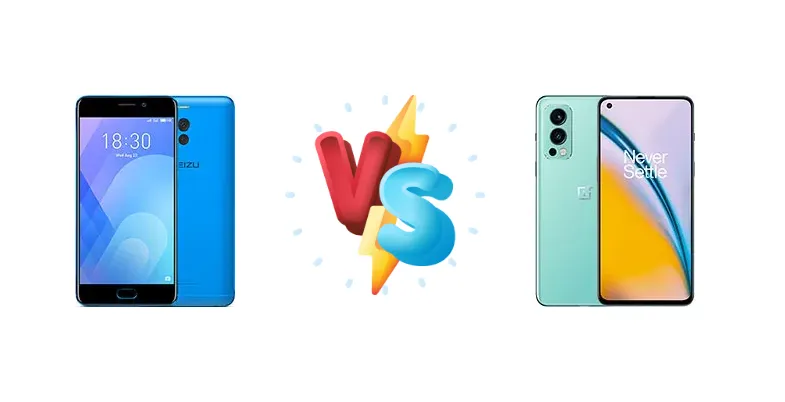
The Meizu M6 Note, representing a more mature budget offering, faces off against the OnePlus Nord 2 5G, a device aiming for a more premium mid-range experience. This comparison dissects the core differences between Qualcomm’s Snapdragon 625 and MediaTek’s Dimensity 1200, examining how these chipsets impact daily use, gaming, and overall value.
🏆 Quick Verdict
For the average user prioritizing performance and future-proofing, the OnePlus Nord 2 5G is the clear winner. Its Dimensity 1200 chipset delivers significantly faster processing speeds and 5G connectivity, complemented by blazing-fast 65W charging. The M6 Note remains a viable option for those on a very tight budget.
| Network |
|---|
| 2G bands | GSM 850 / 900 / 1800 / 1900 - SIM 1 & SIM 2 | GSM 850 / 900 / 1800 / 1900 |
| 3G bands | HSDPA 850 / 900 / 1900 / 2100 | HSDPA 800 / 850 / 900 / 1700(AWS) / 1800 / 1900 / 2100 |
| 4G bands | 1, 3, 5, 7, 8, 20, 38, 40 | 1, 2, 3, 4, 5, 7, 8, 12, 17, 18, 19, 20, 26, 28, 32, 34, 38, 39, 40, 41, 66 - EU |
| 5G bands | - | 1, 3, 7, 8, 20, 28, 38, 41, 66, 78 SA/NSA - EU |
| Speed | HSPA, LTE | HSPA 42.2/5.76 Mbps, LTE Cat18 1200/150 Mbps, 5G |
| Technology | GSM / CDMA / HSPA / LTE | GSM / HSPA / LTE / 5G |
| | CDMA 800 | - |
| Launch |
|---|
| Announced | 2017, August. Released 2017, September | 2021, July 22 |
| Status | Discontinued | Available. Released 2021, July 28 |
| Body |
|---|
| Build | Glass front, aluminum back, aluminum frame | Glass front (Gorilla Glass 5), glass back (Gorilla Glass 5), plastic frame |
| Dimensions | 154.6 x 75.2 x 8.4 mm (6.09 x 2.96 x 0.33 in) | 159.1 x 73.3 x 8.3 mm (6.26 x 2.89 x 0.33 in) |
| SIM | Nano-SIM + Nano-SIM | Nano-SIM + Nano-SIM |
| Weight | 173 g (6.10 oz) | 189 g (6.67 oz) |
| Display |
|---|
| Protection | - | Corning Gorilla Glass 5 |
| Resolution | 1080 x 1920 pixels, 16:9 ratio (~403 ppi density) | 1080 x 2400 pixels, 20:9 ratio (~409 ppi density) |
| Size | 5.5 inches, 82.6 cm2 (~71.0% screen-to-body ratio) | 6.43 inches, 99.8 cm2 (~85.6% screen-to-body ratio) |
| Type | IPS LCD | Fluid AMOLED, 90Hz, HDR10+ |
| Platform |
|---|
| CPU | Octa-core 2.0 GHz Cortex-A53 | Octa-core (1x3.0 GHz Cortex-A78 & 3x2.6 GHz Cortex-A78 & 4x2.0 GHz Cortex-A55) |
| Chipset | Qualcomm MSM8953 Snapdragon 625 (14 nm) | Mediatek Dimensity 1200 (6 nm) |
| GPU | Adreno 506 | Mali-G77 MC9 |
| OS | Android 7.1.2 (Nougat), Flyme 7.3 | Android 11, upgradable to Android 13, OxygenOS 13 |
| Memory |
|---|
| Card slot | microSDXC | No |
| Internal | 16GB 4GB RAM, 32GB 3GB RAM, 64GB 4GB RAM | 128GB 6GB RAM, 128GB 8GB RAM, 256GB 8GB RAM, 256GB 12GB RAM |
| | eMMC 5.1 | - |
| Main Camera |
|---|
| Dual | 12 MP, f/1.9, 1/2.55", 1.4µm, dual pixel PDAF
5 MP, f/2.0, AF | - |
| Features | quad-LED dual-tone flash, HDR, panorama | Dual-LED flash, HDR, panorama |
| Triple | - | 50 MP, f/1.9, 24mm (wide), 1/1.56", 1.0µm, PDAF, OIS
8 MP, f/2.3, 120˚ (ultrawide)
Auxiliary lens |
| Video | 1080p@30fps | 4K@30fps, 1080p@30/60/120fps, gyro-EIS |
| Selfie camera |
|---|
| Features | - | Auto HDR |
| Single | 16 MP, f/2.0, 26mm (wide), 1/3.06", 1.0µm | 32 MP, f/2.5, (wide), 1/2.8", 0.8µm |
| Video | 1080p@30fps | 1080p@30fps, gyro-EIS |
| Sound |
|---|
| 3.5mm jack | Yes | No |
| 35mm jack | Yes | No |
| Loudspeaker | Yes | Yes, with stereo speakers |
| Comms |
|---|
| Bluetooth | 4.2, A2DP, LE | 5.2, A2DP, LE, aptX HD |
| NFC | No | Yes |
| Positioning | GPS, GLONASS | GPS, GLONASS, GALILEO, BDS, SBAS, NavIC |
| Radio | No | No |
| USB | microUSB 2.0 | USB Type-C 2.0, OTG |
| WLAN | Wi-Fi 802.11 a/b/g/n, dual-band | Wi-Fi 802.11 a/b/g/n/ac/6, dual-band, Wi-Fi Direct |
| Features |
|---|
| Sensors | Fingerprint (front-mounted), accelerometer, gyro, proximity, compass | Fingerprint (under display, optical), accelerometer, gyro, proximity, compass |
| Battery |
|---|
| Charging | 24W wired | 65W wired, PD, 100% in 30 min |
| Type | Li-Ion 4000 mAh, non-removable | Li-Po 4500 mAh |
| Misc |
|---|
| Colors | Black, Blue, Gold | Gray Sierra, Blue Haze, Green Wood, Pac-Man Edition |
| Models | M6 Note, MZ-M6 Note | DN2101, DN2103 |
| Price | About 170 EUR | € 189.00 / $ 219.99 / £ 148.00 |
| Tests |
|---|
| Battery life | - |
Endurance rating 102h
|
| Camera | - |
Photo / Video |
| Display | - |
Contrast ratio: Infinite (nominal) |
| Loudspeaker | - |
-24.3 LUFS (Very good)
|
| Performance | - |
AnTuTu: 512164 (v8) | 598022 (v9)
GeekBench: 2792 (v5.1)
GFXBench: 38fps (ES 3.1 onscreen) |
Meizu M6 Note
- Lower price point makes it accessible.
- Reliable Snapdragon 625 chipset for basic tasks.
- Decent battery endurance.
- Outdated chipset struggles with demanding apps.
- Slow 24W charging.
- Likely inferior display quality.
OnePlus Nord 2 5G
- Powerful Dimensity 1200 chipset for smooth performance.
- Blazing-fast 65W charging.
- Brighter and more vibrant display.
- Higher price compared to the Meizu M6 Note.
- May experience some thermal throttling under heavy load.
- Software updates may be less frequent than some competitors.
Display Comparison
The OnePlus Nord 2 5G boasts a significantly brighter display, reaching a measured 633 nits, compared to the Meizu M6 Note’s unspecified brightness. While both are adequate for indoor use, the Nord 2 5G will offer superior visibility in direct sunlight. The Nord 2 5G’s ‘Infinite’ contrast ratio (nominal) suggests a typical OLED panel, providing deeper blacks and more vibrant colors than the likely IPS LCD panel in the M6 Note. The absence of refresh rate data for the M6 Note further highlights the Nord 2 5G’s potential for a smoother visual experience.
Camera Comparison
Both devices offer photo and video capabilities, but details are limited. The OnePlus Nord 2 5G likely benefits from a more advanced image signal processor (ISP) integrated within the Dimensity 1200, enabling better noise reduction and dynamic range. Without specific sensor size or aperture information for either device, it’s difficult to make a definitive judgment. However, the Nord 2 5G’s positioning suggests a more sophisticated camera system overall, potentially including features like optical image stabilization (OIS) which is absent on the M6 Note. The M6 Note’s camera is likely focused on basic functionality, while the Nord 2 5G aims for a more versatile photographic experience.
Performance
The core difference lies in the chipsets. The Meizu M6 Note’s Snapdragon 625, built on a 14nm process, features an octa-core Cortex-A53 CPU clocked at 2.0 GHz. This is a capable chip for everyday tasks, but it’s showing its age. The OnePlus Nord 2 5G’s Dimensity 1200, fabricated on a more efficient 6nm process, is a substantial upgrade. Its CPU configuration – a single Cortex-A78 core at 3.0 GHz, three Cortex-A78 cores at 2.6 GHz, and four Cortex-A55 cores at 2.0 GHz – delivers significantly higher single-core and multi-core performance. This translates to faster app loading times, smoother multitasking, and a more responsive user interface. The 6nm node also contributes to better thermal efficiency, reducing the likelihood of throttling during sustained workloads.
Battery Life
Both phones achieve an endurance rating of 102 hours, suggesting similar overall battery life despite the difference in chipset efficiency. However, the charging speeds are drastically different. The Meizu M6 Note’s 24W wired charging is relatively slow compared to the OnePlus Nord 2 5G’s 65W wired charging, which can fully charge the device in just 30 minutes. This difference in charging speed is a significant convenience factor, allowing Nord 2 5G users to quickly top up their battery when needed. The Dimensity 1200’s 6nm process also contributes to better power efficiency, potentially offsetting some of the power draw from the brighter display and faster processor.
Buying Guide
Buy the Meizu M6 Note if you need a reliable, basic smartphone for essential tasks like calling, texting, and light social media use, and prioritize a lower upfront cost. Buy the OnePlus Nord 2 5G if you prefer a smoother, more responsive experience for demanding apps, gaming, and photography, and value the convenience of incredibly fast charging and 5G connectivity.
Frequently Asked Questions
❓ Does the Dimensity 1200 in the OnePlus Nord 2 5G get noticeably hot during extended gaming sessions?
While the Dimensity 1200 is a powerful chip, it can generate heat under sustained load. The 6nm process helps mitigate this, but some thermal throttling is possible during prolonged gaming. However, the Nord 2 5G’s thermal management is generally good, and throttling is unlikely to be severe enough to ruin the experience.
❓ Is the 24W charging on the Meizu M6 Note sufficient for overnight charging, or will I need to plug it in for extended periods?
24W charging is adequate for overnight charging, but it will take considerably longer to fully charge the device compared to the OnePlus Nord 2 5G. Expect a full charge to take several hours, making it less convenient for quick top-ups throughout the day.
❓ How does the Snapdragon 625 handle multitasking compared to the Dimensity 1200?
The Snapdragon 625 can handle basic multitasking, but it will struggle with numerous apps open simultaneously or resource-intensive applications. The Dimensity 1200, with its more powerful CPU and ample RAM, offers a significantly smoother multitasking experience, allowing you to switch between apps seamlessly.