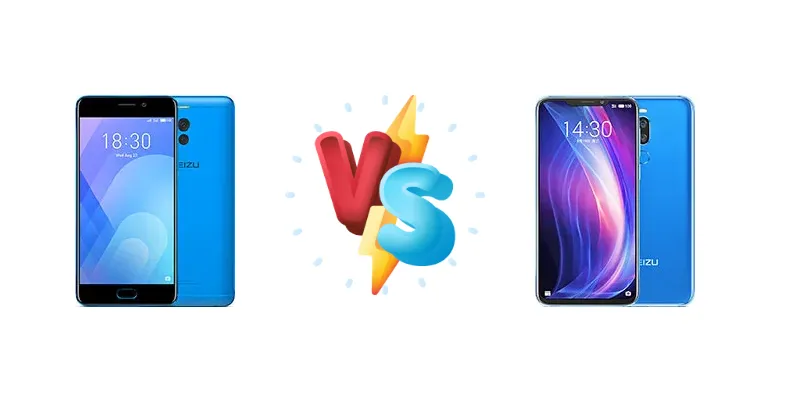
The Meizu M6 Note and X8 represent distinct points in the company's mid-range strategy. The M6 Note, leveraging the efficient Snapdragon 625, aimed for long battery life and reliable performance. The X8, with its newer Snapdragon 710, promised a significant step up in processing power. This comparison dissects the core differences to determine which device delivers the best experience for today's user.
🏆 Quick Verdict
For the average user prioritizing a balance of affordability and performance, the Meizu X8 emerges as the better choice. The Snapdragon 710 offers a noticeable performance uplift over the 625, translating to smoother multitasking and improved gaming, despite potentially slightly reduced battery efficiency. The X8’s more modern chipset justifies the price difference.
| Network |
|---|
| 2G bands | GSM 850 / 900 / 1800 / 1900 - SIM 1 & SIM 2 | GSM 850 / 900 / 1800 / 1900 |
| 3G bands | HSDPA 850 / 900 / 1900 / 2100 | HSDPA 850 / 900 / 2100 - China |
| 4G bands | 1, 3, 5, 7, 8, 20, 38, 40 | 1, 3, 5, 8, 34, 38, 39, 40, 41 - China |
| Speed | HSPA, LTE | HSPA 42.2/5.76 Mbps, LTE Cat15 800/150 Mbps |
| Technology | GSM / CDMA / HSPA / LTE | GSM / CDMA / HSPA / LTE |
| | CDMA 800 | CDMA 800 & TD-SCDMA - China |
| Launch |
|---|
| Announced | 2017, August. Released 2017, September | 2018, September. Released 2018, October |
| Status | Discontinued | Discontinued |
| Body |
|---|
| Build | Glass front, aluminum back, aluminum frame | - |
| Dimensions | 154.6 x 75.2 x 8.4 mm (6.09 x 2.96 x 0.33 in) | 151.2 x 74.6 x 7.8 mm (5.95 x 2.94 x 0.31 in) |
| SIM | Nano-SIM + Nano-SIM | Nano-SIM + Nano-SIM |
| Weight | 173 g (6.10 oz) | 160 g (5.64 oz) |
| Display |
|---|
| Resolution | 1080 x 1920 pixels, 16:9 ratio (~403 ppi density) | 1080 x 2220 pixels, 18.5:9 ratio (~398 ppi density) |
| Size | 5.5 inches, 82.6 cm2 (~71.0% screen-to-body ratio) | 6.2 inches, 97.6 cm2 (~86.5% screen-to-body ratio) |
| Type | IPS LCD | IPS LCD |
| Platform |
|---|
| CPU | Octa-core 2.0 GHz Cortex-A53 | Octa-core (2x2.2 GHz 360 Gold & 6x1.7 GHz Kryo 360 Silver) |
| Chipset | Qualcomm MSM8953 Snapdragon 625 (14 nm) | Qualcomm SDM710 Snapdragon 710 (10 nm) |
| GPU | Adreno 506 | Adreno 616 |
| OS | Android 7.1.2 (Nougat), Flyme 7.3 | Android 8.0 (Oreo), Flyme UI |
| Memory |
|---|
| Card slot | microSDXC | No |
| Internal | 16GB 4GB RAM, 32GB 3GB RAM, 64GB 4GB RAM | 64GB 4GB RAM, 64GB 6GB RAM, 128GB 6GB RAM |
| | eMMC 5.1 | - |
| Main Camera |
|---|
| Dual | 12 MP, f/1.9, 1/2.55", 1.4µm, dual pixel PDAF
5 MP, f/2.0, AF | 12 MP, f/1.9, 1/2.55", 1.4µm, dual pixel PDAF
5 MP |
| Features | quad-LED dual-tone flash, HDR, panorama | Dual-LED dual-tone flash, panorama |
| Video | 1080p@30fps | 1080p@30fps |
| Selfie camera |
|---|
| Single | 16 MP, f/2.0, 26mm (wide), 1/3.06", 1.0µm | 20 MP, f/2.0, (wide), 1/2.8", 1.0µm |
| Video | 1080p@30fps | - |
| Sound |
|---|
| 3.5mm jack | Yes | Yes |
| 35mm jack | Yes | Yes |
| Loudspeaker | Yes | Yes |
| Comms |
|---|
| Bluetooth | 4.2, A2DP, LE | 5.0, A2DP, LE |
| NFC | No | No |
| Positioning | GPS, GLONASS | GPS, GLONASS |
| Radio | No | No |
| USB | microUSB 2.0 | USB Type-C 2.0 |
| WLAN | Wi-Fi 802.11 a/b/g/n, dual-band | Wi-Fi 802.11 b/g/n/ac, dual-band, Wi-Fi Direct |
| Features |
|---|
| Sensors | Fingerprint (front-mounted), accelerometer, gyro, proximity, compass | Fingerprint (rear-mounted), accelerometer, proximity, compass |
| Battery |
|---|
| Charging | 24W wired | - |
| Type | Li-Ion 4000 mAh, non-removable | Li-Ion 3210 mAh, non-removable |
| Misc |
|---|
| Colors | Black, Blue, Gold | Black, Blue, White |
| Models | M6 Note, MZ-M6 Note | X8 |
| Price | About 170 EUR | About 200 EUR |
Meizu M6 Note
- Excellent battery life due to Snapdragon 625 efficiency
- Affordable price point
- Reliable performance for basic tasks
- Slower processor compared to Snapdragon 710
- Less capable for demanding games and applications
- Potentially lower quality display
Meizu X8
- Significantly faster performance with Snapdragon 710
- Improved gaming experience
- More responsive user interface
- Potentially shorter battery life compared to M6 Note
- Higher price point
- May run slightly warmer under heavy load
Display Comparison
Neither device's display specifications are provided, so a direct comparison is limited. However, given the X8's positioning as a slightly more premium device, it likely features a higher quality panel with potentially better color accuracy and brightness. The M6 Note, targeting a lower price point, likely utilizes a more cost-effective display solution. Bezels are likely comparable, reflecting design trends of the time. Without specific data, it's reasonable to assume the X8 offers a visually superior experience.
Camera Comparison
Without detailed camera specifications, a precise comparison is difficult. However, the X8’s positioning suggests a more capable camera system. While both phones likely feature a primary rear camera, the X8 likely benefits from a more advanced image signal processor (ISP) within the Snapdragon 710, leading to better image quality, especially in low-light conditions. The M6 Note’s camera will be adequate for everyday snapshots, but the X8 should offer more detail and dynamic range. Any auxiliary cameras (depth sensors, monochrome sensors) on the X8 would further enhance its photographic capabilities.
Performance
The core difference lies in the chipsets. The Meizu M6 Note’s Qualcomm MSM8953 Snapdragon 625, built on a 14nm process, features an octa-core Cortex-A53 CPU clocked at 2.0 GHz. This is a proven, efficient processor. The Meizu X8, however, boasts the Qualcomm SDM710 Snapdragon 710, fabricated on a more advanced 10nm process. This smaller node allows for greater transistor density and improved power efficiency. Crucially, the Snapdragon 710’s CPU utilizes a dual-cluster architecture – 2x2.2 GHz 360 Gold cores for performance and 6x1.7 GHz Kryo 360 Silver cores for efficiency. This results in significantly faster processing speeds and a more responsive user experience, particularly noticeable in multitasking and demanding applications. The X8 will handle graphically intensive games with greater ease.
Battery Life
The M6 Note’s Snapdragon 625 is renowned for its power efficiency. While the battery capacity isn’t specified, the 625’s efficiency would likely translate to excellent battery life. The X8’s Snapdragon 710, despite being built on a more efficient 10nm process, is a more powerful chip and will consume more power under load. The X8’s 24W wired charging is identical to the M6 Note, meaning charging speeds will be comparable. The M6 Note will likely offer longer screen-on time, while the X8 will provide a faster, more responsive experience at the cost of some battery endurance.
Buying Guide
Buy the Meizu M6 Note if you prioritize maximizing battery life and are primarily focused on essential smartphone tasks like calling, texting, and light social media use. Its Snapdragon 625 is known for its efficiency. Buy the Meizu X8 if you value a more responsive user experience, enjoy mobile gaming, and appreciate the benefits of a more powerful processor for demanding applications. The Snapdragon 710 provides a tangible performance boost.
Frequently Asked Questions
❓ Will the Snapdragon 710 in the X8 handle demanding games like PUBG Mobile smoothly?
Yes, the Snapdragon 710 is significantly more capable than the 625 when it comes to gaming. It should handle PUBG Mobile at medium to high settings with a stable frame rate, providing a much smoother and more enjoyable gaming experience compared to the M6 Note.
❓ Is the difference in performance between the Snapdragon 625 and 710 noticeable in everyday tasks like browsing and social media?
While both phones will handle basic tasks adequately, the Snapdragon 710 in the X8 will provide a noticeably snappier and more responsive experience. App loading times will be faster, multitasking will be smoother, and animations will feel more fluid. The difference is subtle for simple tasks, but becomes apparent with heavier usage.
❓ How much faster is the charging on the Meizu X8 compared to the M6 Note, given they both support 24W charging?
Despite both supporting 24W charging, the X8's charging speed might be slightly affected by its more power-hungry chipset. However, the difference will likely be minimal. Both phones should achieve a full charge in approximately 1.5 to 2 hours, depending on the charger and battery level.