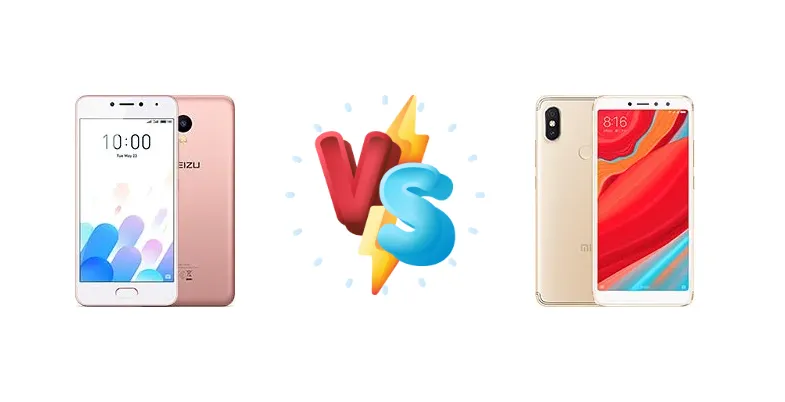
The Meizu M5c and Xiaomi Redmi S2 (also known as the Redmi Y2 in some markets) represent a fascinating snapshot of the entry-level smartphone landscape from 2018. Both aimed to deliver a functional Android experience at an accessible price point, but they took markedly different approaches to achieving that goal. This comparison dissects those approaches, focusing on the core hardware differences that impact everyday usability.
🏆 Quick Verdict
For the average user, the Xiaomi Redmi S2 (Redmi Y2) is the clear winner. Its Qualcomm Snapdragon 625 chipset, built on a 14nm process, provides a substantial performance advantage over the Meizu M5c’s Mediatek MT6737, translating to smoother multitasking and a more responsive user experience. While both phones offer similar battery endurance ratings, the Redmi S2’s superior processing power makes it the more versatile choice.
| Network |
|---|
| 2G bands | GSM 850 / 900 / 1800 / 1900 - SIM 1 & SIM 2 | GSM 850 / 900 / 1800 / 1900 |
| 3G bands | HSDPA 850 / 900 / 1900 / 2100 | HSDPA 850 / 900 / 1900 / 2100 |
| 4G bands | 1, 3, 5, 7, 8, 20, 38, 40 | 1, 3, 4, 5, 7, 8, 20, 38, 40 - Global |
| Speed | HSPA, LTE | HSPA 42.2/5.76 Mbps, LTE (2CA) Cat6 300/50 Mbps |
| Technology | GSM / HSPA / LTE | GSM / CDMA / HSPA / LTE |
| | - | 1, 3, 5, 7, 8, 34, 38, 39, 40, 41 - China |
| Launch |
|---|
| Announced | 2017, May. Released 2017, June | 2018, May. Released 2018, May |
| Status | Discontinued | Discontinued |
| Body |
|---|
| Build | - | Glass front, plastic back, plastic frame |
| Dimensions | 144 x 70.5 x 8.3 mm (5.67 x 2.78 x 0.33 in) | 160.7 x 77.3 x 8.1 mm (6.33 x 3.04 x 0.32 in) |
| SIM | Nano-SIM + Nano-SIM | Nano-SIM + Nano-SIM |
| Weight | 135 g (4.76 oz) | 170 g (6.00 oz) |
| Display |
|---|
| Resolution | 720 x 1280 pixels, 16:9 ratio (~294 ppi density) | 720 x 1440 pixels, 18:9 ratio (~269 ppi density) |
| Size | 5.0 inches, 68.9 cm2 (~67.9% screen-to-body ratio) | 5.99 inches, 92.6 cm2 (~74.5% screen-to-body ratio) |
| Type | IPS LCD | IPS LCD |
| Platform |
|---|
| CPU | Quad-core 1.3 GHz Cortex-A53 | Octa-core 2.0 GHz Cortex-A53 |
| Chipset | Mediatek MT6737 (28 nm) | Qualcomm MSM8953 Snapdragon 625 (14 nm) |
| GPU | Mali-T720MP1 | Adreno 506 |
| OS | Android 6.0 (Marshmallow), Flyme 6 | Android 8.1 (Oreo), upgradable to Android 9, MIUI 12 |
| Memory |
|---|
| Card slot | microSDXC (uses shared SIM slot) | microSDXC (dedicated slot) |
| Internal | 16GB 2GB RAM | 32GB 3GB RAM, 64GB 4GB RAM |
| | eMMC 5.0 | eMMC 5.1 |
| Main Camera |
|---|
| Dual | - | 12 MP, f/2.2, 1.25μm, PDAF
Auxiliary lens |
| Features | Dual-LED dual-tone flash, panorama | LED flash, panorama, HDR |
| Single | 8 MP, f/2.0, AF | - |
| Video | 720p@30fps | 1080p@30fps (gyro-EIS) |
| Selfie camera |
|---|
| Features | - | HDR, LED flash |
| Single | 5 MP, f/2.2 | 16 MP, f/2.5, (wide), 1/3.06" 1.0µm |
| Video | - | 1080p@30fps |
| Sound |
|---|
| 3.5mm jack | Yes | Yes |
| 35mm jack | Yes | Yes |
| Loudspeaker | Yes | Yes |
| Comms |
|---|
| Bluetooth | 4.1, A2DP, LE | 4.2, A2DP, LE |
| Infrared port | - | Yes |
| NFC | No | No |
| Positioning | GPS, GLONASS | - |
| Radio | No | FM radio |
| USB | microUSB 2.0, OTG | microUSB 2.0 |
| WLAN | Wi-Fi 802.11 a/b/g/n, dual-band | Wi-Fi 802.11 b/g/n, Wi-Fi Direct |
| Features |
|---|
| Sensors | Accelerometer, gyro (digital), proximity, compass | Fingerprint (rear-mounted), accelerometer, gyro, proximity, compass |
| Battery |
|---|
| Charging | - | 10W wired |
| Type | Li-Ion 3000 mAh, non-removable | Li-Po 3080 mAh, non-removable |
| Misc |
|---|
| Colors | Black, Blue, Red, Gold, Pink | Gray, Gold, Rose Gold, Mesmerising Blue, Stunning Black |
| Models | M5c, MZ-M5c | M1803E6G, M1803E6H, M1803E6I |
| Price | About 140 EUR | About 160 EUR |
| SAR | - | 0.43 W/kg (head) 1.58 W/kg (body) |
| Tests |
|---|
| Audio quality | - |
Noise -90.3dB / Crosstalk -93.1dB |
| Battery life | - |
Endurance rating 92h
|
| Camera | - |
Photo / Video |
| Display | - |
Contrast ratio: 1072:1 (nominal), 3.077 (sunlight) |
| Loudspeaker | - |
Voice 68dB / Noise 69dB / Ring 82dB
|
| Performance |
GeekBench: 1285 (v4.4) |
AnTuTu: 77488 (v7)
GeekBench: 4313 (v4.4)
GFXBench: 7.4fps (ES 3.1 onscreen) |
Meizu M5c
- Potentially lower price point (depending on market)
- Compact size (5-inch display)
- Functional for basic tasks
- Significantly weaker performance
- Less efficient processor
- Likely limited camera features
Xiaomi Redmi S2 (Redmi Y2)
- Superior performance with Snapdragon 625
- More efficient processor for longer battery life under load
- Larger display for better media consumption
- Potentially higher price
- Larger form factor may not suit all users
- May have more bloatware (typical of Xiaomi)
Display Comparison
Both devices share a similar display contrast ratio of 1072:1 (nominal) and 3.077 (sunlight), suggesting comparable outdoor visibility. However, detailed display specifications like resolution and panel type are missing. Given the price point, both likely utilize IPS LCD panels. The Redmi S2’s larger screen size (typically 5.99 inches vs. the M5c’s 5 inches) provides a more immersive viewing experience, though this comes at the cost of potentially lower pixel density. Without knowing the exact resolutions, it’s difficult to definitively declare a display winner.
Camera Comparison
Both phones feature photo and video capabilities, but detailed camera specifications are lacking. The absence of information regarding sensor size, aperture, or image stabilization makes a direct comparison challenging. However, given Xiaomi’s historical focus on camera performance, even in budget devices, it’s reasonable to assume the Redmi S2 offers a more refined camera experience. The inclusion of a dedicated camera app with various modes and features is also more likely on the Redmi S2. The M5c likely relies on basic camera software with limited features.
Performance
The performance gap between these two devices is significant. The Xiaomi Redmi S2’s Qualcomm Snapdragon 625, an octa-core processor built on a 14nm FinFET process, is a far more efficient and powerful chipset than the Meizu M5c’s MediaTek MT6737, a quad-core processor fabricated on a larger 28nm node. The 14nm process allows the Snapdragon 625 to deliver more performance per watt, resulting in less heat generation and improved sustained performance. The Redmi S2’s CPU clock speed of 2.0 GHz further contributes to its advantage over the M5c’s 1.3 GHz CPU. This translates to faster app loading times, smoother animations, and a more responsive overall user experience on the Redmi S2.
Battery Life
Interestingly, both devices boast an endurance rating of 92 hours, suggesting similar real-world battery life. However, this doesn’t tell the whole story. The Redmi S2’s more efficient Snapdragon 625 chipset contributes to this endurance despite potentially having a similar or slightly smaller battery capacity. The Redmi S2 supports 10W wired charging, a standard for the time, while charging speed information for the M5c is unavailable. The Snapdragon 625’s power efficiency means the Redmi S2 can maintain its battery life even under heavier usage scenarios.
Buying Guide
Buy the Meizu M5c if you prioritize a minimal, no-frills Android experience and are operating on an extremely tight budget. It’s a functional device for basic tasks like calls, texts, and light social media. Buy the Xiaomi Redmi S2 (Redmi Y2) if you value performance, even in a budget phone, and anticipate using more demanding apps or multitasking frequently. The Snapdragon 625 offers a significantly better user experience for a modest price increase.
Frequently Asked Questions
❓ Is the Mediatek MT6737 in the Meizu M5c sufficient for modern apps like WhatsApp and Facebook?
While the MT6737 can handle basic apps like WhatsApp and Facebook, it will struggle with more demanding applications or multitasking. Expect noticeable lag and slower loading times. It's best suited for users with very light smartphone needs.
❓ Does the Snapdragon 625 in the Redmi S2 offer a noticeable improvement in gaming performance?
Yes, the Snapdragon 625 provides a significant improvement in gaming performance compared to the MT6737. While it won't run the latest graphically intensive games at maximum settings, it can handle popular titles like PUBG Mobile and Mobile Legends at medium settings with acceptable frame rates.
❓ What about software updates? Which phone is more likely to receive updates?
Historically, Xiaomi has provided more consistent software updates for its Redmi series than Meizu has for its M series. While neither phone is likely to receive major Android version updates at this point, the Redmi S2 is more likely to receive security patches and minor improvements.