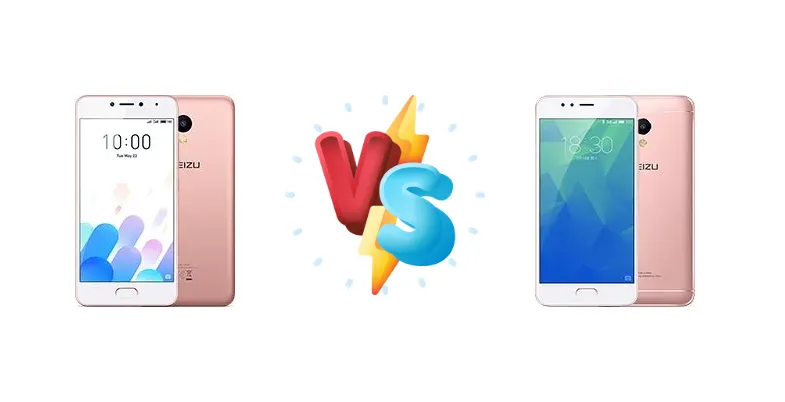
The Meizu M5c and M5s represent Meizu's attempts to capture the budget smartphone market. While visually similar, key internal differences – particularly in the chipset – dictate their performance and suitability for different users. This comparison dives deep into those differences to help you choose the best option for your needs.
🏆 Quick Verdict
For most users, the Meizu M5s is the superior choice. Its octa-core MT6753 chipset provides a noticeable performance boost over the M5c’s quad-core MT6737, making it better suited for multitasking and moderately demanding apps. While battery life is rated the same, the faster charging on the M5s is a significant convenience.
| Network |
|---|
| 2G bands | GSM 850 / 900 / 1800 / 1900 - SIM 1 & SIM 2 | GSM 850 / 900 / 1800 / 1900 - SIM 1 & SIM 2 |
| 3G bands | HSDPA 850 / 900 / 1900 / 2100 | HSDPA 900 / 1900 / 2100 |
| 4G bands | 1, 3, 5, 7, 8, 20, 38, 40 | LTE 1800 / 2100 / 2600 TD-LTE 2300 / 2600 |
| Speed | HSPA, LTE | HSPA, LTE |
| Technology | GSM / HSPA / LTE | GSM / HSPA / LTE |
| Launch |
|---|
| Announced | 2017, May. Released 2017, June | 2017, February. Released 2017, February |
| Status | Discontinued | Discontinued |
| Body |
|---|
| Dimensions | 144 x 70.5 x 8.3 mm (5.67 x 2.78 x 0.33 in) | 148.2 x 72.5 x 8.4 mm (5.83 x 2.85 x 0.33 in) |
| SIM | Nano-SIM + Nano-SIM | Nano-SIM + Nano-SIM |
| Weight | 135 g (4.76 oz) | 143 g (5.04 oz) |
| Display |
|---|
| Resolution | 720 x 1280 pixels, 16:9 ratio (~294 ppi density) | 720 x 1280 pixels, 16:9 ratio (~282 ppi density) |
| Size | 5.0 inches, 68.9 cm2 (~67.9% screen-to-body ratio) | 5.2 inches, 74.5 cm2 (~69.4% screen-to-body ratio) |
| Type | IPS LCD | IPS LCD |
| Platform |
|---|
| CPU | Quad-core 1.3 GHz Cortex-A53 | Octa-core 1.3 GHz Cortex-A53 |
| Chipset | Mediatek MT6737 (28 nm) | Mediatek MT6753 (28 nm) |
| GPU | Mali-T720MP1 | Mali-T720MP2 |
| OS | Android 6.0 (Marshmallow), Flyme 6 | Android 6.0 (Marshmallow), Flyme 5.2 |
| Memory |
|---|
| Card slot | microSDXC (uses shared SIM slot) | microSDXC (uses shared SIM slot) |
| Internal | 16GB 2GB RAM | 16GB 3GB RAM, 32GB 3GB RAM |
| | eMMC 5.0 | - |
| Main Camera |
|---|
| Features | Dual-LED dual-tone flash, panorama | Dual-LED dual-tone flash |
| Single | 8 MP, f/2.0, AF | 13 MP, f/2.2, PDAF |
| Video | 720p@30fps | 1080p@30fps |
| Selfie camera |
|---|
| Single | 5 MP, f/2.2 | 5 MP, f/2.0 |
| Sound |
|---|
| 3.5mm jack | Yes | Yes |
| 35mm jack | Yes | Yes |
| Loudspeaker | Yes | Yes |
| Comms |
|---|
| Bluetooth | 4.1, A2DP, LE | 4.0, A2DP, LE |
| NFC | No | No |
| Positioning | GPS, GLONASS | GPS, GLONASS |
| Radio | No | No |
| USB | microUSB 2.0, OTG | microUSB 2.0 |
| WLAN | Wi-Fi 802.11 a/b/g/n, dual-band | Wi-Fi 802.11 a/b/g/n, dual-band |
| Features |
|---|
| Sensors | Accelerometer, gyro (digital), proximity, compass | Fingerprint (front-mounted), accelerometer, gyro (digital), proximity, compass |
| Battery |
|---|
| Charging | - | 24W wired |
| Type | Li-Ion 3000 mAh, non-removable | Li-Ion 3000 mAh, non-removable |
| Misc |
|---|
| Colors | Black, Blue, Red, Gold, Pink | Champanage Gold, Rose Gold, Stay Gray, Moonlight Silver |
| Models | M5c, MZ-M5c | M5s, MZ-M5s |
| Price | About 140 EUR | About 130 EUR |
| Tests |
|---|
| Audio quality | - |
Noise -91.3dB / Crosstalk -86.1dB |
| Battery life | - | Endurance rating 56h |
| Camera | - |
Photo / Video |
| Display | - |
Contrast ratio: 955:1 (nominal), 2.580 (sunlight) |
| Loudspeaker | - |
Voice 65dB / Noise 69dB / Ring 84dB |
| Performance |
GeekBench: 1285 (v4.4) |
Basemark OS II 2.0: 781Basemark X: 4646 |
Meizu M5c
- Lower price point makes it very accessible.
- Functional for basic smartphone tasks.
- Identical display characteristics to the M5s.
- Quad-core processor limits performance.
- Slower charging speeds.
- Likely less responsive user experience.
Meizu M5s
- Octa-core processor delivers smoother performance.
- 24W fast charging for quicker top-ups.
- Better suited for multitasking and moderate gaming.
- Slightly higher price than the M5c.
- Camera specifications are largely unknown.
- Still a budget device with limitations.
Display Comparison
Both the Meizu M5c and M5s share the same display characteristics, boasting a contrast ratio of 955:1 (nominal) and 2.580 (sunlight). This suggests a similar viewing experience in both indoor and outdoor conditions. However, the lack of specific information regarding panel type (IPS vs. TFT) or resolution limits a deeper analysis. The shared contrast ratio indicates a comparable ability to display deep blacks and vibrant colors, but neither phone is likely to compete with higher-end displays in terms of color accuracy or viewing angles.
Camera Comparison
Both phones are listed with 'Photo / Video' capabilities, but lack specific details regarding sensor size, aperture, or image processing. This suggests that the camera performance is likely similar and geared towards casual photography. Without further information, it’s difficult to assess the quality of images or videos produced by either device. The absence of details also suggests neither phone features advanced camera features like optical image stabilization (OIS).
Performance
The core difference between these two devices lies in their chipsets. The Meizu M5c utilizes the Mediatek MT6737, a quad-core processor built on a 28nm process. The M5s, however, steps up to the Mediatek MT6753, an octa-core processor also on a 28nm process. This doubling of cores translates to a significant performance advantage for the M5s, particularly in multitasking and app loading times. While both CPUs are clocked at 1.3 GHz, the MT6753’s architecture allows it to handle more complex tasks with greater ease. Users intending to play games or run multiple apps simultaneously will find the M5s a far more capable device.
Battery Life
Both the Meizu M5c and M5s have an endurance rating of 56 hours, indicating comparable battery life under similar usage conditions. However, the M5s boasts 24W wired charging, a substantial upgrade over the likely slower charging speeds of the M5c. This faster charging capability significantly reduces the time required to replenish the battery, offering a more convenient user experience. While the battery capacity isn’t specified, the faster charging on the M5s effectively mitigates any potential disadvantage from a slightly smaller battery.
Buying Guide
Buy the Meizu M5c if you prioritize absolute affordability and only need a phone for basic tasks like calls, texts, and light social media. It’s a functional device for those on a very tight budget. Buy the Meizu M5s if you value smoother performance, faster charging, and a more responsive user experience, even if it means spending a little more. It’s the better option for anyone who wants a phone that can handle more than just the basics.
Frequently Asked Questions
❓ Will the Meizu M5s handle popular games like PUBG Mobile?
The Mediatek MT6753 in the M5s can run PUBG Mobile, but likely at lower graphics settings and frame rates to maintain a playable experience. Don't expect flagship-level performance; it's best suited for casual gaming sessions. The M5c's MT6737 would struggle significantly more.
❓ Is the lack of specific camera details a concern?
Yes, it suggests that neither phone excels in the camera department. Both are likely to produce acceptable photos in good lighting conditions, but don't expect high-quality images in low light or advanced features like HDR. They are adequate for casual snapshots, but not for serious photography.
❓ How long does it *actually* take to charge the Meizu M5s from 0% to 100%?
With 24W charging, the Meizu M5s should fully charge in approximately 1 hour and 30 minutes to 2 hours, depending on usage during charging. This is considerably faster than the M5c, which likely takes over 3 hours to fully charge.