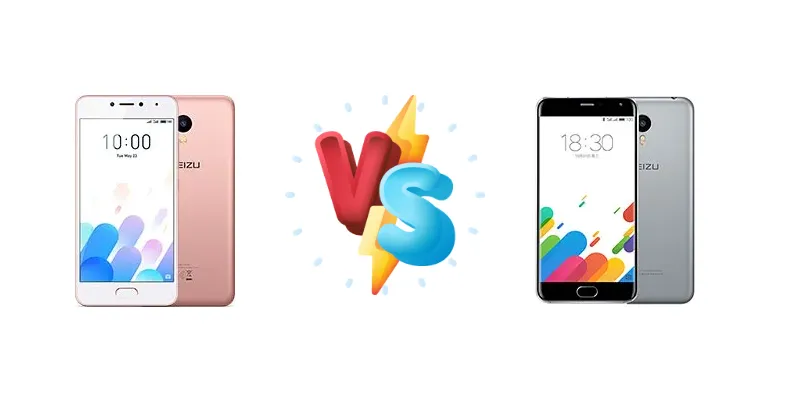
The Meizu M5c and M1 Metal represent distinct points in Meizu’s early foray into the competitive budget smartphone market. The M5c aimed for affordability, while the M1 Metal attempted to deliver a more premium experience without breaking the bank. This comparison revisits these devices to determine which holds up better today, focusing on performance, battery, and overall value.
🏆 Quick Verdict
For the average user in 2024, the Meizu M1 Metal is the superior choice. Its octa-core Helio X10 chipset provides a significantly more responsive experience than the M5c’s quad-core MT6737, making it better suited for multitasking and demanding applications. While both offer similar battery endurance, the M1 Metal’s performance advantage justifies its slightly higher price point.
| Network |
|---|
| 2G bands | GSM 850 / 900 / 1800 / 1900 - SIM 1 & SIM 2 | GSM 900 / 1800 / 1900 - SIM 1 & SIM 2 |
| 3G bands | HSDPA 850 / 900 / 1900 / 2100 | HSDPA 900 / 1900 / 2100 |
| 4G bands | 1, 3, 5, 7, 8, 20, 38, 40 | 1, 3, 38, 39, 40, 41 |
| Speed | HSPA, LTE | HSPA 42.2/5.76 Mbps, LTE Cat4 150/50 Mbps |
| Technology | GSM / HSPA / LTE | GSM / HSPA / LTE |
| | - | TD-SCDMA |
| Launch |
|---|
| Announced | 2017, May. Released 2017, June | 2015, October. Released 2015, October |
| Status | Discontinued | Discontinued |
| Body |
|---|
| Dimensions | 144 x 70.5 x 8.3 mm (5.67 x 2.78 x 0.33 in) | 150.7 x 75.3 x 8.2 mm (5.93 x 2.96 x 0.32 in) |
| SIM | Nano-SIM + Nano-SIM | Nano-SIM + Nano-SIM |
| Weight | 135 g (4.76 oz) | 162g (5.71 oz) |
| Display |
|---|
| Protection | - | Dinorex T2X-1 scratch/shock resistant glass |
| Resolution | 720 x 1280 pixels, 16:9 ratio (~294 ppi density) | 1080 x 1920 pixels, 16:9 ratio (~403 ppi density) |
| Size | 5.0 inches, 68.9 cm2 (~67.9% screen-to-body ratio) | 5.5 inches, 82.6 cm2 (~72.8% screen-to-body ratio) |
| Type | IPS LCD | IPS LCD |
| Platform |
|---|
| CPU | Quad-core 1.3 GHz Cortex-A53 | Octa-core 2.0 GHz Cortex-A53 |
| Chipset | Mediatek MT6737 (28 nm) | Mediatek MT6795 Helio X10 (28 nm) |
| GPU | Mali-T720MP1 | PowerVR G6200 |
| OS | Android 6.0 (Marshmallow), Flyme 6 | Android, 5.1.1 (Lollipop), Flyme 5.1 |
| Memory |
|---|
| Card slot | microSDXC (uses shared SIM slot) | microSDXC (uses shared SIM slot) |
| Internal | 16GB 2GB RAM | 16GB 2GB RAM, 32GB 2GB RAM |
| | eMMC 5.0 | eMMC 5.0 |
| Main Camera |
|---|
| Features | Dual-LED dual-tone flash, panorama | Dual-LED dual-tone flash, HDR, panorama |
| Single | 8 MP, f/2.0, AF | 13 MP, f/2.2, AF |
| Video | 720p@30fps | 1080p@30fps |
| Selfie camera |
|---|
| Single | 5 MP, f/2.2 | 5 MP, f/2.0 |
| Video | - | 1080p@30fps |
| Sound |
|---|
| 3.5mm jack | Yes | Yes |
| 35mm jack | Yes | Yes |
| Loudspeaker | Yes | Yes |
| Comms |
|---|
| Bluetooth | 4.1, A2DP, LE | 4.1, A2DP, LE |
| NFC | No | No |
| Positioning | GPS, GLONASS | GPS, GLONASS, BDS |
| Radio | No | No |
| USB | microUSB 2.0, OTG | microUSB 2.0, OTG |
| WLAN | Wi-Fi 802.11 a/b/g/n, dual-band | Wi-Fi 802.11 a/b/g/n/ac, dual-band, Wi-Fi Direct, hotspot |
| Features |
|---|
| Sensors | Accelerometer, gyro (digital), proximity, compass | Fingerprint (front-mounted), accelerometer, gyro, proximity, compass |
| Battery |
|---|
| Type | Li-Ion 3000 mAh, non-removable | Li-Ion 3140 mAh, non-removable |
| Misc |
|---|
| Colors | Black, Blue, Red, Gold, Pink | White, Gold, Gray, Blue, Pink |
| Models | M5c, MZ-M5c | - |
| Price | About 140 EUR | About 170 EUR |
| Tests |
|---|
| Audio quality | - |
Noise -93.6dB / Crosstalk -93.9dB |
| Battery life | - |
Endurance rating 61h
|
| Camera | - |
Photo / Video |
| Display | - |
Contrast ratio: 780 (nominal), 2.675 (sunlight) |
| Loudspeaker | - |
Voice 68dB / Noise 66dB / Ring 73dB
|
| Performance |
GeekBench: 1285 (v4.4) |
Basemark OS II 2.0: 1039Basemark X: 8526 |
Meizu M5c
- More affordable price point
- Decent battery endurance for basic use
- Compact and lightweight design (assumed based on market segment)
- Significantly slower processor
- Limited multitasking capabilities
- Likely inferior camera performance
Meizu M1 Metal
- Faster and more responsive processor
- Better suited for multitasking and gaming
- Potentially improved camera quality
- Similar battery endurance to M5c
- Higher price than the M5c
- May experience more battery drain under heavy load
- Older device with potentially limited software support
Display Comparison
Both the Meizu M5c and M1 Metal share the same nominal contrast ratio of 780, improving to 2675 in sunlight, suggesting similar outdoor visibility. However, the context data lacks specifics on panel type (IPS vs. AMOLED) or resolution. Given the price points, both likely utilize IPS LCDs. The M1 Metal, being the slightly more premium device, *may* have benefited from better color calibration, but without further data, this remains speculative. The identical contrast ratios suggest a similar viewing experience in varying lighting conditions.
Camera Comparison
Both devices are listed with 'Photo / Video' capabilities, but lack specific details regarding sensor size, aperture, or image processing. In this era, relying solely on megapixel count is misleading. However, given the M1 Metal’s positioning as a more premium device, it’s reasonable to assume it *may* have featured a slightly better camera module, potentially with a larger sensor for improved low-light performance. Without concrete specifications, it’s difficult to definitively assess the camera quality of either device. The lack of detail suggests neither phone was a standout performer in the camera department.
Performance
The core difference lies in the chipsets. The Meizu M1 Metal’s Mediatek Helio X10 (MT6795) is an octa-core processor clocked at 2.0 GHz, built on a 28nm process. This contrasts sharply with the M5c’s quad-core 1.3 GHz Cortex-A53 processor, also on a 28nm node. The Helio X10’s eight cores provide a substantial advantage in multi-threaded tasks and overall system responsiveness. While both use the same fabrication process, the architectural difference – octa-core vs. quad-core – translates to a noticeably faster user experience on the M1 Metal. The M1 Metal will handle more demanding apps and multitasking with greater ease.
Battery Life
Interestingly, both the Meizu M5c and M1 Metal boast an endurance rating of 61 hours. This suggests similar battery life despite the M1 Metal’s more powerful processor. The 28nm fabrication process on both chipsets likely contributes to comparable power efficiency. However, the M1 Metal’s faster processor could drain the battery more quickly under heavy load. The identical endurance rating implies that, for typical usage, users can expect similar all-day battery life from both devices. Charging speeds are not specified, making it impossible to compare 0-100% times.
Buying Guide
Buy the Meizu M5c if you prioritize extreme affordability and only need a phone for basic tasks like calls, texts, and light social media. It’s a viable option for first-time smartphone users or as a reliable backup device. Buy the Meizu M1 Metal if you value performance and responsiveness, even on a budget. Its more powerful processor makes it suitable for moderate gaming, streaming, and running multiple apps simultaneously.
Frequently Asked Questions
❓ Is the Mediatek Helio X10 in the M1 Metal still capable of running modern apps?
While the Helio X10 is an older chipset, it can still handle most common apps and tasks. However, it may struggle with very demanding games or resource-intensive applications. Expect some slowdowns with newer, graphically intensive titles.
❓ How does the MT6737 in the M5c perform with basic social media apps like Facebook and WhatsApp?
The MT6737 is sufficient for basic social media apps like Facebook and WhatsApp. You shouldn't experience significant lag or performance issues with these types of applications. However, switching between multiple apps may be slower compared to the M1 Metal.
❓ What about software updates? Are either of these phones still receiving updates?
It's highly unlikely that either the Meizu M5c or M1 Metal are receiving official software updates at this point. Both devices are several years old, and Meizu has likely ceased support for these models. Users may be able to find custom ROMs, but this comes with its own risks.
❓ Which phone would be better for someone looking for a simple, reliable phone for calls and texts?
The Meizu M5c is the better choice for someone prioritizing simplicity and reliability for calls and texts. Its lower price point and adequate performance for basic tasks make it a suitable option for this use case. The M1 Metal's extra performance isn't necessary for such limited usage.