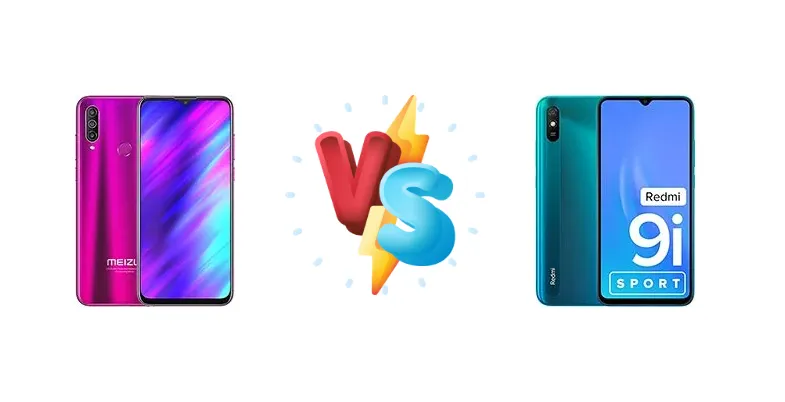
Both the Meizu M10 and Xiaomi Redmi 9i Sport occupy the fiercely competitive sub-$150 smartphone segment. While both aim to deliver essential functionality at an accessible price, they take different approaches to achieving this. The key differentiator lies in their chipsets, impacting performance and power efficiency. This comparison dives deep into these differences to help you choose the right device.
🏆 Quick Verdict
For the average user prioritizing battery life and sustained performance, the Xiaomi Redmi 9i Sport is the better choice. Its newer 12nm Helio G25 chipset offers improved efficiency over the Meizu M10’s older 16nm Helio P25, translating to longer usage times and potentially less thermal throttling during extended tasks.
| Network |
|---|
| 2G bands | GSM 850 / 900 / 1800 / 1900 | GSM 850 / 900 / 1800 / 1900 |
| 3G bands | HSDPA 850 / 900 / 1900 / 2100 - Global | HSDPA 850 / 900 / 2100 |
| 4G bands | 1, 2, 3, 5, 7, 8, 20, 40 - Global | 1, 3, 5, 8, 40, 41 |
| Speed | HSPA, LTE | HSPA, LTE |
| Technology | GSM / CDMA / HSPA / LTE | GSM / HSPA / LTE |
| | 1, 2, 3, 4, 5, 7, 8, 28, 40 - LATAM | - |
| Launch |
|---|
| Announced | 2019, September. Released 2019, October | 2021, September 28 |
| Status | Discontinued | Available. Released 2021, September 28 |
| Body |
|---|
| Dimensions | 164.9 x 76.3 x 8.5 mm (6.49 x 3.00 x 0.33 in) | 164.9 x 77.1 x 9 mm (6.49 x 3.04 x 0.35 in) |
| SIM | Nano-SIM + Nano-SIM | Nano-SIM + Nano-SIM |
| Weight | 184 g (6.49 oz) | 194 g (6.84 oz) |
| | - | Water-repellent coating |
| Display |
|---|
| Resolution | 720 x 1600 pixels, 20:9 ratio (~270 ppi density) | 720 x 1600 pixels, 20:9 ratio (~269 ppi density) |
| Size | 6.5 inches, 102.0 cm2 (~81.1% screen-to-body ratio) | 6.53 inches, 102.9 cm2 (~81.0% screen-to-body ratio) |
| Type | IPS LCD, 450 nits (typ) | IPS LCD, 400 nits (typ) |
| Platform |
|---|
| CPU | Octa-core (4x2.5 GHz Cortex-A53 & 4x1.6 GHz Cortex-A53) | Octa-core (4x2.0 GHz Cortex-A53 & 4x1.5 GHz Cortex-A53) |
| Chipset | Mediatek MT6757T Helio P25 (16 nm) | Mediatek MT6762G Helio G25 (12 nm) |
| GPU | Mali-T880MP2 | PowerVR GE8320 |
| OS | Android 9.0 (Pie), Flyme 8 | Android 10, MIUI 12 |
| Memory |
|---|
| Card slot | No | microSDXC (dedicated slot) |
| Internal | 32GB 2GB RAM, 32GB 3GB RAM | 64GB 4GB RAM, 128GB 4GB RAM |
| | - | eMMC 5.1 |
| Main Camera |
|---|
| Features | LED flash, HDR, panorama | LED flash, HDR |
| Single | - | 13 MP, f/2.2, 28mm (wide), 1.0µm, PDAF |
| Triple | 13 MP, f/2.0, (wide), PDAF
2 MP, f/2.2
2 MP, f/2.2 | - |
| Video | 1080p@30fps | 1080p@30fps |
| Selfie camera |
|---|
| Features | HDR | HDR |
| Single | 8 MP, f/2.0 | 5 MP, f/2.2, (wide), 1.12µm |
| Video | 1080p@30fps | 1080p@30fps |
| Sound |
|---|
| 3.5mm jack | Yes | Yes |
| 35mm jack | Yes | Yes |
| Loudspeaker | Yes | Yes |
| Comms |
|---|
| Bluetooth | 4.2, A2DP, LE | 5.0, A2DP, LE |
| NFC | No | No |
| Positioning | GPS, GLONASS, BDS | GPS, GLONASS, BDS |
| Radio | No | FM radio |
| USB | microUSB 2.0 | microUSB 2.0, OTG |
| WLAN | Wi-Fi 802.11 b/g/n | Wi-Fi 802.11 а/b/g/n, Wi-Fi Direct |
| Features |
|---|
| Sensors | Fingerprint (rear-mounted), accelerometer, proximity, compass | Accelerometer, proximity, compass |
| Battery |
|---|
| Charging | - | 10W wired |
| Type | Li-Po 4000 mAh, non-removable | Li-Po 5000 mAh |
| Misc |
|---|
| Colors | Phantom Black, Purplish Red, Sea Blue | Carbon Black, Coral Green, Metallic Blue |
| Price | About 180 EUR | About 100 EUR |
Meizu M10
- Potentially higher peak CPU clock speed for short bursts.
- May be available at a slightly lower price point.
- Meizu's Flyme OS offers a unique software experience (preference-based).
- Less efficient 16nm chipset leads to shorter battery life.
- Potential for more thermal throttling under sustained load.
- Charging specifications are unknown, potentially slower.
Xiaomi Redmi 9i Sport
- More efficient 12nm Helio G25 chipset for longer battery life.
- 10W wired charging for convenient top-ups.
- Optimized for gaming with the 'G' series chipset.
- Slightly lower peak CPU clock speed.
- Xiaomi's MIUI can be resource-intensive.
- Build quality may be similar to other budget Xiaomi devices.
Display Comparison
Neither device boasts a standout display. Both are likely to feature 720p+ LCD panels, typical for this price bracket. However, details like peak brightness and color gamut coverage are unavailable. The focus here is on functionality over fidelity. Bezels are expected to be noticeable on both, as maximizing screen real estate isn't a priority at this price point.
Camera Comparison
Camera performance is likely to be similar on both devices, relying on budget sensors and image processing. Details on sensor sizes and apertures are missing, but it’s safe to assume both will feature a primary camera and potentially depth/macro sensors of limited utility. Image quality will be acceptable in good lighting conditions, but expect struggles in low-light scenarios. The focus should be on capturing memories, not professional-grade photography.
Performance
The core difference lies in the chipsets. The Meizu M10’s MediaTek Helio P25 (MT6757T) is built on a 16nm process, while the Redmi 9i Sport utilizes the Helio G25 (MT6762G) fabricated on a more efficient 12nm node. While the P25 has a higher peak CPU clock speed (2.5 GHz vs 2.0 GHz), the G25’s process node and architectural refinements likely result in better sustained performance and thermal management. Both CPUs feature the same Cortex-A53 cores, but the G25’s efficiency gains are crucial for everyday tasks and light gaming. The G25 is designed for gaming, hence the 'G' designation, suggesting a slight GPU advantage, though both GPUs are entry-level.
Battery Life
Battery capacity details are missing for both devices. However, the Redmi 9i Sport’s 12nm Helio G25 chipset provides a significant advantage in power efficiency. This translates to longer battery life on a single charge, even with a similar capacity battery to the Meizu M10. The Redmi 9i Sport also includes 10W wired charging, a convenience the Meizu M10 may lack, or offer at a slower rate. This difference in charging speed impacts usability, especially for users who need to quickly top up their device.
Buying Guide
Buy the Meizu M10 if you prioritize a slightly higher peak CPU clock speed and are comfortable managing battery life more carefully. It might offer a marginal performance boost in short bursts. Buy the Xiaomi Redmi 9i Sport if you value all-day battery life, consistent performance, and the convenience of 10W charging, making it ideal for users who rely heavily on their phone throughout the day.
Frequently Asked Questions
❓ Will the Redmi 9i Sport handle popular games like PUBG Mobile or Call of Duty?
The Helio G25 in the Redmi 9i Sport is designed for entry-level gaming. While it can run PUBG Mobile and Call of Duty, expect to play at lower graphics settings and frame rates to maintain a smooth experience. The Meizu M10 will likely offer similar performance, but may experience more thermal throttling during extended gaming sessions.
❓ Does the Meizu M10 support fast charging, and how long does it take to fully charge?
Charging specifications for the Meizu M10 are not readily available. It's likely to support standard 5W or 10W charging. Without specific details, estimating the full charge time is difficult, but expect it to take several hours. The Redmi 9i Sport's 10W charging is a clear advantage in this regard.
❓ Which phone is better for watching videos and browsing the web?
Both phones are adequate for basic video streaming and web browsing. However, the Redmi 9i Sport’s more efficient chipset will provide a smoother experience during prolonged use, minimizing lag and stuttering. The battery life advantage also means you can enjoy content for longer without needing to recharge.