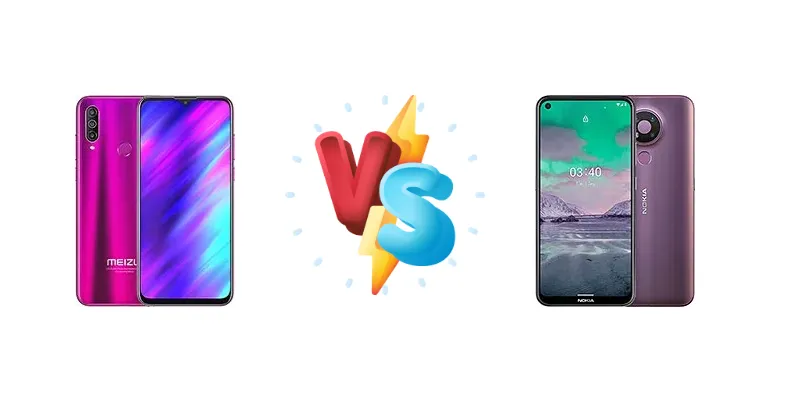
The Meizu M10 and Nokia 3.4 represent two distinct approaches to the budget smartphone market. The M10, leveraging Mediatek's Helio P25, aims for raw processing power within a constrained budget. Conversely, the Nokia 3.4 utilizes Qualcomm's Snapdragon 460, prioritizing efficiency and a more modern architecture. This comparison dissects their key differences to help you determine which device best suits your needs.
🏆 Quick Verdict
For the average user prioritizing long-term software support and a more efficient processor, the Nokia 3.4 is the better choice. While the Meizu M10's Helio P25 offers a theoretical CPU clock speed advantage, the Snapdragon 460's newer architecture and 11nm process deliver a smoother, more consistent experience, especially in sustained tasks.
| Network |
|---|
| 2G bands | GSM 850 / 900 / 1800 / 1900 | GSM 850 / 900 / 1800 / 1900 |
| 3G bands | HSDPA 850 / 900 / 1900 / 2100 - Global | HSDPA 850 / 900 / 1700(AWS) / 1900 / 2100 |
| 4G bands | 1, 2, 3, 5, 7, 8, 20, 40 - Global | 1, 2, 3, 4, 5, 7, 8, 12, 17, 13, 28, 66 |
| Speed | HSPA, LTE | HSPA, LTE |
| Technology | GSM / CDMA / HSPA / LTE | GSM / HSPA / LTE |
| | 1, 2, 3, 4, 5, 7, 8, 28, 40 - LATAM | - |
| Launch |
|---|
| Announced | 2019, September. Released 2019, October | 2020, September 22. Released 2020, October 26 |
| Status | Discontinued | Discontinued |
| Body |
|---|
| Dimensions | 164.9 x 76.3 x 8.5 mm (6.49 x 3.00 x 0.33 in) | 161 x 76 x 8.7 mm (6.34 x 2.99 x 0.34 in) |
| SIM | Nano-SIM + Nano-SIM | · Nano-SIM· Nano-SIM + Nano-SIM |
| Weight | 184 g (6.49 oz) | 180 g (6.35 oz) |
| Display |
|---|
| Resolution | 720 x 1600 pixels, 20:9 ratio (~270 ppi density) | 720 x 1560 pixels, 19.5:9 ratio (~269 ppi density) |
| Size | 6.5 inches, 102.0 cm2 (~81.1% screen-to-body ratio) | 6.39 inches, 100.2 cm2 (~81.9% screen-to-body ratio) |
| Type | IPS LCD, 450 nits (typ) | IPS LCD, 400 nits (typ) |
| Platform |
|---|
| CPU | Octa-core (4x2.5 GHz Cortex-A53 & 4x1.6 GHz Cortex-A53) | Octa-core (4x1.8 GHz Cortex-A73 & 4x1.8 GHz Cortex-A53) |
| Chipset | Mediatek MT6757T Helio P25 (16 nm) | Qualcomm SM4250 Snapdragon 460 (11 nm) |
| GPU | Mali-T880MP2 | Adreno 610 |
| OS | Android 9.0 (Pie), Flyme 8 | Android 10, upgradable to Android 11 |
| Memory |
|---|
| Card slot | No | microSDXC (dedicated slot) |
| Internal | 32GB 2GB RAM, 32GB 3GB RAM | 32GB 3GB RAM, 64GB 3GB RAM, 64GB 4GB RAM |
| | - | eMMC 5.1 |
| Main Camera |
|---|
| Features | LED flash, HDR, panorama | LED flash, HDR, panorama |
| Triple | 13 MP, f/2.0, (wide), PDAF
2 MP, f/2.2
2 MP, f/2.2 | 13 MP, (wide), PDAF
5 MP, (ultrawide)
Auxiliary lens |
| Video | 1080p@30fps | 1080p@30fps |
| Selfie camera |
|---|
| Features | HDR | - |
| Single | 8 MP, f/2.0 | 8 MP, (wide) |
| Video | 1080p@30fps | 1080p@30fps |
| Sound |
|---|
| 3.5mm jack | Yes | Yes |
| 35mm jack | Yes | Yes |
| Loudspeaker | Yes | Yes |
| Comms |
|---|
| Bluetooth | 4.2, A2DP, LE | 4.2, A2DP, aptX |
| NFC | No | Yes (market/region dependent) |
| Positioning | GPS, GLONASS, BDS | GPS, GLONASS, GALILEO, BDS |
| Radio | No | FM radio |
| USB | microUSB 2.0 | USB Type-C 2.0 |
| WLAN | Wi-Fi 802.11 b/g/n | Wi-Fi 802.11 b/g/n |
| Features |
|---|
| Sensors | Fingerprint (rear-mounted), accelerometer, proximity, compass | Fingerprint (rear-mounted), accelerometer, gyro, proximity |
| Battery |
|---|
| Charging | - | 10W wired |
| Type | Li-Po 4000 mAh, non-removable | Li-Po 4000 mAh |
| Misc |
|---|
| Colors | Phantom Black, Purplish Red, Sea Blue | Fjord, Dusk, Charcoal |
| Models | - | TA-1288, TA-1285, TA-1283 |
| Price | About 180 EUR | About 100 EUR |
| SAR | - | 0.83 W/kg (head) 1.05 W/kg (body) |
| SAR EU | - | 0.36 W/kg (head) 1.56 W/kg (body) |
Meizu M10
- Potentially higher peak CPU performance due to 2.5GHz cores.
- May offer a lower price point.
- Simple and straightforward Android experience (depending on the UI).
- Older, less efficient 16nm process.
- Helio P25 prone to thermal throttling.
- Likely limited software update support.
Nokia 3.4
- More efficient Snapdragon 460 processor.
- Guaranteed software updates from Nokia.
- Modern CPU architecture with Cortex-A73 cores.
- Slower CPU clock speeds compared to the Meizu M10.
- 10W charging is relatively slow.
- May be slightly more expensive.
Display Comparison
Neither device boasts a standout display. Specifications are unavailable for the Meizu M10's display, but given its price point, it likely utilizes an IPS LCD panel with a 720p resolution. The Nokia 3.4 also features an IPS LCD, but its focus is on a larger 6.39-inch size. The absence of high refresh rates or advanced panel technologies like LTPO on either device means display quality will be a secondary consideration for buyers.
Camera Comparison
Camera performance is likely to be similar on both devices, leaning towards basic functionality. Details on the Meizu M10's camera are scarce, but budget phones often prioritize megapixel count over sensor size and image processing. The Nokia 3.4's camera setup is also entry-level. Without specific sensor size information, it's difficult to definitively declare a winner, but Qualcomm's image signal processor (ISP) within the Snapdragon 460 generally provides better image processing capabilities than Mediatek's equivalent in the Helio P25, potentially leading to slightly more detailed and vibrant photos.
Performance
The core difference lies in the chipsets. The Meizu M10's Mediatek Helio P25 (16nm) features an octa-core CPU split into a cluster of four Cortex-A53 cores clocked at 2.5GHz and another four at 1.6GHz. The Nokia 3.4's Qualcomm Snapdragon 460 (11nm) employs a more modern architecture with four Cortex-A73 cores at 1.8GHz paired with four Cortex-A53 cores also at 1.8GHz. While the P25 boasts higher clock speeds, the Snapdragon 460's newer architecture and smaller 11nm process node translate to better power efficiency and sustained performance. The A73 cores in the Snapdragon 460 offer a significant IPC (Instructions Per Clock) advantage over the A53 cores dominating the Helio P25, resulting in snappier app launches and smoother multitasking. The 11nm process also means less heat generation, reducing the likelihood of thermal throttling during prolonged use.
Battery Life
Battery life will depend heavily on usage patterns. The Nokia 3.4 includes 10W wired charging, a relatively slow standard. The Meizu M10's charging speed is unknown, but likely similar. The Snapdragon 460's superior power efficiency will likely translate to longer battery life on the Nokia 3.4, even if the M10 has a slightly larger battery capacity (specifications unavailable). The 11nm process node plays a crucial role in minimizing power consumption during both active use and standby.
Buying Guide
Buy the Meizu M10 if you prioritize maximizing CPU performance on a tight budget and are comfortable with a potentially less refined software experience. This phone is best for users who frequently run single-threaded applications or older games. Buy the Nokia 3.4 if you value a more modern, efficient processor, guaranteed software updates from Nokia, and a generally smoother user experience, even if it means sacrificing some peak CPU clock speed.
Frequently Asked Questions
❓ Will the Meizu M10 struggle with demanding apps like Facebook or YouTube?
The Helio P25 in the Meizu M10 can handle basic apps like Facebook and YouTube, but you may experience occasional lag or stuttering, especially when multitasking. The Snapdragon 460 in the Nokia 3.4 will provide a smoother experience with these apps due to its more efficient architecture.
❓ How long will the Nokia 3.4 receive Android updates?
Nokia is known for its commitment to software updates. The Nokia 3.4 is guaranteed to receive at least two major Android version updates and three years of security patches, ensuring your phone remains secure and up-to-date for a longer period.
❓ Is the Snapdragon 460 capable of playing modern mobile games?
The Snapdragon 460 can play many popular mobile games, but you'll likely need to lower the graphics settings to achieve a playable frame rate. Demanding titles may experience noticeable lag or stuttering. The Helio P25 might offer slightly higher frame rates in some games due to its higher clock speed, but the Snapdragon 460's stability will be superior.