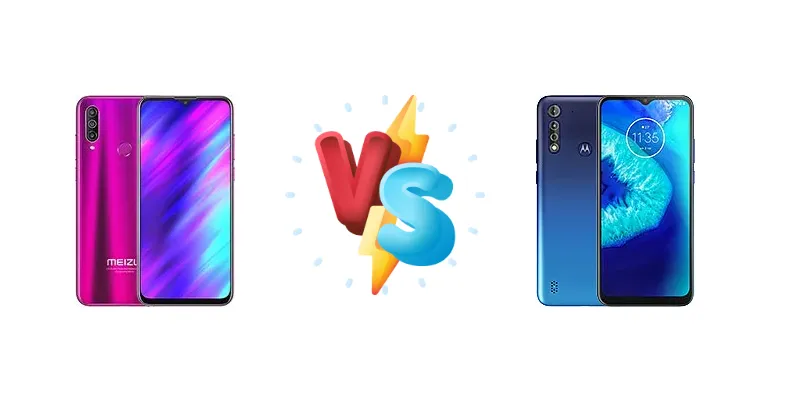
The Meizu M10 and Motorola Moto G8 Power Lite represent two approaches to the ultra-budget smartphone market. The M10, with its older but potentially more powerful Helio P25, aims for a performance edge, while the G8 Power Lite prioritizes longevity with its more efficient Helio P35 and larger battery capacity. This comparison dissects their key differences to determine which device delivers the best value.
🏆 Quick Verdict
For the average user prioritizing all-day battery life and consistent, if not blazing-fast, performance, the Motorola Moto G8 Power Lite is the better choice. Its more efficient Helio P35 chipset and 10W charging offer a more reliable experience, despite the Meizu M10's theoretically faster CPU cores.
| Network |
|---|
| 2G bands | GSM 850 / 900 / 1800 / 1900 | GSM 850 / 900 / 1800 / 1900 |
| 3G bands | HSDPA 850 / 900 / 1900 / 2100 - Global | HSDPA 850 / 900 / 1900 / 2100 |
| 4G bands | 1, 2, 3, 5, 7, 8, 20, 40 - Global | LTE |
| Speed | HSPA, LTE | HSPA, LTE |
| Technology | GSM / CDMA / HSPA / LTE | GSM / HSPA / LTE |
| | 1, 2, 3, 4, 5, 7, 8, 28, 40 - LATAM | - |
| Launch |
|---|
| Announced | 2019, September. Released 2019, October | 2020, April 03. Released 2020, April 03 |
| Status | Discontinued | Discontinued |
| Body |
|---|
| Build | - | Glass front, plastic back, plastic frame |
| Dimensions | 164.9 x 76.3 x 8.5 mm (6.49 x 3.00 x 0.33 in) | 164.9 x 75.8 x 9.2 mm (6.49 x 2.98 x 0.36 in) |
| SIM | Nano-SIM + Nano-SIM | · Nano-SIM· Nano-SIM + Nano-SIM |
| Weight | 184 g (6.49 oz) | 200 g (7.05 oz) |
| | - | Water-repellent coating |
| Display |
|---|
| Resolution | 720 x 1600 pixels, 20:9 ratio (~270 ppi density) | 720 x 1600 pixels, 20:9 ratio (~269 ppi density) |
| Size | 6.5 inches, 102.0 cm2 (~81.1% screen-to-body ratio) | 6.5 inches, 102.8 cm2 (~82.2% screen-to-body ratio) |
| Type | IPS LCD, 450 nits (typ) | IPS LCD |
| Platform |
|---|
| CPU | Octa-core (4x2.5 GHz Cortex-A53 & 4x1.6 GHz Cortex-A53) | Octa-core (4x2.3 GHz Cortex-A53 & 4x1.8 GHz Cortex-A53) |
| Chipset | Mediatek MT6757T Helio P25 (16 nm) | Mediatek MT6765 Helio P35 (12 nm) |
| GPU | Mali-T880MP2 | PowerVR GE8320 |
| OS | Android 9.0 (Pie), Flyme 8 | Android 9.0 (Pie) |
| Memory |
|---|
| Card slot | No | microSDXC (dedicated slot) |
| Internal | 32GB 2GB RAM, 32GB 3GB RAM | 64GB 4GB RAM |
| | - | eMMC 5.1 |
| Main Camera |
|---|
| Features | LED flash, HDR, panorama | LED flash, HDR, panorama |
| Triple | 13 MP, f/2.0, (wide), PDAF
2 MP, f/2.2
2 MP, f/2.2 | 16 MP, f/2.0, (wide), 1.0µm, PDAF
2 MP (macro)
Auxiliary lens |
| Video | 1080p@30fps | 1080p@30fps |
| Selfie camera |
|---|
| Features | HDR | HDR |
| Single | 8 MP, f/2.0 | 8 MP, f/2.0, (wide), 1.12µm |
| Video | 1080p@30fps | 1080p@30fps |
| Sound |
|---|
| 3.5mm jack | Yes | Yes |
| 35mm jack | Yes | Yes |
| Loudspeaker | Yes | Yes |
| Comms |
|---|
| Bluetooth | 4.2, A2DP, LE | 4.2, A2DP, LE |
| NFC | No | No |
| Positioning | GPS, GLONASS, BDS | GPS, GLONASS, GALILEO |
| Radio | No | FM radio |
| USB | microUSB 2.0 | microUSB 2.0 |
| WLAN | Wi-Fi 802.11 b/g/n | Wi-Fi 802.11 b/g/n, Wi-Fi Direct |
| Features |
|---|
| Sensors | Fingerprint (rear-mounted), accelerometer, proximity, compass | Fingerprint (rear-mounted), accelerometer, gyro, proximity |
| Battery |
|---|
| Charging | - | 10W wired |
| Type | Li-Po 4000 mAh, non-removable | Li-Po 5000 mAh |
| Misc |
|---|
| Colors | Phantom Black, Purplish Red, Sea Blue | Arctic Blue, Royal Blue |
| Models | - | XT2055-2 |
| Price | About 180 EUR | About 160 EUR |
Meizu M10
- Potentially faster CPU clock speeds for burst performance.
- Meizu’s Flyme OS may offer unique software features.
- Potentially more versatile camera setup (depending on sensor configuration).
- Less power-efficient chipset (Helio P25).
- Likely shorter battery life.
- Potential for thermal throttling under sustained load.
Motorola Moto G8 Power Lite
- More power-efficient chipset (Helio P35).
- Longer battery life.
- More consistent performance due to better thermal management.
- Slightly slower CPU clock speeds.
- Motorola’s near-stock Android may lack advanced features.
- 10W charging is relatively slow.
Display Comparison
Neither device boasts a standout display. Both likely feature LCD panels, typical for this price bracket. The key difference lies under the hood: display driver efficiency. While specific display specs are unavailable, the G8 Power Lite’s more modern Helio P35 likely incorporates improved display power management, potentially leading to slightly better battery life during video playback or prolonged screen-on time. Bezels are expected to be substantial on both devices, reflecting their budget positioning.
Camera Comparison
Camera performance is likely to be similar on both devices, with both relying on budget sensors and image processing. Without specific sensor details, it’s difficult to make a definitive judgment. However, the G8 Power Lite’s more efficient chipset could allow for slightly better image processing speeds. Both devices likely include a primary camera and depth sensor, with the M10 potentially offering a slightly more versatile camera setup based on Meizu’s historical focus on camera features. Expect limited low-light performance from both.
Performance
The Meizu M10’s Mediatek MT6757T Helio P25 (16nm) features an octa-core CPU with a split configuration: four cores clocked at 2.5 GHz and four at 1.6 GHz. The Motorola Moto G8 Power Lite utilizes the Mediatek MT6765 Helio P35 (12nm) with a more uniform octa-core setup at 2.3 GHz and 1.8 GHz. Despite the M10’s higher peak clock speeds, the P35’s smaller 12nm process node offers superior power efficiency. This translates to less heat generation and potentially more sustained performance under load. The P35’s architecture is also more refined, meaning it can achieve more work per clock cycle. While the M10 might show a slight edge in benchmark scores, the G8 Power Lite will likely provide a smoother, more consistent user experience in everyday tasks.
Battery Life
The Motorola Moto G8 Power Lite’s strength lies in its battery optimization. While the exact battery capacity isn’t specified, the Helio P35’s 12nm process and efficient power management will significantly extend battery life compared to the M10’s Helio P25. The inclusion of 10W wired charging on the G8 Power Lite, while slow by modern standards, provides a reliable and consistent charging experience. The M10’s charging speed is unknown, but likely similar. The G8 Power Lite is designed for users who prioritize minimizing charging frequency.
Buying Guide
Buy the Meizu M10 if you need a phone capable of handling moderately demanding tasks and occasional gaming, and are willing to accept potentially shorter battery life. It's suited for users who prioritize responsiveness over endurance. Buy the Motorola Moto G8 Power Lite if you prioritize battery life above all else, and need a phone that can reliably last a full day (or more) on a single charge, even with moderate usage. This is the phone for users who don't want to worry about constantly reaching for a charger.
Frequently Asked Questions
❓ Will the Meizu M10 struggle with multitasking compared to the Moto G8 Power Lite?
While the M10's CPU has higher peak clock speeds, the Moto G8 Power Lite's Helio P35 is more efficient and less prone to throttling. This means the G8 Power Lite will likely handle sustained multitasking – switching between apps frequently – more smoothly than the M10, which may experience slowdowns under heavy load.
❓ Is the 10W charging on the Moto G8 Power Lite painfully slow in 2024?
Yes, 10W charging is slow compared to modern standards. However, the G8 Power Lite's excellent battery life mitigates this issue. You won't need to charge it as frequently, making the slower charging speed less of a concern. It's a trade-off for prioritizing battery longevity.
❓ Can either of these phones handle popular mobile games like PUBG Mobile or Call of Duty Mobile?
Both phones can *run* these games, but don't expect high frame rates or graphics settings. The Helio P35 in the Moto G8 Power Lite will likely provide a slightly more stable experience due to better thermal management, preventing significant frame drops during extended gaming sessions. Lowering graphics settings is recommended on both devices.