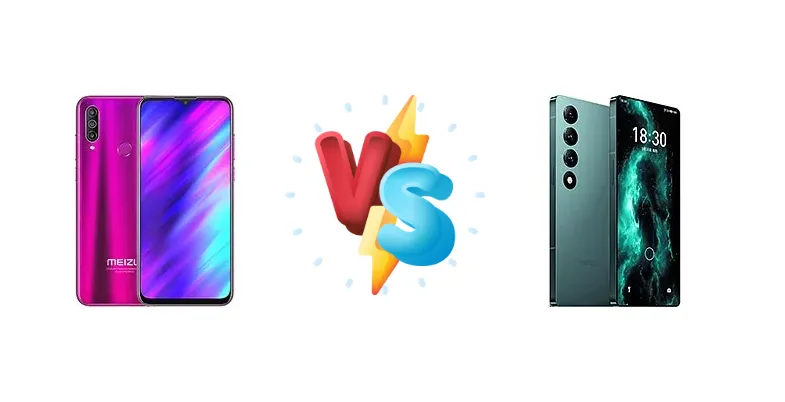
Meizu has a history of producing stylish and feature-rich phones. The Meizu M10 represents an older, budget-friendly option, while the Meizu 20 Infinity is a flagship powerhouse. Let's dive into a detailed comparison to see which device offers the best value and performance.
🏆 Quick Verdict
The Meizu 20 Infinity utterly dominates the Meizu M10. Its Snapdragon 8 Gen 2 chipset, superior display, advanced camera system, and faster charging make it a clear winner for users prioritizing performance and premium features, despite the higher price.
| Network |
|---|
| 2G bands | GSM 850 / 900 / 1800 / 1900 | GSM 850 / 900 / 1800 / 1900 |
| 3G bands | HSDPA 850 / 900 / 1900 / 2100 - Global | HSDPA 850 / 900 / 1700(AWS) / 1900 / 2100 |
| 4G bands | 1, 2, 3, 5, 7, 8, 20, 40 - Global | 1, 2, 3, 4, 5, 7, 8, 12, 13, 17, 18, 19, 20, 26, 34, 38, 39, 40, 41, 42 |
| 5G bands | - | 1, 3, 5, 7, 8, 28, 38, 40, 41, 66, 77, 78, 79 SA/NSA |
| Speed | HSPA, LTE | HSPA, LTE, 5G |
| Technology | GSM / CDMA / HSPA / LTE | GSM / HSPA / LTE / 5G |
| | 1, 2, 3, 4, 5, 7, 8, 28, 40 - LATAM | - |
| Launch |
|---|
| Announced | 2019, September. Released 2019, October | 2023, March 30 |
| Status | Discontinued | Available. Released 2023, June 12 |
| Body |
|---|
| Dimensions | 164.9 x 76.3 x 8.5 mm (6.49 x 3.00 x 0.33 in) | 163.4 x 73.3 x 8.2 mm (6.43 x 2.89 x 0.32 in) |
| SIM | Nano-SIM + Nano-SIM | Nano-SIM + Nano-SIM |
| Weight | 184 g (6.49 oz) | 215 g (7.58 oz) |
| Display |
|---|
| Resolution | 720 x 1600 pixels, 20:9 ratio (~270 ppi density) | 1368 x 3192 pixels, 21:9 ratio (~511 ppi density) |
| Size | 6.5 inches, 102.0 cm2 (~81.1% screen-to-body ratio) | 6.79 inches, 107.7 cm2 (~89.9% screen-to-body ratio) |
| Type | IPS LCD, 450 nits (typ) | LTPO OLED, 1B colors, 120Hz, 600 nits (typ), 1800 nits (peak) |
| Platform |
|---|
| CPU | Octa-core (4x2.5 GHz Cortex-A53 & 4x1.6 GHz Cortex-A53) | Octa-core (1x3.2 GHz Cortex-X3 & 2x2.8 GHz Cortex-A715 & 2x2.8 GHz Cortex-A710 & 3x2.0 GHz Cortex-A510) |
| Chipset | Mediatek MT6757T Helio P25 (16 nm) | Qualcomm SM8550-AB Snapdragon 8 Gen 2 (4 nm) |
| GPU | Mali-T880MP2 | Adreno 740 |
| OS | Android 9.0 (Pie), Flyme 8 | Android 13, Flyme 10 |
| Memory |
|---|
| Card slot | No | No |
| Internal | 32GB 2GB RAM, 32GB 3GB RAM | 256GB 12GB RAM, 512GB 12GB RAM, 1TB 16GB RAM |
| | - | UFS 4.0 |
| Main Camera |
|---|
| Features | LED flash, HDR, panorama | LED flash, panorama, HDR |
| Triple | 13 MP, f/2.0, (wide), PDAF
2 MP, f/2.2
2 MP, f/2.2 | 50 MP, f/1.8, 23mm (wide), 1/1.56", PDAF, OIS
12 MP f/2.0, 50mm (telephoto), 1/2.9", PDAF, OIS, optical zoom
12 MP, f/2.2, 13mm, 122˚ (ultrawide), 1/2.55" |
| Video | 1080p@30fps | 8K, 4K, 1080p; gyro-EIS |
| Selfie camera |
|---|
| Features | HDR | HDR |
| Single | 8 MP, f/2.0 | 32 MP, f/2.4, (wide) |
| Video | 1080p@30fps | Yes |
| Sound |
|---|
| 3.5mm jack | Yes | No |
| 35mm jack | Yes | No |
| Loudspeaker | Yes | Yes, with stereo speakers |
| Comms |
|---|
| Bluetooth | 4.2, A2DP, LE | 5.3, A2DP, LE |
| NFC | No | Yes |
| Positioning | GPS, GLONASS, BDS | GPS (L1+L5), GLONASS, BDS, GALILEO |
| Radio | No | No |
| USB | microUSB 2.0 | USB Type-C |
| WLAN | Wi-Fi 802.11 b/g/n | Wi-Fi 802.11 а/b/g/n/ac/6e/7, tri-band |
| Features |
|---|
| Sensors | Fingerprint (rear-mounted), accelerometer, proximity, compass | Fingerprint (under display, optical), accelerometer, gyro, proximity, compass, barometer |
| | - | Ultra Wideband (UWB) support |
| Battery |
|---|
| Charging | - | 65W wired, PD PPS, QC4
50W wireless |
| Type | Li-Po 4000 mAh, non-removable | Li-Po 4800 mAh |
| Misc |
|---|
| Colors | Phantom Black, Purplish Red, Sea Blue | Gray, Green, Silver |
| Price | About 180 EUR | About 820 EUR |
Meizu M10
- Affordable
- Decent battery life (likely)
- Compact size (potentially)
- Outdated chipset
- Low performance
- Basic camera
- Lower quality display
Meizu 20 Infinity
- Flagship performance
- Stunning display
- Advanced camera system
- Fast charging
- Premium design
- Expensive
- Potentially large size
- Wireless charging may be a battery drain
Display Comparison
The Meizu 20 Infinity boasts a significantly superior display. Expect a vibrant AMOLED panel with a high refresh rate (likely 120Hz or higher, based on flagship standards) and excellent color accuracy, compared to the M10's likely LCD panel with standard refresh rate. The Infinity's display will offer a smoother, more immersive viewing experience.
Camera Comparison
The Meizu 20 Infinity's camera system is expected to be far more advanced, likely featuring a high-resolution main sensor, ultrawide lens, and potentially telephoto lens. Expect better image quality, dynamic range, and low-light performance. The M10's camera is adequate for basic photography but lacks the features and image quality of the Infinity.
Performance
The performance gap is massive. The Snapdragon 8 Gen 2 in the Meizu 20 Infinity is a flagship-level chipset, offering blazing-fast speeds and exceptional efficiency. The M10's Helio P25 is a mid-range chip from a few years ago, struggling to keep up with modern apps and games. Expect significant lag and stuttering on the M10.
Battery Life
While both phones likely have decent battery capacities, the Meizu 20 Infinity's 65W wired and 50W wireless charging provides a significant advantage. It can be charged much faster than the M10, which likely supports slower charging speeds.
Buying Guide
The Meizu M10 is a good choice for budget-conscious users who need a basic smartphone for everyday tasks like calls, texts, and light browsing. The Meizu 20 Infinity is ideal for power users, gamers, and anyone who demands top-tier performance, a stunning display, and a versatile camera system.
Frequently Asked Questions
❓ Is the Meizu 20 Infinity worth the price?
If you prioritize performance, a great display, and a good camera, the Meizu 20 Infinity is worth the investment. However, it's a premium device with a premium price tag.
❓ Can the Meizu M10 handle everyday tasks?
Yes, the Meizu M10 can handle basic tasks like calls, texts, and browsing. However, it may struggle with more demanding apps or multitasking.