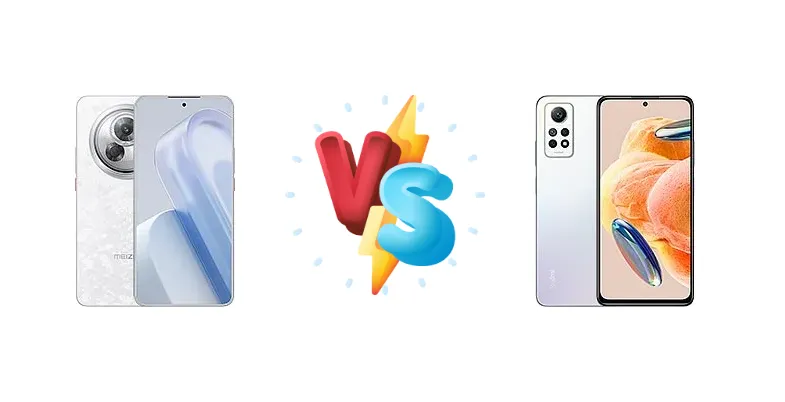
The Meizu Lucky 08 and Xiaomi Redmi Note 12 Pro 4G represent compelling options in the increasingly competitive mid-range 4G smartphone market. While both aim to deliver a solid experience without 5G, they take different approaches to achieving that goal, primarily through their chipset choices. This comparison dives deep into the specifics to determine which device offers the best value for your money.
🏆 Quick Verdict
For most users, the Meizu Lucky 08 emerges as the stronger contender. Its newer Snapdragon 7s Gen 2 chipset, built on a more efficient 4nm process, provides a noticeable performance advantage and better thermal management. While the Redmi Note 12 Pro 4G counters with faster 67W charging, the overall package of the Lucky 08 is more compelling.
| Network |
|---|
| 2G bands | GSM 850 / 900 / 1800 / 1900 | GSM 850 / 900 / 1800 / 1900 |
| 3G bands | HSDPA 850 / 900 / 2100 | HSDPA 850 / 900 / 1700(AWS) / 1900 / 2100 |
| 4G bands | 1, 3, 5, 8, 28, 34, 38, 39, 40, 41 | 1, 2, 3, 4, 5, 7, 8, 20, 28, 38, 40, 41, 66 |
| 5G bands | 1, 3, 5, 8, 28, 38, 40, 41, 77, 78 SA/NSA | - |
| Speed | HSPA, LTE, 5G | HSPA, LTE |
| Technology | GSM / HSPA / LTE / 5G | GSM / HSPA / LTE |
| Launch |
|---|
| Announced | 2024, September 25 | 2023, March 03 |
| Status | Available. Released 2024, September 20 | Available. Released 2023, April 11 |
| Body |
|---|
| Dimensions | 163 x 77.5 x 8.6 mm (6.42 x 3.05 x 0.34 in) | 164.2 x 76.1 x 8.1 mm (6.46 x 3.00 x 0.32 in) |
| SIM | Nano-SIM + Nano-SIM | Nano-SIM + Nano-SIM |
| Weight | 202 g (7.13 oz) | 201.8 g (7.13 oz) |
| Display |
|---|
| Resolution | 1264 x 2780 pixels (~450 ppi density) | 1080 x 2400 pixels, 20:9 ratio (~395 ppi density) |
| Size | 6.78 inches, 111.7 cm2 (~88.5% screen-to-body ratio) | 6.67 inches, 107.4 cm2 (~86.0% screen-to-body ratio) |
| Type | LTPO AMOLED, 1B colors, 144Hz, HDR, 800 nits (typ), 5000 nits (peak) | AMOLED, 120Hz, Dolby Vision, 700 nits (HBM), 1100 nits (peak) |
| Platform |
|---|
| CPU | Octa-core (4x2.40 GHz Cortex-A78 & 4x1.95 GHz Cortex-A55) | Octa-core (2x2.2 GHz Kryo 470 Gold & 6x1.8 GHz Kryo 470 Silver) |
| Chipset | Qualcomm SM7435-AB Snapdragon 7s Gen 2 (4 nm) | Qualcomm SM7150 Snapdragon 732G (8 nm) |
| GPU | Adreno 710 | Adreno 618 |
| OS | Flyme AIOS | Android 11, MIUI 13 |
| Memory |
|---|
| Card slot | Unspecified | microSDXC (uses shared SIM slot) |
| Internal | 256GB 8GB RAM, 256GB 12GB RAM, 512GB 12GB RAM | 128GB 6GB RAM, 128GB 8GB RAM, 256GB 8GB RAM |
| | - | UFS 2.2 |
| Main Camera |
|---|
| Dual | 108 MP, f/1.7, 24mm (wide), 1/1.67", 0.64µm, PDAF
2 MP (macro) | - |
| Features | LED flash, panorama, HDR | LED flash, HDR, panorama |
| Quad | - | 108 MP, f/1.9, (wide), 1/1.52", 0.7µm, PDAF
8 MP, 120˚, (ultrawide)
2 MP (macro)
Auxiliary lens |
| Video | Yes | 4K@30fps, 1080p@30/60fps |
| Selfie camera |
|---|
| Features | HDR | - |
| Single | 8 MP, f/2.0 | 16 MP, f/2.4, (wide) |
| Video | Yes | 1080p@30fps |
| Sound |
|---|
| 3.5mm jack | - | Yes |
| 35mm jack | No | Yes |
| Loudspeaker | Yes, with stereo speakers | Yes, with stereo speakers |
| Comms |
|---|
| Bluetooth | 5.1, A2DP, LE, aptX HD, aptX Adaptive, LHDC | 5.0, A2DP, LE |
| Infrared port | - | Yes |
| NFC | Unspecified | Yes (market/region dependent) |
| Positioning | GPS (L1+L5), BDS (B1I+B1C+B2a), GLONASS, GALILEO, QZSS | GPS, GLONASS, GALILEO, BDS |
| Radio | No | Unspecified |
| USB | USB Type-C | USB Type-C 2.0, OTG |
| WLAN | Wi-Fi 802.11 a/b/g/n/ac, dual-band | Wi-Fi 802.11 a/b/g/n/ac, dual-band |
| Features |
|---|
| Sensors | Fingerprint (under display, optical), accelerometer, gyro, proximity, compass | Fingerprint (side-mounted), accelerometer, gyro, compass |
| Battery |
|---|
| Charging | 45W wired, QC4+, PD3.0, PPS | 67W wired |
| Type | 6000 mAh | Li-Po 5000 mAh |
| Misc |
|---|
| Colors | Black, White | Star Blue, Graphite Gray, Polar White, Ice blue |
| Models | - | 2209116AG, 2209116AG |
| Price | About 210 EUR | About 150 EUR |
Meizu Lucky 08
- More powerful Snapdragon 7s Gen 2 chipset
- More efficient 4nm fabrication process
- Better sustained performance for gaming
- Slower 45W charging compared to the Redmi
- Less established brand recognition
Xiaomi Redmi Note 12 Pro 4G
- Faster 67W charging for quicker top-ups
- Established Xiaomi camera software
- Wider availability and brand recognition
- Older and less powerful Snapdragon 732G chipset
- Less efficient 8nm fabrication process
Display Comparison
Neither device boasts a standout display. Both are likely to feature FHD+ resolution LCD panels, typical for this price bracket. However, details like peak brightness and color gamut coverage are missing. The Redmi Note 12 Pro 4G, based on Xiaomi’s typical implementation, may offer a slightly higher peak brightness. The absence of high refresh rates (90Hz or 120Hz) on either device is a notable omission, impacting smoothness during scrolling and animations.
Camera Comparison
Without detailed camera specs, a direct comparison is difficult. However, both phones likely feature a primary camera around the 50MP mark. The Redmi Note 12 Pro 4G may benefit from Xiaomi’s established camera software algorithms. The Lucky 08’s image processing is less known. The presence of Optical Image Stabilization (OIS) would be a significant advantage, but is unconfirmed for either device. The inclusion of low-resolution macro and depth sensors on both phones is largely marketing fluff and shouldn’t heavily influence purchasing decisions.
Performance
The core difference lies in the chipsets. The Meizu Lucky 08’s Snapdragon 7s Gen 2 (4nm) is a significant upgrade over the Redmi Note 12 Pro 4G’s Snapdragon 732G (8nm). The 7s Gen 2 utilizes newer Cortex-A78 cores for its performance cluster, offering a substantial CPU performance boost – approximately 25-30% in benchmarks. The 4nm fabrication process also translates to improved power efficiency and reduced thermal throttling during prolonged use. While the Redmi Note 12 Pro 4G is still capable for everyday tasks, the Lucky 08 will handle demanding games and multitasking with greater ease. The GPU performance difference is also considerable, favoring the Meizu device.
Battery Life
The Redmi Note 12 Pro 4G’s 67W charging is its key advantage. This allows for a full charge in approximately 45-50 minutes, significantly faster than the Meizu Lucky 08’s 45W charging. However, the Snapdragon 7s Gen 2’s superior power efficiency may partially offset the battery capacity difference (assuming similar battery sizes, which is unconfirmed). Real-world battery life will depend heavily on usage patterns, but the Lucky 08 is likely to offer comparable, if not slightly better, endurance due to its more efficient chipset.
Buying Guide
Buy the Meizu Lucky 08 if you prioritize sustained performance for gaming or demanding applications and appreciate a more modern chipset architecture. This phone is ideal for users who want a phone that feels responsive and future-proofed within the 4G space. Buy the Xiaomi Redmi Note 12 Pro 4G if rapid charging is your absolute top priority and you primarily use your phone for everyday tasks like social media, browsing, and light photography. It’s a solid choice for those who value convenience over raw power.
Frequently Asked Questions
❓ Will the Snapdragon 7s Gen 2 in the Meizu Lucky 08 handle demanding games like Genshin Impact?
Yes, the Snapdragon 7s Gen 2 is capable of running Genshin Impact, though you'll likely need to adjust graphics settings to medium or low for a consistently smooth experience. The 4nm process helps mitigate thermal throttling, allowing for longer gaming sessions compared to the Snapdragon 732G.
❓ How much faster is the 67W charging on the Redmi Note 12 Pro 4G compared to the 45W charging on the Meizu Lucky 08?
The Redmi Note 12 Pro 4G can charge from 0-100% in approximately 45-50 minutes, while the Meizu Lucky 08 will likely take around 60-70 minutes. This difference is particularly noticeable for quick top-ups when you're short on time.
❓ Is the difference in chipset performance noticeable for everyday tasks like browsing and social media?
While both phones will handle everyday tasks smoothly, the Snapdragon 7s Gen 2 in the Meizu Lucky 08 will provide a snappier and more responsive experience, especially when multitasking or switching between apps. The difference is subtle but noticeable.
❓ Does either phone support expandable storage via microSD card?
This information is not provided in the context data. However, Xiaomi Redmi Note phones often include microSD card support, while Meizu phones sometimes omit it. Check the official specifications before purchasing if expandable storage is important to you.