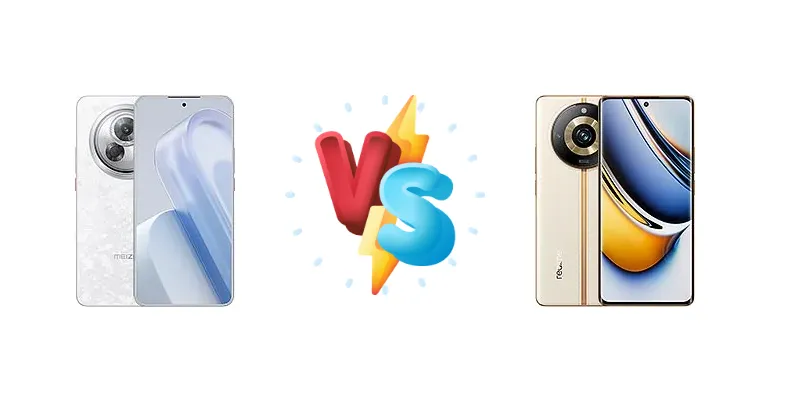
The Meizu Lucky 08 and Realme 11 Pro+ represent compelling options in the increasingly competitive mid-range smartphone market. The Lucky 08 leverages Qualcomm’s efficient Snapdragon 7s Gen 2, while the 11 Pro+ opts for MediaTek’s Dimensity 7050. This comparison dissects their key differences, focusing on performance, charging speed, and display quality to determine which device delivers the best value.
🏆 Quick Verdict
For the average user prioritizing rapid charging and a brighter display, the Realme 11 Pro+ is the stronger choice. Its 100W charging significantly outperforms the Meizu Lucky 08’s 45W, and the 793 nits peak brightness provides better outdoor visibility. However, the Lucky 08’s more efficient chipset offers a compelling alternative for those focused on sustained performance and thermal management.
| Network |
|---|
| 2G bands | GSM 850 / 900 / 1800 / 1900 | GSM 850 / 900 / 1800 / 1900 |
| 3G bands | HSDPA 850 / 900 / 2100 | HSDPA 850 / 900 / 2100 |
| 4G bands | 1, 3, 5, 8, 28, 34, 38, 39, 40, 41 | 1, 3, 5, 8, 28, 38, 40, 41 - India |
| 5G bands | 1, 3, 5, 8, 28, 38, 40, 41, 77, 78 SA/NSA | 1, 3, 5, 8, 28, 40, 41, 77, 78 SA/NSA - International |
| Speed | HSPA, LTE, 5G | HSPA, LTE, 5G |
| Technology | GSM / HSPA / LTE / 5G | GSM / CDMA / HSPA / CDMA2000 / LTE / 5G |
| | - | CDMA2000 1x |
| Launch |
|---|
| Announced | 2024, September 25 | 2023, May 10 |
| Status | Available. Released 2024, September 20 | Available. Released 2023, May 15 |
| Body |
|---|
| Build | - | Glass front, leather or plastic back, plastic frame |
| Dimensions | 163 x 77.5 x 8.6 mm (6.42 x 3.05 x 0.34 in) | 161.6 x 73.9 x 8.2 mm or 8.7 mm |
| SIM | Nano-SIM + Nano-SIM | Nano-SIM + Nano-SIM |
| Weight | 202 g (7.13 oz) | 183 g or 189 g (6.46 oz) |
| Display |
|---|
| Resolution | 1264 x 2780 pixels (~450 ppi density) | 1080 x 2412 pixels, 20:9 ratio (~394 ppi density) |
| Size | 6.78 inches, 111.7 cm2 (~88.5% screen-to-body ratio) | 6.7 inches, 108.0 cm2 (~90.5% screen-to-body ratio) |
| Type | LTPO AMOLED, 1B colors, 144Hz, HDR, 800 nits (typ), 5000 nits (peak) | AMOLED, 1B colors, HDR10+, 120Hz, 950 nits (peak) |
| Platform |
|---|
| CPU | Octa-core (4x2.40 GHz Cortex-A78 & 4x1.95 GHz Cortex-A55) | Octa-core (2x2.6 GHz Cortex-A78 & 6x2.0 GHz Cortex-A55) |
| Chipset | Qualcomm SM7435-AB Snapdragon 7s Gen 2 (4 nm) | Mediatek Dimensity 7050 (6 nm) |
| GPU | Adreno 710 | Mali-G68 MC4 |
| OS | Flyme AIOS | Android 13, up to 2 major Android upgrades, Realme UI 5.0 |
| Memory |
|---|
| Card slot | Unspecified | No |
| Internal | 256GB 8GB RAM, 256GB 12GB RAM, 512GB 12GB RAM | 256GB 8GB RAM, 256GB 12GB RAM, 512GB 12GB RAM, 1TB 12GB RAM |
| Main Camera |
|---|
| Dual | 108 MP, f/1.7, 24mm (wide), 1/1.67", 0.64µm, PDAF
2 MP (macro) | - |
| Features | LED flash, panorama, HDR | LED flash, HDR, panorama |
| Triple | - | 200 MP, f/1.7, 23mm (wide), 1/1.4", 0.56µm, PDAF, OIS
8 MP, f/2.2, 16mm, 112˚ (ultrawide)
2 MP (macro) |
| Video | Yes | 4K@30fps, 1080p@30/60/120/480fps, 720p@960fps, gyro-EIS |
| Selfie camera |
|---|
| Features | HDR | Panorama |
| Single | 8 MP, f/2.0 | 32 MP, f/2.5, 22mm (wide) |
| Video | Yes | 1080p@30fps |
| Sound |
|---|
| 3.5mm jack | - | No |
| 35mm jack | No | No |
| Loudspeaker | Yes, with stereo speakers | Yes, with stereo speakers |
| | - | 24-bit/192kHz audio |
| Comms |
|---|
| Bluetooth | 5.1, A2DP, LE, aptX HD, aptX Adaptive, LHDC | 5.2, A2DP, LE, aptX HD |
| NFC | Unspecified | Yes |
| Positioning | GPS (L1+L5), BDS (B1I+B1C+B2a), GLONASS, GALILEO, QZSS | GPS, GLONASS, GALILEO, BDS, QZSS, NavIC |
| Radio | No | No |
| USB | USB Type-C | USB Type-C 2.0 |
| WLAN | Wi-Fi 802.11 a/b/g/n/ac, dual-band | Wi-Fi 802.11 a/b/g/n/ac/6, dual-band |
| Features |
|---|
| Sensors | Fingerprint (under display, optical), accelerometer, gyro, proximity, compass | Fingerprint (under display, optical), accelerometer, gyro, proximity, compass |
| Battery |
|---|
| Charging | 45W wired, QC4+, PD3.0, PPS | 100W wired |
| Type | 6000 mAh | 5000 mAh |
| Misc |
|---|
| Colors | Black, White | Astral Black, Sunrise Beige, Oasis Green |
| Models | - | RMX3740, RMX3741 |
| Price | About 210 EUR | € 399.90 / ₹ 27,990 |
Meizu Lucky 08
- More efficient 4nm Snapdragon 7s Gen 2 chipset
- Potentially better sustained performance due to thermal efficiency
- Support for QC4+, PD3.0, and PPS charging standards
- Slower 45W charging compared to the Realme 11 Pro+
- Display brightness data unavailable, likely lower than Realme
Realme 11 Pro+
- Ultra-fast 100W charging for quick top-ups
- Brighter 793 nits display for excellent outdoor visibility
- Likely features a high-resolution main camera (200MP)
- Less efficient 6nm Dimensity 7050 chipset
- Potential for more thermal throttling under sustained load
Display Comparison
The Realme 11 Pro+ boasts a significantly brighter display, reaching a measured 793 nits peak brightness, making it considerably more usable in direct sunlight compared to the Meizu Lucky 08 (brightness data unavailable). While both likely utilize AMOLED panels given the market segment, the Realme’s higher peak brightness is a tangible advantage. Details regarding refresh rate, resolution, and PWM dimming frequency are missing for both devices, but the Realme’s brightness advantage is a clear win for outdoor visibility. The absence of LTPO technology on either device suggests a standard refresh rate, impacting battery life during dynamic content.
Camera Comparison
Camera details are limited. The Realme 11 Pro+ is known for its 200MP main sensor (not in provided data, but a key marketing feature), suggesting a focus on high-resolution photography. The Meizu Lucky 08’s camera specifications are unknown, making a direct comparison difficult. Without information on sensor size, aperture, and optical image stabilization (OIS), it’s impossible to assess image quality beyond resolution. The presence of a 2MP macro camera on either device is likely a marketing gimmick with limited practical value.
Performance
The Realme 11 Pro+’s Dimensity 7050 (6nm) features a slightly higher clocked prime core (2.6 GHz vs 2.4 GHz on the Lucky 08’s Snapdragon 7s Gen 2), but the Snapdragon benefits from a more efficient 4nm manufacturing process. This translates to potentially better thermal management and sustained performance under load. The Dimensity 7050’s octa-core configuration (2x Cortex-A78 & 6x Cortex-A55) is similar to the Snapdragon’s (4x Cortex-A78 & 4x Cortex-A55), but the 4nm node gives the Snapdragon an edge in power efficiency. RAM type and speed are unspecified, but LPDDR5X would be expected in this price range, further influencing performance.
Battery Life
The Realme 11 Pro+’s 100W charging is a standout feature, allowing for a full charge in under 30 minutes. The Meizu Lucky 08’s 45W charging, while supporting QC4+, PD3.0, and PPS, is significantly slower. The Realme 11 Pro+ has an endurance rating of 112 hours, suggesting good battery optimization. While battery capacity is not specified for either device, the faster charging speed of the Realme 11 Pro+ mitigates the impact of a potentially smaller battery, offering more convenient top-ups throughout the day.
Buying Guide
Buy the Meizu Lucky 08 if you need a phone that prioritizes sustained performance during extended gaming sessions or demanding tasks, benefiting from the Snapdragon 7s Gen 2’s 4nm process and efficient thermal profile. Buy the Realme 11 Pro+ if you prefer blazing-fast 100W charging, a brighter display for outdoor use, and are willing to trade some potential thermal efficiency for quicker power-ups and a more vibrant viewing experience.
Frequently Asked Questions
❓ Does the Dimensity 7050 in the Realme 11 Pro+ tend to overheat during prolonged gaming sessions?
While the Dimensity 7050 is a capable chipset, its 6nm process is less efficient than the Snapdragon 7s Gen 2’s 4nm node. This means the Realme 11 Pro+ may experience more thermal throttling during extended gaming, potentially leading to reduced performance over time. However, Realme’s software optimizations and cooling solutions may mitigate this issue to some extent.
❓ Is the 45W charging on the Meizu Lucky 08 slow compared to the competition?
Yes, 45W charging is relatively slow compared to the 100W charging offered by the Realme 11 Pro+. While 45W is still faster than standard charging, it will take significantly longer to fully charge the Meizu Lucky 08. This difference is particularly noticeable for users who frequently need to top up their battery quickly.
❓ How does the Snapdragon 7s Gen 2 handle graphically intensive games like Genshin Impact or PUBG?
The Snapdragon 7s Gen 2 is capable of running graphically demanding games like Genshin Impact and PUBG, but you may need to adjust graphics settings to achieve a smooth frame rate. The 4nm process helps maintain stable performance for longer periods, minimizing throttling. Expect playable frame rates at medium to high settings.