
Meizu Lucky 08 vs Motorola Edge 40 Neo: A Deep Dive into Mid-Range Contenders
| Phones Images | |||||
|---|---|---|---|---|---|
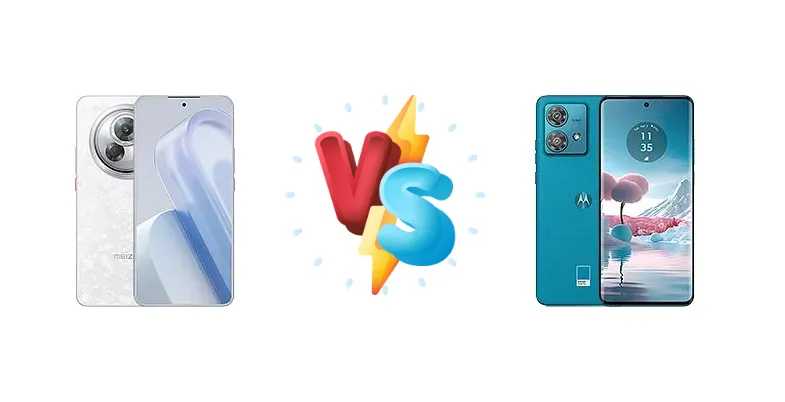
|
🏆 Quick Verdict
For the average user prioritizing all-day battery life and rapid charging, the Motorola Edge 40 Neo is the stronger choice. Its 68W charging and 10:28h active use score outweigh the Lucky 08’s slightly newer chipset, offering a more convenient and reliable daily experience.
| PHONES | ||
|---|---|---|
| Phone Names | Meizu Lucky 08 | Motorola Edge 40 Neo |
| Network | ||
|---|---|---|
| 2G bands | GSM 850 / 900 / 1800 / 1900 | GSM 850 / 900 / 1800 / 1900 |
| 3G bands | HSDPA 850 / 900 / 2100 | HSDPA 800 / 850 / 900 / 1700(AWS) / 1900 / 2100 |
| 4G bands | 1, 3, 5, 8, 28, 34, 38, 39, 40, 41 | 1, 2, 3, 4, 5, 7, 8, 12, 13, 17, 18, 19, 20, 25, 26, 28, 32, 38, 38, 39, 40, 41, 42, 43, 48, 66 |
| 5G bands | 1, 3, 5, 8, 28, 38, 40, 41, 77, 78 SA/NSA | 1, 2, 3, 5, 7, 8, 20, 28, 38, 40, 41, 66, 77, 78 SA/NSA |
| Speed | HSPA, LTE, 5G | HSPA, LTE, 5G |
| Technology | GSM / HSPA / LTE / 5G | GSM / HSPA / LTE / 5G |
| Launch | ||
|---|---|---|
| Announced | 2024, September 25 | 2023, September 14 |
| Status | Available. Released 2024, September 20 | Available. Released 2023, September 14 |
| Body | ||
|---|---|---|
| Build | - | Glass front (Gorilla Glass 3), plastic frame, plastic back |
| Dimensions | 163 x 77.5 x 8.6 mm (6.42 x 3.05 x 0.34 in) | 159.6 x 72 x 7.9 mm (6.28 x 2.83 x 0.31 in) |
| SIM | Nano-SIM + Nano-SIM | · Nano-SIM + eSIM· Nano-SIM + Nano-SIM |
| Weight | 202 g (7.13 oz) | 170 g or 172 g (6.00 oz) |
| Display | ||
|---|---|---|
| Protection | - | Corning Gorilla Glass 3 |
| Resolution | 1264 x 2780 pixels (~450 ppi density) | 1080 x 2400 pixels, 20:9 ratio (~402 ppi density) |
| Size | 6.78 inches, 111.7 cm2 (~88.5% screen-to-body ratio) | 6.55 inches, 103.6 cm2 (~90.1% screen-to-body ratio) |
| Type | LTPO AMOLED, 1B colors, 144Hz, HDR, 800 nits (typ), 5000 nits (peak) | P-OLED, 1B colors, 144Hz, HDR10+, 1300 nits (peak) |
| Platform | ||
|---|---|---|
| CPU | Octa-core (4x2.40 GHz Cortex-A78 & 4x1.95 GHz Cortex-A55) | Octa-core (2x2.5 GHz Cortex-A78 & 6x2.0 GHz Cortex-A55) |
| Chipset | Qualcomm SM7435-AB Snapdragon 7s Gen 2 (4 nm) | MediaTek Dimensity 7030 (6 nm) |
| GPU | Adreno 710 | Mali-G610 MC3 |
| OS | Flyme AIOS | Android 13, up to 2 major Android upgrades |
| Memory | ||
|---|---|---|
| Card slot | Unspecified | No |
| Internal | 256GB 8GB RAM, 256GB 12GB RAM, 512GB 12GB RAM | 128GB 8GB RAM, 256GB 8GB RAM, 256GB 12GB RAM |
| Main Camera | ||
|---|---|---|
| Dual | 108 MP, f/1.7, 24mm (wide), 1/1.67", 0.64µm, PDAF 2 MP (macro) | 50 MP, f/1.8, (wide), 1/1.55", 1.0µm, multi-directional PDAF, OIS 13 MP, f/2.2, 120˚ (ultrawide), 1/3.0", 1.12µm, PDAF |
| Features | LED flash, panorama, HDR | LED flash, HDR, panorama |
| Video | Yes | 4K@30fps, 1080p@30/60/120/240fps, gyro-EIS |
| Selfie camera | ||
|---|---|---|
| Features | HDR | HDR |
| Single | 8 MP, f/2.0 | 32 MP, f/2.4, (wide), 1/3.0", 0.7µm |
| Video | Yes | 4K@30fps, 1080p@30fps |
| Sound | ||
|---|---|---|
| 35mm jack | No | No |
| Loudspeaker | Yes, with stereo speakers | Yes, with stereo speakers |
| Comms | ||
|---|---|---|
| Bluetooth | 5.1, A2DP, LE, aptX HD, aptX Adaptive, LHDC | 5.4, A2DP, LE |
| NFC | Unspecified | Yes |
| Positioning | GPS (L1+L5), BDS (B1I+B1C+B2a), GLONASS, GALILEO, QZSS | GPS, GLONASS, GALILEO |
| Radio | No | No |
| USB | USB Type-C | USB Type-C 2.0, OTG |
| WLAN | Wi-Fi 802.11 a/b/g/n/ac, dual-band | Wi-Fi 802.11 a/b/g/n/ac/6e, tri-band, Wi-Fi Direct |
| Features | ||
|---|---|---|
| Sensors | Fingerprint (under display, optical), accelerometer, gyro, proximity, compass | Fingerprint (under display, optical), accelerometer, gyro, proximity, compass |
| Battery | ||
|---|---|---|
| Charging | 45W wired, QC4+, PD3.0, PPS | 68W wired, 50% in 15 min |
| Type | 6000 mAh | Li-Po 5000 mAh |
| Misc | ||
|---|---|---|
| Colors | Black, White | Black, Soothing Sea, Caneel Bay, Peach Fuzz |
| Models | - | XT2307-1 |
| Price | About 210 EUR | $ 299.00 / € 168.73 / ₹ 19,900 |
Meizu Lucky 08
- Newer Snapdragon 7s Gen 2 chipset
- Potentially better power efficiency (4nm)
- May receive more software updates
- Limited battery information
- Slower charging speed (45W)
- Unknown display quality
Motorola Edge 40 Neo
- Excellent battery life (10:28h active use)
- Ultra-fast 68W charging
- Bright display (1073 nits)
- Older Dimensity 7030 chipset
- 6nm process may be less efficient
- Software support timeline unclear
Display Comparison
The Motorola Edge 40 Neo boasts a significantly brighter display, reaching a measured 1073 nits. While the Lucky 08’s display specs are unavailable, this brightness advantage is crucial for outdoor visibility. The Edge 40 Neo’s panel likely benefits from Motorola’s color calibration, offering a more accurate and vibrant viewing experience. Without knowing the panel type of the Lucky 08, it’s difficult to assess potential differences in refresh rate or HDR support, but the Neo’s brightness is a clear win.
Camera Comparison
Detailed camera specs for both devices are limited. However, the focus should be on the main sensor and image processing. Without knowing the sensor sizes or apertures, it’s difficult to make a definitive judgment. Motorola generally employs competent image processing algorithms, prioritizing natural-looking photos. Meizu’s camera software is less well-known, making it harder to predict its strengths and weaknesses. The absence of details regarding OIS on either device suggests reliance on software stabilization, potentially impacting low-light video quality.
Performance
The Meizu Lucky 08 utilizes the Qualcomm SM7435-AB Snapdragon 7s Gen 2 (4nm), featuring an octa-core CPU with 4x2.40 GHz Cortex-A78 and 4x1.95 GHz Cortex-A55 cores. The Motorola Edge 40 Neo is powered by the MediaTek Dimensity 7030 (6nm) with 2x2.5 GHz Cortex-A78 and 6x2.0 GHz Cortex-A55 cores. The 4nm process of the Snapdragon 7s Gen 2 *should* offer better power efficiency, but the Dimensity 7030’s slightly higher clocked prime cores could provide a marginal performance boost in single-threaded tasks. However, the 6nm process of the Dimensity 7030 is still efficient, and the difference in real-world performance is likely minimal for most users. The Lucky 08’s newer architecture may offer better long-term software support and optimization.
Battery Life
The Motorola Edge 40 Neo shines in battery performance, achieving an impressive 10:28h of active use and an endurance rating of 80 hours. The Meizu Lucky 08’s battery capacity is unknown, but the Edge 40 Neo’s endurance is a significant advantage. Furthermore, the Edge 40 Neo’s 68W charging, capable of reaching 50% charge in just 15 minutes, drastically outperforms the Lucky 08’s 45W charging. This faster charging speed minimizes downtime and provides a more convenient user experience.
Buying Guide
Buy the Meizu Lucky 08 if you prioritize the latest Qualcomm silicon and potentially benefit from future software optimizations tailored to the Snapdragon 7s Gen 2. This phone is ideal for users who frequently flash custom ROMs or enjoy tinkering with their devices. Buy the Motorola Edge 40 Neo if you value a balanced package with excellent battery endurance, incredibly fast charging, and a polished, user-friendly software experience. It’s the better option for those seeking a hassle-free, long-lasting smartphone.