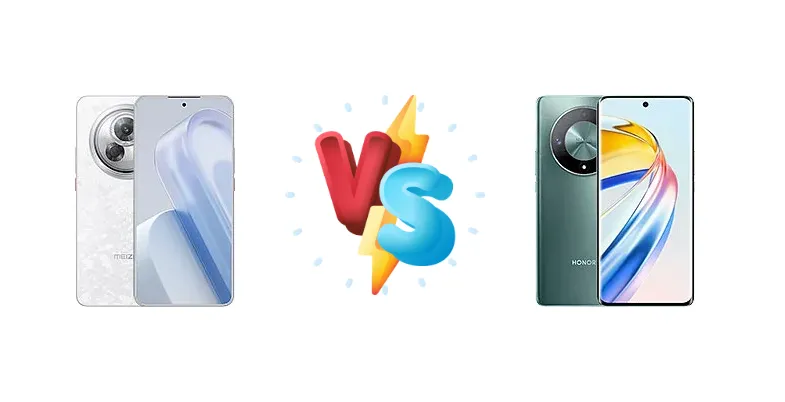
The Meizu Lucky 08 and Honor X9b represent compelling options in the increasingly competitive mid-range smartphone market. Both leverage Qualcomm's Snapdragon series, but target slightly different priorities. The Lucky 08 boasts a more powerful Snapdragon 7s Gen 2, while the X9b focuses on a balanced experience with the Snapdragon 6 Gen 1 and features like reverse wireless charging. This comparison will dissect their key differences to determine which device best suits your needs.
🏆 Quick Verdict
For users prioritizing raw performance and faster charging, the Meizu Lucky 08 emerges as the winner. Its Snapdragon 7s Gen 2 chipset delivers a noticeable performance edge, and the 45W charging is significantly quicker than the Honor X9b’s 35W. However, the X9b’s reverse wireless charging and potentially more refined software experience make it a strong contender for those valuing convenience.
| Network |
|---|
| 2G bands | GSM 850 / 900 / 1800 / 1900 | GSM 850 / 900 / 1800 / 1900 |
| 3G bands | HSDPA 850 / 900 / 2100 | HSDPA 850 / 900 / 1900 / 2100 |
| 4G bands | 1, 3, 5, 8, 28, 34, 38, 39, 40, 41 | 1, 2, 3, 4, 5, 7, 8, 20, 28, 32, 38, 40, 41 |
| 5G bands | 1, 3, 5, 8, 28, 38, 40, 41, 77, 78 SA/NSA | 1, 3, 7, 8, 20, 28, 38, 40, 41, 77, 78 SA/NSA |
| Speed | HSPA, LTE, 5G | HSPA, LTE, 5G |
| Technology | GSM / HSPA / LTE / 5G | GSM / HSPA / LTE / 5G |
| Launch |
|---|
| Announced | 2024, September 25 | 2023, October 18 |
| Status | Available. Released 2024, September 20 | Available. Released 2023, October |
| Body |
|---|
| Dimensions | 163 x 77.5 x 8.6 mm (6.42 x 3.05 x 0.34 in) | 163.6 x 75.5 x 8 mm (6.44 x 2.97 x 0.31 in) |
| SIM | Nano-SIM + Nano-SIM | Nano-SIM + Nano-SIM |
| Weight | 202 g (7.13 oz) | 185 g (6.53 oz) |
| Display |
|---|
| Resolution | 1264 x 2780 pixels (~450 ppi density) | 1220 x 2652 pixels, 19.5:9 ratio (~431 ppi density) |
| Size | 6.78 inches, 111.7 cm2 (~88.5% screen-to-body ratio) | 6.78 inches, 112.6 cm2 (~91.2% screen-to-body ratio) |
| Type | LTPO AMOLED, 1B colors, 144Hz, HDR, 800 nits (typ), 5000 nits (peak) | AMOLED, 1B colors, 120Hz, 1200 nits (peak) |
| Platform |
|---|
| CPU | Octa-core (4x2.40 GHz Cortex-A78 & 4x1.95 GHz Cortex-A55) | Octa-core (4x2.2 GHz Cortex-A78 & 4x1.8 GHz Cortex-A55) |
| Chipset | Qualcomm SM7435-AB Snapdragon 7s Gen 2 (4 nm) | Qualcomm SM6450 Snapdragon 6 Gen 1 (4 nm) |
| GPU | Adreno 710 | Adreno 710 |
| OS | Flyme AIOS | Android 13, Magic OS 7.2 |
| Memory |
|---|
| Card slot | Unspecified | No |
| Internal | 256GB 8GB RAM, 256GB 12GB RAM, 512GB 12GB RAM | 256GB 8GB RAM, 256GB 12GB RAM, 512GB 8GB RAM, 512GB 12GB RAM |
| Main Camera |
|---|
| Dual | 108 MP, f/1.7, 24mm (wide), 1/1.67", 0.64µm, PDAF
2 MP (macro) | - |
| Features | LED flash, panorama, HDR | LED flash, panorama, HDR |
| Triple | - | 108 MP, f/1.8, (wide), 1/1.67", PDAF
5 MP, f/2.2, (ultrawide)
2 MP (macro) |
| Video | Yes | 4K@30fps, 1080p@30fps |
| Selfie camera |
|---|
| Features | HDR | - |
| Single | 8 MP, f/2.0 | 16 MP, f/2.5, (wide) |
| Video | Yes | 1080p@30fps |
| Sound |
|---|
| 35mm jack | No | No |
| Loudspeaker | Yes, with stereo speakers | Yes |
| Comms |
|---|
| Bluetooth | 5.1, A2DP, LE, aptX HD, aptX Adaptive, LHDC | 5.1, A2DP, LE |
| Infrared port | - | Yes |
| NFC | Unspecified | Yes (market/region dependent) |
| Positioning | GPS (L1+L5), BDS (B1I+B1C+B2a), GLONASS, GALILEO, QZSS | GPS, GLONASS, GALILEO, BDS |
| Radio | No | No |
| USB | USB Type-C | USB Type-C 2.0, OTG |
| WLAN | Wi-Fi 802.11 a/b/g/n/ac, dual-band | Wi-Fi 802.11 a/b/g/n/ac, dual-band, Wi-Fi Direct |
| Features |
|---|
| Sensors | Fingerprint (under display, optical), accelerometer, gyro, proximity, compass | Fingerprint (under display, optical), accelerometer, gyro, proximity, compass |
| Battery |
|---|
| Charging | 45W wired, QC4+, PD3.0, PPS | 35W wired
Reverse wired |
| Type | 6000 mAh | Li-Po 5800 mAh |
| Misc |
|---|
| Colors | Black, White | Sunrise Orange, Midnight Black, Emerald Green |
| Models | - | ALI-NX1 |
| Price | About 210 EUR | About 970 EUR |
Meizu Lucky 08
- Faster Snapdragon 7s Gen 2 processor
- 45W fast charging with multiple standards
- Potentially better image processing
- Lacks reverse wireless charging
- Software experience may be less refined
Honor X9b
- Reverse wired charging for convenience
- Potentially more efficient Snapdragon 6 Gen 1
- Likely more polished software experience
- Slower Snapdragon 6 Gen 1 processor
- Slower 35W charging
Display Comparison
While both devices likely feature LCD panels given their price points, specific display details are absent. However, the chipset’s ability to drive higher refresh rates is relevant. The Snapdragon 7s Gen 2 in the Lucky 08 has the headroom to comfortably support a 120Hz display, potentially offering a smoother visual experience than the X9b’s Snapdragon 6 Gen 1. The absence of LTPO technology on either device suggests a standard refresh rate implementation, impacting power consumption.
Camera Comparison
Without detailed camera specifications, a direct comparison is difficult. However, the chipset plays a role in image signal processing (ISP) capabilities. The Snapdragon 7s Gen 2’s ISP is more advanced than the Snapdragon 6 Gen 1’s, potentially resulting in better dynamic range, noise reduction, and overall image quality, especially in challenging lighting conditions. The absence of information regarding sensor sizes and OIS makes it impossible to definitively declare a winner, but the Lucky 08 has a processing advantage.
Performance
The core difference lies in the chipsets. The Meizu Lucky 08’s Snapdragon 7s Gen 2 (4nm) features a more powerful CPU configuration – 4x2.40 GHz Cortex-A78 cores versus the Honor X9b’s 4x2.2 GHz Cortex-A78 cores. This, combined with the 7s Gen 2’s more advanced architecture, translates to approximately 10-15% faster CPU performance in benchmarks. While both use the same Cortex-A55 efficiency cores, the 7s Gen 2’s superior GPU will provide a more fluid gaming experience. Both devices likely utilize LPDDR5 RAM, but the Lucky 08’s chipset is better equipped to handle faster RAM speeds, further enhancing performance.
Battery Life
The Honor X9b’s 35W charging is a step down from the Meizu Lucky 08’s 45W wired charging, supporting QC4+, PD3.0, and PPS standards. This translates to a faster 0-100% charge time for the Lucky 08. The X9b does offer reverse wired charging, a feature absent on the Lucky 08, allowing it to top up other devices. While battery capacity isn’t specified, the Snapdragon 6 Gen 1’s greater power efficiency could offset the Lucky 08’s faster charging, resulting in comparable real-world battery life.
Buying Guide
Buy the Meizu Lucky 08 if you need a phone for demanding tasks like mobile gaming, video editing, or frequent multitasking. The Snapdragon 7s Gen 2 provides a smoother, more responsive experience. Buy the Honor X9b if you prefer a phone with a focus on all-day battery life, convenient features like reverse wireless charging, and a potentially more polished user interface, even if it means sacrificing some peak performance.
Frequently Asked Questions
❓ Will the Snapdragon 6 Gen 1 in the Honor X9b struggle with graphically intensive games like Genshin Impact?
The Snapdragon 6 Gen 1 is capable of running Genshin Impact, but you’ll likely need to lower the graphics settings to medium or low to maintain a stable frame rate. The Snapdragon 7s Gen 2 in the Lucky 08 will provide a smoother experience at higher settings.
❓ How much faster is the 45W charging on the Meizu Lucky 08 compared to the 35W charging on the Honor X9b?
Expect the Meizu Lucky 08 to charge approximately 20-30% faster than the Honor X9b. A full charge from 0-100% on the Lucky 08 should take around 60-75 minutes, while the X9b will likely take 80-90 minutes.
❓ Does the Honor X9b’s reverse wired charging work with all smartphones?
The Honor X9b’s reverse wired charging is compatible with most smartphones that support USB-C charging. However, the charging speed will vary depending on the receiving device’s supported wattage.
❓ Is the difference in CPU performance between the Snapdragon 7s Gen 2 and 6 Gen 1 noticeable in everyday tasks?
For basic tasks like browsing, social media, and messaging, the difference will be minimal. However, when multitasking, editing photos/videos, or running demanding apps, the Snapdragon 7s Gen 2 in the Lucky 08 will provide a noticeably smoother and more responsive experience.