
Meizu Lucky 08 vs Google Pixel 7a: A Detailed Comparison of Mid-Range Powerhouses
| Phones Images | |||||
|---|---|---|---|---|---|
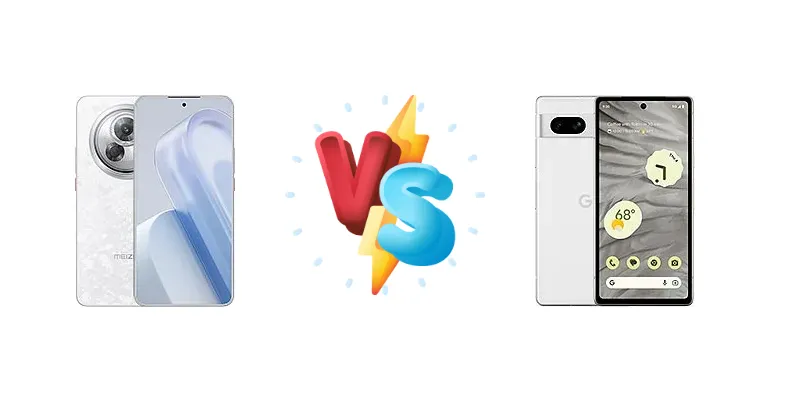
|
🏆 Quick Verdict
For the average user prioritizing camera quality and software experience, the Google Pixel 7a is the clear winner. However, the Meizu Lucky 08 offers a compelling alternative for those who value faster charging and potentially better thermal management, all at a potentially lower price point.
| PHONES | ||
|---|---|---|
| Phone Names | Meizu Lucky 08 | Google Pixel 7a |
| Network | ||
|---|---|---|
| 2G bands | GSM 850 / 900 / 1800 / 1900 | GSM 850 / 900 / 1800 / 1900 |
| 3G bands | HSDPA 850 / 900 / 2100 | HSDPA 800 / 850 / 900 / 1700(AWS) / 1900 / 2100 |
| 4G bands | 1, 3, 5, 8, 28, 34, 38, 39, 40, 41 | 1, 2, 3, 4, 5, 7, 8, 12, 13, 14, 17, 20, 25, 26, 28, 29, 30, 38, 40, 41, 48, 66, 71 - GWKK3, G0DZQ |
| 5G bands | 1, 3, 5, 8, 28, 38, 40, 41, 77, 78 SA/NSA | 1, 2, 3, 5, 7, 8, 12, 14, 20, 25, 28, 30, 38, 41, 48, 66, 71, 77, 78 SA/NSA/Sub6 - GWKK3 |
| Speed | HSPA, LTE, 5G | HSPA, LTE, 5G |
| Technology | GSM / HSPA / LTE / 5G | GSM / HSPA / LTE / 5G |
| - | 1, 2, 3, 5, 7, 8, 12, 20, 25, 28, 38, 40, 41, 66, 75, 76, 77, 78, 79 SA/NSA/Sub6 - GHL1X, G82U8 | |
| Launch | ||
|---|---|---|
| Announced | 2024, September 25 | 2023, May 10 |
| Status | Available. Released 2024, September 20 | Available. Released 2023, May 10 |
| Body | ||
|---|---|---|
| Build | - | Glass front (Gorilla Glass 3), aluminum frame, plastic back |
| Dimensions | 163 x 77.5 x 8.6 mm (6.42 x 3.05 x 0.34 in) | 152 x 72.9 x 9 mm (5.98 x 2.87 x 0.35 in) |
| SIM | Nano-SIM + Nano-SIM | Nano-SIM + eSIM |
| Weight | 202 g (7.13 oz) | 193.5 g (6.84 oz) |
| - | IP67 dust/water resistant (up to 1m for 30 min) | |
| Display | ||
|---|---|---|
| Protection | - | Corning Gorilla Glass 3 |
| Resolution | 1264 x 2780 pixels (~450 ppi density) | 1080 x 2400 pixels, 20:9 ratio (~429 ppi density) |
| Size | 6.78 inches, 111.7 cm2 (~88.5% screen-to-body ratio) | 6.1 inches, 90.7 cm2 (~81.8% screen-to-body ratio) |
| Type | LTPO AMOLED, 1B colors, 144Hz, HDR, 800 nits (typ), 5000 nits (peak) | OLED, HDR, 90Hz |
| - | Always-on display | |
| Platform | ||
|---|---|---|
| CPU | Octa-core (4x2.40 GHz Cortex-A78 & 4x1.95 GHz Cortex-A55) | Octa-core (2x2.85 GHz Cortex-X1 & 2x2.35 GHz Cortex-A78 & 4x1.80 GHz Cortex-A55) |
| Chipset | Qualcomm SM7435-AB Snapdragon 7s Gen 2 (4 nm) | Google Tensor G2 (5 nm) |
| GPU | Adreno 710 | Mali-G710 MP7 |
| OS | Flyme AIOS | Android 13, upgradable to Android 15, up to 5 major Android upgrades |
| Memory | ||
|---|---|---|
| Card slot | Unspecified | No |
| Internal | 256GB 8GB RAM, 256GB 12GB RAM, 512GB 12GB RAM | 128GB 8GB RAM |
| - | UFS 3.1 | |
| Main Camera | ||
|---|---|---|
| Dual | 108 MP, f/1.7, 24mm (wide), 1/1.67", 0.64µm, PDAF 2 MP (macro) | 64 MP, f/1.9, 26mm (wide), 1/1.73", 0.8µm, dual pixel PDAF, OIS 13 MP, f/2.2, 120˚ (ultrawide), 1.12µm |
| Features | LED flash, panorama, HDR | Dual-LED flash, Pixel Shift, Auto-HDR, panorama |
| Video | Yes | 4K@30/60fps, 1080p@30/60/120/240fps, OIS |
| Selfie camera | ||
|---|---|---|
| Features | HDR | HDR, panorama |
| Single | 8 MP, f/2.0 | 13 MP, f/2.2, 20mm (ultrawide), 1.12µm |
| Video | Yes | 4K@30fps, 1080p@30fps |
| Sound | ||
|---|---|---|
| 3.5mm jack | - | No |
| 35mm jack | No | No |
| Loudspeaker | Yes, with stereo speakers | Yes, with stereo speakers |
| Comms | ||
|---|---|---|
| Bluetooth | 5.1, A2DP, LE, aptX HD, aptX Adaptive, LHDC | 5.3, A2DP, LE |
| NFC | Unspecified | Yes |
| Positioning | GPS (L1+L5), BDS (B1I+B1C+B2a), GLONASS, GALILEO, QZSS | GPS, GLONASS, GALILEO, BDS, QZSS, NavIC |
| Radio | No | No |
| USB | USB Type-C | USB Type-C 3.2 |
| WLAN | Wi-Fi 802.11 a/b/g/n/ac, dual-band | Wi-Fi 802.11 a/b/g/n/ac/6e, tri-band |
| Features | ||
|---|---|---|
| Sensors | Fingerprint (under display, optical), accelerometer, gyro, proximity, compass | Fingerprint (under display, optical), accelerometer, gyro, proximity, compass, barometer |
| Battery | ||
|---|---|---|
| Charging | 45W wired, QC4+, PD3.0, PPS | 18W wired, PD3.0 7.5W wireless |
| Type | 6000 mAh | Li-Po 4385 mAh |
| Misc | ||
|---|---|---|
| Colors | Black, White | Charcoal, Snow, Sea, Coral |
| Models | - | GWKK3, GHL1X, G0DZQ, G82U8 |
| Price | About 210 EUR | € 179.90 / $ 150.00 / £ 170.00 / ₹ 25,980 |
Meizu Lucky 08
- 45W Fast Charging: Significantly faster than the Pixel 7a.
- Snapdragon 7s Gen 2: Efficient 4nm process for potentially better thermal management.
- Potentially Lower Price: Likely to be more affordable than the Pixel 7a.
- Camera Likely Inferior: Won't match the Pixel 7a's image quality.
- Software Support: Meizu's software update track record is less reliable than Google's.
Google Pixel 7a
- Exceptional Camera: Google's computational photography is a major strength.
- Tensor G2 Chipset: Powerful performance and machine learning capabilities.
- Guaranteed Software Updates: Direct from Google for years to come.
- Slow Charging: 18W charging is significantly slower than the Lucky 08.
- Potential Thermal Throttling: Tensor G2 can run hot under sustained load.
Display Comparison
The Pixel 7a boasts a measured peak brightness of 1070 nits, ensuring excellent visibility even in direct sunlight. While the Lucky 08’s display specifications are currently unavailable, it’s likely to be a standard OLED panel. The Pixel 7a’s brightness advantage is significant for outdoor use. The Pixel 7a’s display is also likely to benefit from Google’s color calibration expertise, offering more accurate colors out of the box. Without knowing the Lucky 08’s panel technology (LTPO or not), it’s difficult to assess potential power savings.
Camera Comparison
The Pixel 7a’s camera system is its standout feature, leveraging Google’s renowned computational photography algorithms. While specific sensor details are missing for both phones, the Pixel 7a’s image processing pipeline is a significant advantage. The Lucky 08’s camera capabilities are less well-defined, and it’s unlikely to match the Pixel 7a’s consistently excellent image quality, especially in challenging lighting conditions. The Pixel 7a’s video recording capabilities are also expected to be superior, benefiting from the Tensor G2’s image signal processor.
Performance
The Google Pixel 7a’s Tensor G2 (5nm) features a more complex CPU configuration with 2x2.85 GHz Cortex-X1 cores, designed for peak performance, alongside 2x2.35 GHz Cortex-A78 cores and 4x1.80 GHz Cortex-A55 cores. The Meizu Lucky 08 utilizes the Snapdragon 7s Gen 2 (4nm) with a more balanced 4x2.40 GHz Cortex-A78 and 4x1.95 GHz Cortex-A55 setup. While the Tensor G2 has higher clock speeds on its prime cores, the Snapdragon 7s Gen 2 benefits from a more efficient 4nm process, potentially leading to better sustained performance and thermal management. The Tensor G2’s integrated machine learning capabilities also give the Pixel 7a an edge in tasks like voice recognition and image processing. The Pixel 7a likely has faster RAM (LPDDR5x) than the Lucky 08, further boosting performance.
Battery Life
The Pixel 7a has an endurance rating of 76 hours, indicating solid battery life. The Meizu Lucky 08 compensates for a potentially smaller battery with significantly faster 45W wired charging (QC4+, PD3.0, PPS) compared to the Pixel 7a’s 18W charging (PD3.0) and 7.5W wireless charging. This means the Lucky 08 can go from 0-100% much faster, a crucial advantage for users who frequently need to top up their battery. While the Pixel 7a’s endurance rating suggests longer overall battery life, the Lucky 08’s charging speed offers greater convenience.
Buying Guide
Buy the Meizu Lucky 08 if you need a phone that charges incredibly quickly (45W) and you prioritize sustained performance during extended gaming sessions, potentially benefiting from the Snapdragon 7s Gen 2’s 4nm process. Buy the Google Pixel 7a if you prefer a best-in-class camera experience, seamless software updates directly from Google, and a proven track record of computational photography excellence, even if it means slower charging.