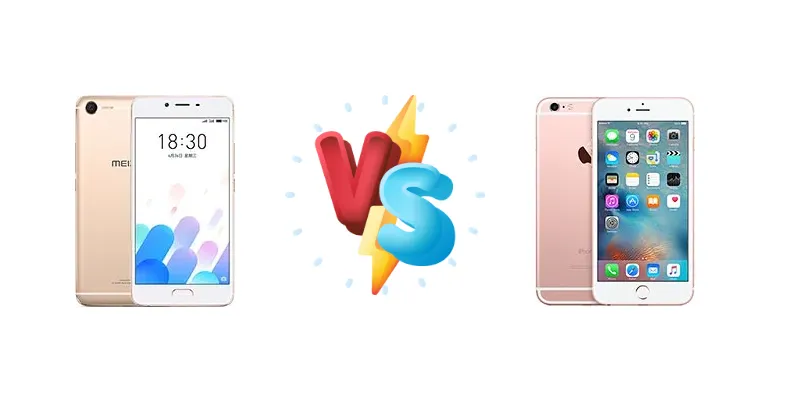
The Meizu E2 and Apple iPhone 6s Plus represent different approaches to the smartphone market from 2016/2017. The Meizu E2 aimed to deliver a modern feature set at a competitive price point, leveraging Mediatek's chipset. The iPhone 6s Plus, while older, continues to hold appeal due to Apple’s ecosystem and software support, even as its hardware ages. This comparison examines which device offers the better experience in 2024, considering their respective strengths and weaknesses.
🏆 Quick Verdict
For the average user in 2024, the iPhone 6s Plus remains the slightly better choice. While the Meizu E2 offers faster charging with its 24W support, the iPhone 6s Plus benefits from Apple’s optimized software, superior display contrast, and a more refined user experience, despite the age of both devices.
| Network |
|---|
| 2G bands | GSM 850 / 900 / 1800 / 1900 - SIM 1 & SIM 2 | GSM 850 / 900 / 1800 / 1900 |
| 3G bands | HSDPA | HSDPA 850 / 900 / 1700 / 1900 / 2100 |
| 4G bands | LTE | 1, 2, 3, 4, 5, 7, 8, 12, 13, 17, 18, 19, 20, 25, 26, 28, 29, 30 - A1633 |
| EDGE | Yes | - |
| GPRS | Yes | - |
| Speed | HSPA, LTE | HSPA 42.2/5.76 Mbps, LTE (2CA) Cat6 300/50 Mbps, EV-DO Rev.A 3.1 Mbps |
| Technology | GSM / HSPA / LTE | GSM / CDMA / HSPA / EVDO / LTE |
| | - | 1, 2, 3, 4, 5, 7, 8, 12, 13, 17, 18, 19, 20, 25, 26, 28, 29, 30, 38, 39, 40, 41 - A1634 |
| Launch |
|---|
| Announced | 2017, April. Released 2017, April | 2015, September 09. Released 2015, September 25 |
| Status | Discontinued | Discontinued |
| Body |
|---|
| Build | - | Glass front (Corning-made glass), aluminum back, aluminum frame |
| Dimensions | 153.7 x 75.7 x 7.5 mm (6.05 x 2.98 x 0.30 in) | 158.2 x 77.9 x 7.3 mm (6.23 x 3.07 x 0.29 in) |
| SIM | Nano-SIM + Nano-SIM | Nano-SIM |
| Weight | 155 g (5.47 oz) | 192 g (6.77 oz) |
| | - | Apple Pay (Visa, MasterCard, AMEX certified) |
| Display |
|---|
| Protection | - | Ion-strengthened glass, oleophobic coating |
| Resolution | 1080 x 1920 pixels, 16:9 ratio (~403 ppi density) | 1080 x 1920 pixels, 16:9 ratio (~401 ppi density) |
| Size | 5.5 inches, 82.6 cm2 (~71.0% screen-to-body ratio) | 5.5 inches, 83.4 cm2 (~67.7% screen-to-body ratio) |
| Type | IPS LCD | IPS LCD |
| | - | 3D Touch display |
| Platform |
|---|
| CPU | Octa-core (4x2.3 GHz Cortex-A53 & 4x1.6 GHz Cortex-A53) | Dual-core 1.84 GHz Twister |
| Chipset | Mediatek MT6757 Helio P20 (16 nm) | Apple A9 (14/16 nm - maker dependant) |
| GPU | Mali-T880MP2 | PowerVR GT7600 (six-core graphics) |
| OS | Android 7 (Nougat), Flyme 6 | iOS 9, upgradable to iOS 15.8.5 |
| Memory |
|---|
| Card slot | microSDXC (uses shared SIM slot) | No |
| Internal | 16GB 2GB RAM, 32GB 3GB RAM, 64GB 4GB RAM | 16GB 2GB RAM, 32GB 2GB RAM, 64GB 2GB RAM, 128GB 2GB RAM |
| | - | NVMe |
| Main Camera |
|---|
| Features | Quad-LED dual-tone flash, HDR, panorama | Dual-LED dual-tone flash, HDR |
| Single | 13 MP, f/2.2, PDAF | 12 MP, f/2.2, 29mm (standard), 1/3.0", 1.22µm, PDAF, OIS |
| Video | 1080p@30fps | 4K@30fps, 1080p@60fps, 1080p@120fps, 720p@240fps |
| Selfie camera |
|---|
| Features | - | Face detection, HDR, panorama |
| Single | 8 MP, f/2.0, 1/3.2", 1.4µm | 5 MP, f/2.2, 31mm (standard) |
| Video | 1080p@30fps | 720p@30fps |
| Sound |
|---|
| 3.5mm jack | Yes | Yes |
| 35mm jack | Yes | Yes |
| Loudspeaker | Yes | Yes |
| | - | 16-bit/44.1kHz audio
|
| Comms |
|---|
| Bluetooth | 4.2, A2DP, LE | 4.2, A2DP, LE |
| NFC | No | Yes (Apple Pay only) |
| Positioning | GPS, GLONASS | GPS, GLONASS, GALILEO, QZSS |
| Radio | No | No |
| USB | microUSB 2.0 | Lightning, USB 2.0 |
| WLAN | Wi-Fi 802.11 a/b/g/n, dual-band, Wi-Fi Direct | Wi-Fi 802.11 a/b/g/n/ac, dual-band, hotspot |
| Features |
|---|
| Sensors | Fingerprint (front-mounted), accelerometer, gyro, proximity, compass | Fingerprint (front-mounted), accelerometer, gyro, proximity, compass, barometer |
| Battery |
|---|
| Charging | 24W wired | - |
| Stand-by | - | Up to 384 h (3G) |
| Talk time | - | Up to 24 h (3G) |
| Type | Li-Ion 3400 mAh, non-removable | Li-Ion 2750 mAh, non-removable (10.45 Wh) |
| Misc |
|---|
| Colors | Black, Gold, Silver | Space Gray, Silver, Gold, Rose Gold |
| Models | - | A1634, A1687, A1690, A1699, iPhone8,2 |
| Price | About 210 EUR | About 240 EUR |
| SAR | - | 1.12 W/kg (head) 1.14 W/kg (body) |
| SAR EU | - | 0.93 W/kg (head) 0.98 W/kg (body) |
| Tests |
|---|
| Audio quality | - |
Noise -93.4dB / Crosstalk -71.1dB |
| Battery life | - |
Endurance rating 85h
|
| Camera | - |
Photo / Video |
| Display | - |
Contrast ratio: 1382:1 (nominal), 3.530 (sunlight) |
| Loudspeaker | - |
Voice 65dB / Noise 65dB / Ring 64dB
|
| Performance | - |
Basemark OS II 2.0: 2261 |
Meizu E2
- Faster 24W charging
- Potentially lower price point
- Octa-core processor offers theoretical multitasking benefits
- Less refined software experience
- Uncertain camera performance
- Potentially lower build quality
Apple iPhone 6s Plus
- Smoother, more optimized software
- Superior display contrast and color accuracy
- Optical Image Stabilization (OIS) for better photos and videos
- Slower charging speeds
- Older chipset architecture
- Limited battery capacity compared to newer phones
Display Comparison
Both the Meizu E2 and iPhone 6s Plus share a remarkably similar display contrast ratio, boasting 1382:1 nominally and 3.530 in sunlight. This suggests comparable visibility in bright conditions. However, the iPhone 6s Plus benefits from Apple’s color calibration and display technology, likely resulting in more accurate and pleasing colors. The Meizu E2’s display specifications lack detail regarding color gamut coverage, potentially limiting its color reproduction capabilities. Bezels are expected to be larger on both devices, reflective of the design trends of their time.
Camera Comparison
Both devices offer photo and video capabilities, but detailed camera specifications for the Meizu E2 are lacking. The iPhone 6s Plus, while not a camera leader even at launch, benefits from Apple’s image processing algorithms, delivering consistently good results in various lighting conditions. The absence of sensor size information for the Meizu E2 makes a direct comparison difficult, but it’s likely the iPhone 6s Plus has a more capable sensor. The iPhone 6s Plus also includes optical image stabilization (OIS), a feature that significantly improves low-light photography and video recording stability. The Meizu E2’s camera performance is likely more dependent on software optimization, which may not match Apple’s level of refinement.
Performance
The chipset architectures represent a fundamental difference. The Meizu E2 utilizes a Mediatek MT6757 Helio P20, an octa-core processor with a big.LITTLE configuration (4x2.3 GHz Cortex-A53 & 4x1.6 GHz Cortex-A53). This design aims for efficiency by using the slower cores for less demanding tasks. Conversely, the iPhone 6s Plus is powered by Apple’s A9, a dual-core 1.84 GHz Twister processor. Despite having fewer cores, the A9’s architecture is significantly more efficient and powerful per core. The A9’s performance advantage stems from Apple’s custom CPU design and tight software integration. While the Helio P20 offers more cores, the A9’s superior single-core performance translates to a snappier experience in most everyday tasks. The A9’s 14/16nm process node (dependent on the manufacturer) also contributes to better thermal management.
Battery Life
Interestingly, both devices share an endurance rating of 85 hours, suggesting similar real-world battery life despite the differences in chipset and core count. However, the Meizu E2 boasts 24W wired charging, a significant advantage over the iPhone 6s Plus’s slower charging speeds. This means the Meizu E2 can be charged from 0-100% much faster, a crucial benefit for users who prioritize convenience. The iPhone 6s Plus relies on a smaller wattage charger, resulting in a longer charging time. While the battery capacity isn’t specified for either device, the endurance rating suggests efficient power management on both sides.
Buying Guide
Buy the Meizu E2 if you prioritize fast charging and are comfortable with a less polished software experience. It’s a good option for users seeking a functional smartphone on a very tight budget. Buy the Apple iPhone 6s Plus if you value a smoother, more reliable user experience, a better display, and access to Apple’s ecosystem, even if it means accepting slower charging and an older chipset.
Frequently Asked Questions
❓ Is the Mediatek Helio P20 in the Meizu E2 powerful enough for modern apps?
While the Helio P20 was a capable processor in its time, it will struggle with demanding modern applications and games. Expect noticeable slowdowns and lag when multitasking or running resource-intensive software. The iPhone 6s Plus’s A9 chip, despite its age, generally handles these tasks more smoothly due to Apple’s optimization.
❓ How does the battery life of the Meizu E2 compare to the iPhone 6s Plus with typical usage?
Both phones have an endurance rating of 85 hours, suggesting similar battery life under comparable usage scenarios. However, the Meizu E2’s faster charging capabilities mean you’ll spend less time tethered to a wall charger, even if the overall battery capacity is similar.
❓ Will I receive software updates on either of these phones?
Software update support is extremely limited for both devices. The iPhone 6s Plus has ceased receiving major iOS updates, and the Meizu E2 likely has no official software support remaining. Security updates are also unlikely, making both phones potentially vulnerable to security threats.