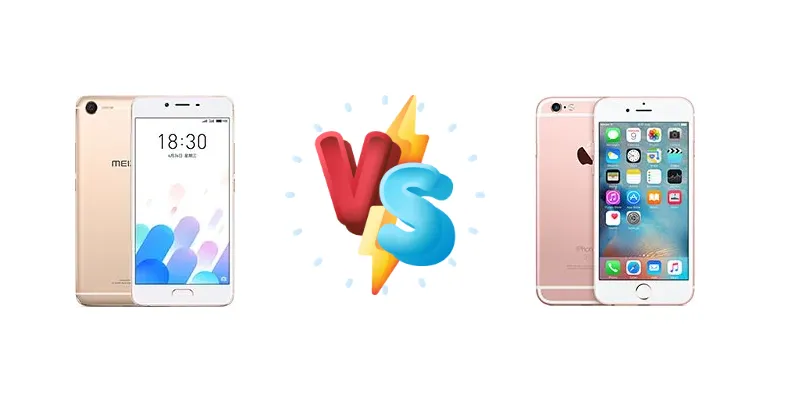
The Meizu E2 and Apple iPhone 6s represent vastly different approaches to the smartphone market. The iPhone 6s, released in 2015, was a flagship device, while the Meizu E2, launched later, aimed for the budget-conscious consumer. This comparison examines how these two phones stack up in 2024, considering performance, battery, and overall user experience.
🏆 Quick Verdict
For the average user in 2024, the Meizu E2 offers a more compelling package. While the iPhone 6s benefits from Apple’s optimized software, the E2’s newer Mediatek Helio P20 chipset and faster 24W charging provide a more modern experience, especially considering the age and potential battery degradation of the iPhone 6s.
| Network |
|---|
| 2G bands | GSM 850 / 900 / 1800 / 1900 - SIM 1 & SIM 2 | GSM 850 / 900 / 1800 / 1900 |
| 3G bands | HSDPA | HSDPA 850 / 900 / 1700 / 1900 / 2100 |
| 4G bands | LTE | 1, 2, 3, 4, 5, 7, 8, 12, 13, 17, 18, 19, 20, 25, 26, 28, 29 - A1688 |
| EDGE | Yes | - |
| GPRS | Yes | - |
| Speed | HSPA, LTE | HSPA 42.2/5.76 Mbps, LTE (2CA) Cat6 300/50 Mbps, EV-DO Rev.A 3.1 Mbps |
| Technology | GSM / HSPA / LTE | GSM / CDMA / HSPA / EVDO / LTE |
| | - | 1, 2, 3, 4, 5, 7, 8, 12, 13, 17, 18, 19, 20, 25, 26, 28, 29, 30, 38, 39, 40, 41 - A1687 |
| Launch |
|---|
| Announced | 2017, April. Released 2017, April | 2015, September 09. Released 2015, September 25 |
| Status | Discontinued | Discontinued |
| Body |
|---|
| Build | - | Glass front (Corning-made glass), aluminum back, aluminum frame |
| Dimensions | 153.7 x 75.7 x 7.5 mm (6.05 x 2.98 x 0.30 in) | 138.3 x 67.1 x 7.1 mm (5.44 x 2.64 x 0.28 in) |
| SIM | Nano-SIM + Nano-SIM | Nano-SIM |
| Weight | 155 g (5.47 oz) | 143 g (5.04 oz) |
| | - | Apple Pay (Visa, MasterCard, AMEX certified) |
| Display |
|---|
| Protection | - | Ion-strengthened glass, oleophobic coating |
| Resolution | 1080 x 1920 pixels, 16:9 ratio (~403 ppi density) | 750 x 1334 pixels, 16:9 ratio (~326 ppi density) |
| Size | 5.5 inches, 82.6 cm2 (~71.0% screen-to-body ratio) | 4.7 inches, 60.9 cm2 (~65.6% screen-to-body ratio) |
| Type | IPS LCD | IPS LCD, 500 nits |
| | - | 3D Touch |
| Platform |
|---|
| CPU | Octa-core (4x2.3 GHz Cortex-A53 & 4x1.6 GHz Cortex-A53) | Dual-core 1.84 GHz Twister |
| Chipset | Mediatek MT6757 Helio P20 (16 nm) | Apple A9 (14/16 nm - maker dependant) |
| GPU | Mali-T880MP2 | PowerVR GT7600 (six-core graphics) |
| OS | Android 7 (Nougat), Flyme 6 | iOS 9, upgradable to iOS 15.8.5 |
| Memory |
|---|
| Card slot | microSDXC (uses shared SIM slot) | No |
| Internal | 16GB 2GB RAM, 32GB 3GB RAM, 64GB 4GB RAM | 16GB 2GB RAM, 32GB 2GB RAM, 64GB 2GB RAM, 128GB 2GB RAM |
| Main Camera |
|---|
| Features | Quad-LED dual-tone flash, HDR, panorama | Dual-LED dual-tone flash, HDR |
| Single | 13 MP, f/2.2, PDAF | 12 MP, f/2.2, 29mm (standard), 1/3.0", 1.22µm, PDAF |
| Video | 1080p@30fps | 4K@30fps, 1080p@60fps,1080p@120fps, 720p@240fps |
| Selfie camera |
|---|
| Features | - | Face detection, HDR, panorama |
| Single | 8 MP, f/2.0, 1/3.2", 1.4µm | 5 MP, f/2.2, 31mm (standard) |
| Video | 1080p@30fps | 720p@30fps |
| Sound |
|---|
| 3.5mm jack | Yes | Yes |
| 35mm jack | Yes | Yes |
| Loudspeaker | Yes | Yes |
| | - | 16-bit/44.1kHz audio
|
| Comms |
|---|
| Bluetooth | 4.2, A2DP, LE | 4.2, A2DP, LE |
| NFC | No | Yes (Apple Pay only) |
| Positioning | GPS, GLONASS | GPS, GLONASS, GALILEO, QZSS |
| Radio | No | No |
| USB | microUSB 2.0 | Lightning, USB 2.0 |
| WLAN | Wi-Fi 802.11 a/b/g/n, dual-band, Wi-Fi Direct | Wi-Fi 802.11 a/b/g/n/ac, dual-band, hotspot |
| Features |
|---|
| Sensors | Fingerprint (front-mounted), accelerometer, gyro, proximity, compass | Fingerprint (front-mounted), accelerometer, gyro, proximity, compass, barometer |
| Battery |
|---|
| Charging | 24W wired | - |
| Stand-by | - | Up to 240 h (3G) |
| Talk time | - | Up to 14 h (3G) |
| Type | Li-Ion 3400 mAh, non-removable | Li-Ion 1715 mAh, non-removable (6.91 Wh) |
| Misc |
|---|
| Colors | Black, Gold, Silver | Space Gray, Silver, Gold, Rose Gold |
| Models | - | A1633, A1688, A1691, A1700, iPhone8,1 |
| Price | About 210 EUR | About 230 EUR |
| SAR | - | 1.14 W/kg (head) 1.14 W/kg (body) |
| SAR EU | - | 0.87 W/kg (head) 0.98 W/kg (body) |
| Tests |
|---|
| Audio quality | - |
Noise -93.8dB / Crosstalk -73.2dB |
| Battery life | - |
Endurance rating 62h
|
| Camera | - |
Photo / Video |
| Display | - |
Contrast ratio: 1481 (nominal), 3.783 (sunlight) |
| Loudspeaker | - |
Voice 66dB / Noise 64dB / Ring 65dB
|
| Performance | - |
Basemark OS II 2.0: 2195 |
Meizu E2
- Faster 24W charging
- Octa-core processor for better multitasking
- More modern chipset architecture
- Camera quality likely inferior to iPhone 6s
- Battery capacity unknown, potential for lower endurance
Apple iPhone 6s
- Optimized iOS software experience
- Reliable 12MP camera (for its time)
- Strong brand reputation and ecosystem integration
- Slow charging speeds
- Aging battery with potential degradation
- Dual-core processor may struggle with modern multitasking
Display Comparison
Both the Meizu E2 and iPhone 6s share a contrast ratio of 1481:1 (nominal) and 3.783:1 (sunlight), suggesting similar outdoor visibility. However, the specific panel technology and resolution are not provided for the Meizu E2. The iPhone 6s’s 4.7-inch display, while sharp for its time, is smaller than many modern smartphones. The shared contrast ratio indicates a similar level of black depth and color vibrancy under direct sunlight, but the iPhone 6s likely benefits from Apple’s color calibration.
Camera Comparison
Both devices are listed as having Photo/Video capabilities, but specific details are lacking. The iPhone 6s is known for its reliable 12MP camera with decent image processing. Without sensor size or aperture information for the Meizu E2, it’s difficult to make a direct comparison. However, given the E2’s budget positioning, it’s unlikely to match the iPhone 6s’s image quality, particularly in low-light conditions. The iPhone 6s’s image stabilization would also be a significant advantage.
Performance
The core architectural difference is stark. The iPhone 6s utilizes Apple’s dual-core 1.84 GHz Twister CPU, built on a 14nm or 16nm process, prioritizing single-core performance and efficiency. Conversely, the Meizu E2 features a Mediatek Helio P20 with an octa-core configuration (4x2.3 GHz Cortex-A53 & 4x1.6 GHz Cortex-A53) on a 16nm node. While the iPhone 6s’s A9 chip was incredibly efficient for its time, the E2’s eight cores offer superior multitasking capabilities. The A9’s strength lies in its optimized instruction set and tight software integration, but the E2’s newer chipset architecture should provide a noticeable advantage in handling multiple apps simultaneously.
Battery Life
The iPhone 6s boasts an endurance rating of 62 hours, a respectable figure for its time. The Meizu E2’s battery capacity is not specified, but it compensates with 24W wired charging. This significantly faster charging speed is a major advantage, allowing for quicker top-ups compared to the iPhone 6s’s slower charging. Given the age of the iPhone 6s, its battery has likely degraded, further diminishing its endurance. The E2’s faster charging mitigates the potential disadvantage of a smaller battery capacity.
Buying Guide
Buy the Meizu E2 if you prioritize a more responsive multitasking experience thanks to its octa-core processor and faster charging speeds. It’s ideal for users who need a functional smartphone for everyday tasks without breaking the bank. Buy the Apple iPhone 6s if you are deeply embedded in the Apple ecosystem, value iOS’s software experience, and are willing to accept a smaller battery life and slower charging in exchange for brand familiarity and potentially better long-term software support (though increasingly limited).
Frequently Asked Questions
❓ Is the Mediatek Helio P20 in the Meizu E2 powerful enough for modern apps?
While not a flagship-level processor, the Helio P20 is capable of running most modern apps smoothly. Its octa-core configuration provides sufficient processing power for everyday tasks, social media, and light gaming. However, demanding games or resource-intensive applications may experience some slowdown.
❓ How much has the iPhone 6s's battery life degraded over time?
Given the iPhone 6s was released in 2015, significant battery degradation is highly likely. Battery health typically declines over years of use, resulting in shorter runtimes and potentially unexpected shutdowns. Replacing the battery is an option, but adds to the overall cost of ownership.
❓ Does the Meizu E2 support software updates?
Software update support for the Meizu E2 is likely limited, given its age and budget positioning. It may not receive the same level of ongoing security patches or feature updates as the iPhone 6s, although Apple's support is also dwindling for this older model.
❓ Is the iPhone 6s still a secure device in 2024?
While Apple provides security updates for older devices for a period, the iPhone 6s is nearing the end of its supported lifecycle. This means it may become increasingly vulnerable to security threats over time. Using a VPN and practicing safe browsing habits are recommended.