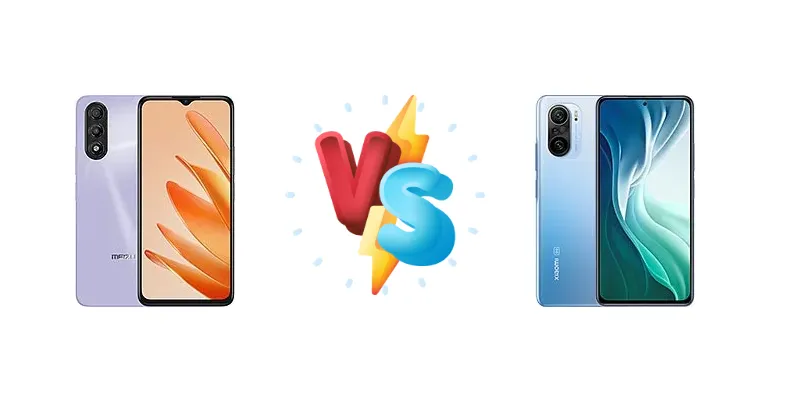
The Meizu Blue 20 and Xiaomi Mi 11i represent distinct approaches to the mid-range smartphone market. The Mi 11i, released with a flagship Snapdragon 888, now faces competition from newer, more efficient chipsets like the Unisoc T765 powering the Meizu Blue 20. This comparison dissects their strengths and weaknesses to determine which device delivers the best experience for your needs.
🏆 Quick Verdict
For most users, the Xiaomi Mi 11i remains the stronger choice. Its Snapdragon 888 5G chipset provides significantly higher peak performance, crucial for demanding tasks and gaming. While the Meizu Blue 20 offers respectable efficiency with the Unisoc T765, it can't match the raw power of the Mi 11i.
| Network |
|---|
| 2G bands | GSM 850 / 900 / 1800 / 1900 | GSM 850 / 900 / 1800 / 1900 |
| 3G bands | HSDPA 850 / 900 / 1900 / 2100 | HSDPA 850 / 900 / 1700(AWS) / 1900 / 2100 |
| 4G bands | LTE | 1, 2, 3, 4, 5, 7, 8, 12, 17, 20, 28, 38, 40, 41, 66 |
| 5G bands | SA/NSA | 1, 3, 5, 7, 8, 20, 28, 38, 41, 77, 78 SA/NSA |
| Speed | HSPA, LTE, 5G | HSPA, LTE, 5G |
| Technology | GSM / HSPA / LTE / 5G | GSM / HSPA / LTE / 5G |
| Launch |
|---|
| Announced | 2024, July 17 | 2021, March 29 |
| Status | Available. Released 2024, July | Available. Released 2021, May 31 |
| Body |
|---|
| Dimensions | 8.3 mm thickness | 163.7 x 76.4 x 7.8 mm (6.44 x 3.01 x 0.31 in) |
| SIM | Nano-SIM + Nano-SIM | Nano-SIM + Nano-SIM |
| Weight | - | 196 g (6.91 oz) |
| | - | IP53, dust and splash resistant |
| Display |
|---|
| Protection | - | Corning Gorilla Glass 5 |
| Resolution | 1080 x 2400 pixels, 20:9 ratio (~404 ppi density) | 1080 x 2400 pixels, 20:9 ratio (~395 ppi density) |
| Size | 6.52 inches, 102.6 cm2 | 6.67 inches, 107.4 cm2 (~85.9% screen-to-body ratio) |
| Type | IPS LCD, 90Hz | Super AMOLED, 120Hz, HDR10+, 900 nits (HBM), 1300 nits (peak) |
| Platform |
|---|
| CPU | Octa-core (2x2.3 GHz Cortex-A76 & 6x2.1 GHz Cortex-A55) | Octa-core (1x2.84 GHz Cortex-X1 & 3x2.42 GHz Cortex-A78 & 4x1.80 GHz Cortex-A55) |
| Chipset | Unisoc T765 (6 nm) | Qualcomm SM8350 Snapdragon 888 5G (5 nm) |
| GPU | Mali-G57 MC2 | Adreno 660 |
| OS | Flyme AIOS | Android 11, MIUI 12 |
| Memory |
|---|
| Card slot | microSDXC | No |
| Internal | 128GB 6GB RAM, 256GB 8GB RAM | 128GB 8GB RAM, 256GB 8GB RAM |
| | - | UFS 3.1 |
| Main Camera |
|---|
| Dual | 13 MP, AF (interpolated to 50 MP)
Secondary unspecified camera | - |
| Features | LED flash, panorama, HDR | Color spectrum sensor, LED flash, HDR, panorama |
| Single | - | 20 MP, f/2.5, (wide), 1/3.4", 0.8µm |
| Triple | - | 108 MP, f/1.8, 26mm (wide), 1/1.52", 0.7µm, PDAF
8 MP, f/2.2, 119˚ (ultrawide)
5 MP, f/2.4, 50mm (telephoto macro), 1/5.0", 1.12µm, AF |
| Video | 4K@30fps, 1080p@30fps | 8K@30fps, 4K@30/60fps, 1080p@30/60/120/240/960fps, gyro-EIS, HDR10+ |
| Selfie camera |
|---|
| Features | - | HDR |
| Single | 5 MP (interpolated to 8 MP) | 20 MP, f/2.5, (wide), 1/3.4", 0.8µm |
| Video | 1080p@30fps | 1080p@30fps, 720p@120fps |
| Sound |
|---|
| 3.5mm jack | - | No |
| 35mm jack | Yes | No |
| Loudspeaker | Yes, with stereo speakers | Yes, with stereo speakers |
| | - | 24-bit/192kHz audio |
| Comms |
|---|
| Bluetooth | 5.0, A2DP | 5.2, A2DP, LE |
| Infrared port | - | Yes |
| NFC | Unspecified | Yes (market/region dependent) |
| Positioning | GPS, GALILEO, GLONASS, BDS | GPS (L1+L5), GLONASS (L1), BDS (B1I+B1c+B2a), GALILEO (E1+E5a), QZSS (L1+L5), NavIC (L5) |
| Radio | No | No |
| USB | USB Type-C | USB Type-C 2.0, OTG |
| WLAN | Wi-Fi 802.11 a/b/g/n/ac, dual-band | Wi-Fi 802.11 a/b/g/n/ac/6, dual-band, Wi-Fi Direct |
| Features |
|---|
| Sensors | Fingerprint (side-mounted); unspecified sensors | Fingerprint (side-mounted), accelerometer, gyro, proximity, compass, barometer |
| Battery |
|---|
| Charging | - | 33W wired, PD3.0, QC3, 100% in 52 min |
| Type | 5010 mAh | Li-Po 4520 mAh |
| Misc |
|---|
| Colors | Black, White, Purple | Celestial Silver, Frosty White, Cosmic Black |
| Models | - | M2012K11G |
| Price | - | About 230 EUR |
| SAR | - | 0.95 W/kg (head) 0.74 W/kg (body) |
| SAR EU | - | 0.57 W/kg (head) 0.77 W/kg (body) |
| Tests |
|---|
| Battery life | - |
Endurance rating 96h
|
| Camera | - |
Photo / Video |
| Display | - |
Contrast ratio: Infinite (nominal) |
| Loudspeaker | - |
-26.0 LUFS (Very good)
|
| Performance | - |
AnTuTu: 690021 (v8)
GeekBench: 3641 (v5.1) |
Meizu Blue 20
- Potentially better thermal management due to 6nm Unisoc T765.
- Good battery life (96h endurance rating).
- Likely more affordable price point.
- Significantly lower CPU and GPU performance compared to Snapdragon 888.
- Limited camera specifications suggest a less capable camera system.
- Charging speed is unknown and potentially slower.
Xiaomi Mi 11i
- Flagship-level performance with Snapdragon 888 5G.
- High peak display brightness (939 nits).
- Fast 33W charging with PD3.0 and QC3.
- Snapdragon 888 is known for potential thermal throttling.
- May be more expensive than the Meizu Blue 20.
- Battery life is comparable, but the chipset is less efficient.
Display Comparison
The Xiaomi Mi 11i boasts a measured peak brightness of 939 nits, ensuring excellent visibility even in direct sunlight. While the Meizu Blue 20’s display specifications are not provided, it’s likely to be lower, potentially impacting outdoor usability. The Mi 11i’s ‘Infinite’ contrast ratio (nominal) suggests a typical AMOLED panel, offering deep blacks and vibrant colors. Without further details on the Blue 20’s panel type, it’s difficult to assess its color accuracy or viewing angles, but the Mi 11i has a clear advantage in brightness.
Camera Comparison
Both devices offer photo and video capabilities, but detailed camera specifications are limited. Without sensor size, aperture, or OIS information for either phone, a direct comparison is challenging. The Mi 11i, being a former flagship, likely features a more sophisticated camera system with better image processing. The absence of details on the Meizu Blue 20’s camera suggests a more basic setup, potentially focusing on affordability rather than image quality. We can assume the Mi 11i will offer more versatile shooting options.
Performance
The core difference lies in the chipsets. The Xiaomi Mi 11i’s Snapdragon 888 (5nm) features a powerful Cortex-X1 prime core clocked at 2.84 GHz, alongside three Cortex-A78 cores and four Cortex-A55 cores. This configuration delivers significantly higher CPU and GPU performance compared to the Meizu Blue 20’s Unisoc T765 (6nm). The T765, with its dual Cortex-A76 and six Cortex-A55 cores, prioritizes efficiency. The 5nm fabrication process of the Snapdragon 888, while powerful, is known to generate more heat than the 6nm process of the Unisoc T765, potentially leading to thermal throttling during sustained workloads. However, the sheer processing power of the Snapdragon 888 will likely outweigh this concern for most users.
Battery Life
Both the Meizu Blue 20 and Xiaomi Mi 11i achieve an endurance rating of 96 hours, indicating similar overall battery life. However, this doesn’t tell the whole story. The Mi 11i supports 33W wired charging with PD3.0 and QC3, reaching 100% charge in 52 minutes. The charging speed of the Meizu Blue 20 is unknown, but a slower charging rate would be a disadvantage. The Unisoc T765’s efficiency in the Blue 20 may contribute to comparable endurance despite potentially having a smaller battery capacity.
Buying Guide
Buy the Meizu Blue 20 if you prioritize power efficiency and a potentially cooler running phone for everyday tasks. Its Unisoc T765 is well-suited for casual users and those who value battery life over absolute performance. Buy the Xiaomi Mi 11i if you demand flagship-level performance for gaming, video editing, or other resource-intensive applications. The Snapdragon 888 delivers a noticeable performance boost, even if it comes with potential thermal considerations.
Frequently Asked Questions
❓ Will the Snapdragon 888 in the Mi 11i overheat during extended gaming sessions?
The Snapdragon 888 is known to generate heat under sustained load. While the Mi 11i likely has thermal management features, some throttling is possible during prolonged gaming. However, the performance drop may not be significant enough to ruin the experience for most users.
❓ How does the Unisoc T765 in the Meizu Blue 20 handle demanding apps like video editors?
The Unisoc T765 is a capable chipset for everyday tasks, but it will struggle with demanding applications like video editors. Rendering times will be significantly slower compared to the Snapdragon 888. It's best suited for light editing or using cloud-based video editing services.
❓ Is the 96-hour battery endurance rating realistic for typical usage?
The 96-hour endurance rating is based on a specific usage model. Real-world battery life will vary depending on your usage patterns, screen brightness, and network conditions. Expect to get at least a full day of moderate use from both devices.
❓ Does the Xiaomi Mi 11i support 5G connectivity?
Yes, the Xiaomi Mi 11i is equipped with a Snapdragon 888 5G chipset, providing full support for 5G networks. This allows for faster download and upload speeds where 5G coverage is available.