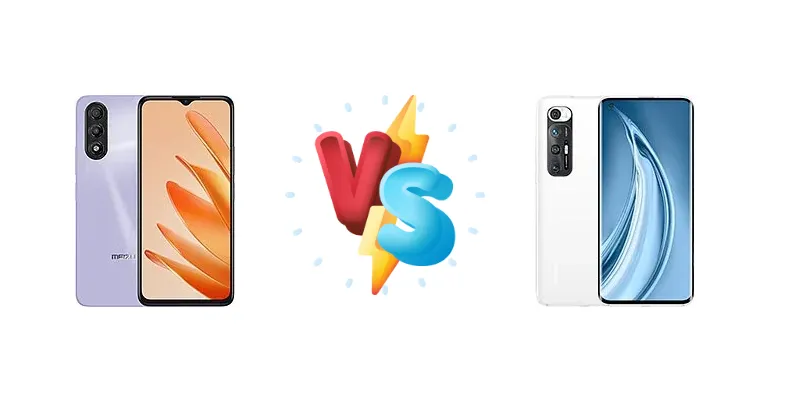
The Meizu Blue 20 and Xiaomi Mi 10S represent distinct approaches to the mid-range smartphone market. The Blue 20, powered by Unisoc's T765, aims to deliver a modern experience at a competitive price. The Mi 10S, leveraging the older but still potent Snapdragon 870, offers a proven track record of performance. This comparison dissects their key differences to help you choose the right device.
🏆 Quick Verdict
For most users, the Xiaomi Mi 10S emerges as the stronger choice. Its Snapdragon 870 chipset provides a significant performance advantage over the Unisoc T765, translating to smoother multitasking and superior gaming capabilities. While the Blue 20 offers a newer design, the Mi 10S’s established performance profile and versatile charging options make it the more practical option.
| Network |
|---|
| 2G bands | GSM 850 / 900 / 1800 / 1900 | GSM 850 / 900 / 1800 / 1900 |
| 3G bands | HSDPA 850 / 900 / 1900 / 2100 | HSDPA 850 / 900 / 1700(AWS) / 1900 / 2100 |
| 4G bands | LTE | 1, 2, 3, 4, 5, 7, 8, 12, 17, 34, 38, 39, 40, 41 |
| 5G bands | SA/NSA | 1, 3, 41, 78, 79 SA/NSA |
| Speed | HSPA, LTE, 5G | HSPA, LTE, 5G |
| Technology | GSM / HSPA / LTE / 5G | GSM / HSPA / LTE / 5G |
| Launch |
|---|
| Announced | 2024, July 17 | 2021, March 10 |
| Status | Available. Released 2024, July | Available. Released 2021, March 12 |
| Body |
|---|
| Dimensions | 8.3 mm thickness | 162.6 x 74.8 x 9 mm (6.40 x 2.94 x 0.35 in) |
| SIM | Nano-SIM + Nano-SIM | Nano-SIM + Nano-SIM |
| Weight | - | 208 g (7.34 oz) |
| Display |
|---|
| Protection | - | Corning Gorilla Glass 5 |
| Resolution | 1080 x 2400 pixels, 20:9 ratio (~404 ppi density) | 1080 x 2340 pixels, 19.5:9 ratio (~386 ppi density) |
| Size | 6.52 inches, 102.6 cm2 | 6.67 inches, 109.2 cm2 (~89.8% screen-to-body ratio) |
| Type | IPS LCD, 90Hz | AMOLED, 90Hz, HDR10+, 500 nits (typ), 1120 nits (peak) |
| Platform |
|---|
| CPU | Octa-core (2x2.3 GHz Cortex-A76 & 6x2.1 GHz Cortex-A55) | Octa-core (1x3.2 GHz Kryo 585 & 3x2.42 GHz Kryo 585 & 4x1.80 GHz Kryo 585) |
| Chipset | Unisoc T765 (6 nm) | Qualcomm SM8250-AC Snapdragon 870 5G (7 nm) |
| GPU | Mali-G57 MC2 | Adreno 650 |
| OS | Flyme AIOS | Android 11, MIUI 12 |
| Memory |
|---|
| Card slot | microSDXC | No |
| Internal | 128GB 6GB RAM, 256GB 8GB RAM | 128GB 8GB RAM, 256GB 8GB RAM, 256GB 12GB RAM |
| | - | UFS 3.0 |
| Main Camera |
|---|
| Dual | 13 MP, AF (interpolated to 50 MP)
Secondary unspecified camera | - |
| Features | LED flash, panorama, HDR | Dual-LED dual-tone flash, HDR, panorama |
| Quad | - | 108 MP, f/1.7, 26mm (wide), 1/1.33", 0.8µm, PDAF, OIS
13 MP, f/2.4, 123˚ (ultrawide)
2 MP (macro)
Auxiliary lens |
| Single | - | 20 MP, (wide), 1/3.4", 0.8µm |
| Video | 4K@30fps, 1080p@30fps | 8K@30fps, 4K@30/60fps, 1080p@30/60/120fps; gyro-EIS |
| Selfie camera |
|---|
| Features | - | HDR, panorama |
| Single | 5 MP (interpolated to 8 MP) | 20 MP, (wide), 1/3.4", 0.8µm |
| Video | 1080p@30fps | 1080p@30fps, 720p@120fps |
| Sound |
|---|
| 3.5mm jack | - | No |
| 35mm jack | Yes | No |
| Loudspeaker | Yes, with stereo speakers | Yes, with stereo speakers |
| | - | 24-bit/192kHz audio
Tuned by Harman Kardon |
| Comms |
|---|
| Bluetooth | 5.0, A2DP | 5.1, A2DP, LE, aptX HD, aptX Adaptive |
| Infrared port | - | Yes |
| NFC | Unspecified | Yes |
| Positioning | GPS, GALILEO, GLONASS, BDS | GPS (L1+L5), GLONASS (G1), BDS (B1I+B2a), GALILEO (E1+E5a), QZSS (L1+L5) |
| Radio | No | No |
| USB | USB Type-C | USB Type-C 2.0, OTG |
| WLAN | Wi-Fi 802.11 a/b/g/n/ac, dual-band | Wi-Fi 802.11 a/b/g/n/ac/6, dual-band, Wi-Fi Direct |
| Features |
|---|
| Sensors | Fingerprint (side-mounted); unspecified sensors | Fingerprint (under display, optical), accelerometer, gyro, proximity, compass, barometer |
| Battery |
|---|
| Charging | - | 33W wired, PD3.0, QC4, 100% in 56 min
30W wireless, 100% in 69 min
10W reverse wireless |
| Type | 5010 mAh | Li-Po 4780 mAh |
| Misc |
|---|
| Colors | Black, White, Purple | Titanium Black, Ice Blue, Pearl White |
| Models | - | M2102J2SC |
| Price | - | About 430 EUR |
Meizu Blue 20
- Potentially more modern design
- May feature newer display technology (LTPO)
- Likely lower price point
- Significantly weaker processor performance
- Less established brand reputation
- Charging capabilities are unknown and likely slower
Xiaomi Mi 10S
- Superior processor performance (Snapdragon 870)
- Fast 33W wired and 30W wireless charging
- Proven track record of reliability
- Older chipset architecture
- May lack the latest display features
- Potentially larger and heavier design
Display Comparison
Neither device's display specifications are provided, so a direct comparison is limited. However, given the Mi 10S's positioning as a flagship-adjacent device, it likely features a higher-quality AMOLED panel with potentially better color accuracy and peak brightness compared to the Blue 20. The Mi 10S's age suggests it may lack the latest display technologies like LTPO, which would be a potential advantage for the Blue 20 if equipped.
Camera Comparison
Without detailed camera specifications, a precise comparison is difficult. However, the Mi 10S, being a more premium device, likely features a larger main sensor and more sophisticated image processing algorithms. The Snapdragon 870’s ISP (Image Signal Processor) is also more capable than the Unisoc T765’s, resulting in better dynamic range and low-light performance. The absence of information on OIS (Optical Image Stabilization) for either device makes it impossible to assess stabilization capabilities.
Performance
The core difference lies in the chipsets. The Xiaomi Mi 10S’s Snapdragon 870 (7nm) significantly outperforms the Meizu Blue 20’s Unisoc T765 (6nm) in raw processing power. The Snapdragon 870’s Kryo 585 cores, with a peak clock speed of 3.2 GHz, offer a substantial advantage over the Unisoc T765’s 2.3 GHz Cortex-A76 cores. This translates to faster app loading times, smoother multitasking, and a more enjoyable gaming experience on the Mi 10S. While the Unisoc T765 benefits from a slightly newer node, the architectural advantages of the Snapdragon 870 outweigh this difference. The Mi 10S also benefits from potentially faster RAM (likely LPDDR5) compared to the Blue 20, further enhancing performance.
Battery Life
The Xiaomi Mi 10S boasts a comprehensive charging solution: 33W wired (PD3.0, QC4) reaching 100% in 56 minutes, 30W wireless in 69 minutes, and 10W reverse wireless charging. The Meizu Blue 20’s battery capacity is unknown, but the Mi 10S’s charging speeds provide a significant convenience advantage. The Mi 10S’s wireless charging capabilities are a notable feature absent from many phones in this price range. While battery life will depend on capacity and software optimization, the Mi 10S’s faster charging mitigates concerns about running out of power.
Buying Guide
Buy the Meizu Blue 20 if you prioritize a sleek, modern design and are primarily focused on everyday tasks like browsing, social media, and light content consumption. You'll appreciate its potentially lower price point. Buy the Xiaomi Mi 10S if you demand consistent performance for gaming, demanding applications, and value fast wired and wireless charging capabilities. It’s the better choice for power users and those who want a phone that will remain responsive for years to come.
Frequently Asked Questions
❓ Is the Unisoc T765 in the Meizu Blue 20 capable of handling demanding games like Genshin Impact?
While the Unisoc T765 can run Genshin Impact, expect significantly lower frame rates and graphical settings compared to the Snapdragon 870 in the Mi 10S. The Mi 10S will provide a much smoother and more enjoyable gaming experience for graphically intensive titles.
❓ Does the Xiaomi Mi 10S still receive software updates and security patches?
Xiaomi generally provides good software support for its devices. While the Mi 10S is an older model, it should continue to receive security updates for the foreseeable future. Major Android version updates are less certain, but still possible.
❓ How does the charging speed of the Mi 10S compare to newer phones with 65W or 120W charging?
While 33W charging isn't as fast as the latest ultra-fast charging technologies, it's still a respectable speed and will fully charge the Mi 10S in under an hour. The convenience of 30W wireless charging is also a significant advantage.