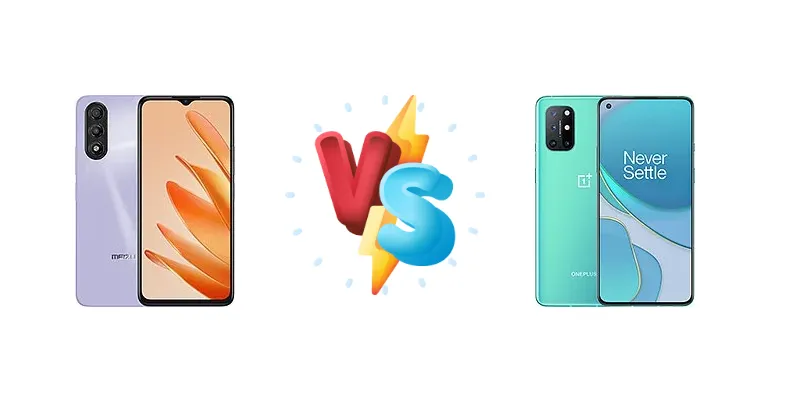
The Meizu Blue 20 represents a resurgence of the brand with a focus on value, powered by the Unisoc T765. It directly challenges established players like the OnePlus 8T+ 5G, which, while older, still boasts the powerful Snapdragon 865. This comparison dissects the trade-offs between a newer, budget-focused chipset and a proven, albeit aging, flagship SoC.
🏆 Quick Verdict
For the average user prioritizing consistent performance and fast charging, the OnePlus 8T+ 5G emerges as the stronger choice. Its Snapdragon 865, built on a 7nm+ process, delivers a more robust experience, especially in demanding tasks, despite the Meizu Blue 20's newer architecture.
| Network |
|---|
| 2G bands | GSM 850 / 900 / 1800 / 1900 | GSM 850 / 900 / 1800 / 1900 |
| 3G bands | HSDPA 850 / 900 / 1900 / 2100 | HSDPA 850 / 900 / 1700(AWS) / 1900 / 2100 |
| 4G bands | LTE | 1, 2, 3, 4, 5, 7, 8, 12, 13, 17, 18, 19, 20, 25, 26, 28, 29, 30, 34, 38, 39, 40, 41, 46, 48, 66, 71 |
| 5G bands | SA/NSA | 2, 25, 41, 66, 71 Sub6/mmWave |
| Speed | HSPA, LTE, 5G | HSPA 42.2/5.76 Mbps, LTE (5CA) Cat18 1200/200 Mbps, 5G 7.5 Gbps DL |
| Technology | GSM / HSPA / LTE / 5G | GSM / CDMA / HSPA / LTE / 5G |
| Launch |
|---|
| Announced | 2024, July 17 | 2020, October 14 |
| Status | Available. Released 2024, July | Available. Released 2020, October 16 |
| Body |
|---|
| Build | - | Glass front (Gorilla Glass 5), glass back (Gorilla Glass 5), aluminum frame |
| Dimensions | 8.3 mm thickness | 160.7 x 74.1 x 8.4 mm (6.33 x 2.92 x 0.33 in) |
| SIM | Nano-SIM + Nano-SIM | Nano-SIM |
| Weight | - | - |
| Display |
|---|
| Protection | - | Corning Gorilla Glass 5 |
| Resolution | 1080 x 2400 pixels, 20:9 ratio (~404 ppi density) | 1080 x 2400 pixels, 20:9 ratio (~402 ppi density) |
| Size | 6.52 inches, 102.6 cm2 | 6.55 inches, 103.6 cm2 (~87.0% screen-to-body ratio) |
| Type | IPS LCD, 90Hz | Fluid AMOLED, 120Hz, HDR10+ |
| Platform |
|---|
| CPU | Octa-core (2x2.3 GHz Cortex-A76 & 6x2.1 GHz Cortex-A55) | Octa-core (1x2.84 GHz Cortex-A77 & 3x2.42 GHz Cortex-A77 & 4x1.80 GHz Cortex-A55) |
| Chipset | Unisoc T765 (6 nm) | Qualcomm SM8250 Snapdragon 865 5G (7 nm+) |
| GPU | Mali-G57 MC2 | Adreno 650 |
| OS | Flyme AIOS | Android 11, OxygenOS 11 |
| Memory |
|---|
| Card slot | microSDXC | No |
| Internal | 128GB 6GB RAM, 256GB 8GB RAM | 256GB 12GB RAM |
| Main Camera |
|---|
| Dual | 13 MP, AF (interpolated to 50 MP)
Secondary unspecified camera | - |
| Features | LED flash, panorama, HDR | Dual-LED flash, HDR, panorama |
| Quad | - | 48 MP, f/1.7, 26mm (wide), 1/2.0", 0.8µm, PDAF, OIS
16 MP, f/2.2, 14mm, 123˚ (ultrawide), 1/3.6", 1.0µm
5 MP (macro)
Auxiliary lens |
| Video | 4K@30fps, 1080p@30fps | 4K@30/60fps, 1080p@30/60/240fps, Auto HDR, gyro-EIS |
| Selfie camera |
|---|
| Features | - | HDR |
| Single | 5 MP (interpolated to 8 MP) | 16 MP, f/2.4, (wide), 1/3.06", 1.0µm |
| Video | 1080p@30fps | 1080p@30fps, gyro-EIS |
| Sound |
|---|
| 35mm jack | Yes | No |
| Loudspeaker | Yes, with stereo speakers | Yes, with stereo speakers |
| Comms |
|---|
| Bluetooth | 5.0, A2DP | 5.1, A2DP, LE, aptX HD |
| NFC | Unspecified | Yes |
| Positioning | GPS, GALILEO, GLONASS, BDS | GPS (L1+L5), GLONASS (G1), BDS (B1), GALILEO (E1+E5a) |
| Radio | No | No |
| USB | USB Type-C | USB Type-C 3.1, OTG |
| WLAN | Wi-Fi 802.11 a/b/g/n/ac, dual-band | Wi-Fi 802.11 a/b/g/n/ac/6, dual-band, Wi-Fi Direct, DLNA |
| Features |
|---|
| Sensors | Fingerprint (side-mounted); unspecified sensors | Fingerprint (under display, optical), accelerometer, gyro, proximity, compass, barometer (market dependant) |
| Battery |
|---|
| Charging | - | 65W wired, 100% in 39 min |
| Type | 5010 mAh | Li-Po 4500 mAh |
| Misc |
|---|
| Colors | Black, White, Purple | Aquamarine Green, Lunar Silver |
| Models | - | KB2007 |
| Price | - | About 640 EUR |
Meizu Blue 20
- Potentially lower price point
- Modern Unisoc T765 chipset (6nm)
- Sleek design (assumed based on brand aesthetic)
- Likely lower overall performance
- Uncertain software support and updates
- Potentially less refined camera system
OnePlus 8T+ 5G
- Powerful Snapdragon 865 processor
- 65W SuperVOOC fast charging (39 minutes)
- Proven software experience and updates
- Older chipset (Snapdragon 865)
- Potentially higher price
- May exhibit some throttling under sustained load
Display Comparison
Neither device's display specifications are provided, so a direct comparison is limited. However, given the OnePlus 8T+'s positioning, it likely features a high refresh rate AMOLED panel, potentially 120Hz, with excellent color accuracy. The Meizu Blue 20, aiming for value, may utilize a slightly less advanced AMOLED or LCD panel. The OnePlus 8T+ likely benefits from a more refined display calibration process, resulting in a more visually pleasing experience.
Camera Comparison
Without specific camera specs, analysis is limited. However, the OnePlus 8T+ 5G, being a flagship-adjacent device, likely features a more sophisticated camera system with a larger primary sensor and optical image stabilization (OIS). The Meizu Blue 20 may rely on software processing to compensate for a potentially smaller sensor. The Snapdragon 865’s ISP (Image Signal Processor) is also more advanced, enabling better image quality and faster processing speeds. The absence of details on the Meizu Blue 20’s camera setup suggests a focus on cost reduction in this area.
Performance
The core difference lies in the chipsets. The OnePlus 8T+ 5G’s Snapdragon 865, fabricated on a 7nm+ process, features a prime Cortex-A77 core clocked at 2.84 GHz, supported by three additional A77 cores and four A55 cores. This configuration provides a significant performance advantage over the Meizu Blue 20’s Unisoc T765. While the T765 (6nm) utilizes Cortex-A76 cores, their lower clock speed (2.3 GHz) and the overall architecture place it in a lower performance tier. The Snapdragon 865’s Adreno 650 GPU also offers superior graphics capabilities, crucial for gaming. The 7nm+ process also contributes to better thermal management, reducing the likelihood of throttling during sustained workloads.
Battery Life
The OnePlus 8T+ 5G boasts a standout feature: 65W SuperVOOC charging, capable of fully charging the device in just 39 minutes. While the Meizu Blue 20’s battery capacity is unknown, the charging speed is not specified, suggesting it’s likely slower. The Snapdragon 865, while powerful, is less power-efficient than the Unisoc T765. However, the OnePlus 8T+'s optimized software and potentially larger battery capacity could offset this difference, providing comparable real-world battery life, coupled with the convenience of incredibly fast charging.
Buying Guide
Buy the Meizu Blue 20 if you need a modern design and are comfortable with a potentially less refined software experience in exchange for a lower price point. It's ideal for everyday tasks and light gaming. Buy the OnePlus 8T+ 5G if you prioritize consistent performance, a proven track record with software updates, and the convenience of 65W SuperVOOC charging, even if it means paying a premium and accepting an older chipset.
Frequently Asked Questions
❓ Is the Unisoc T765 in the Meizu Blue 20 capable of running demanding games like Genshin Impact?
While the Unisoc T765 can run Genshin Impact, expect to make compromises in graphics settings. The Snapdragon 865 in the OnePlus 8T+ 5G will deliver a smoother, more consistent experience at higher settings due to its more powerful GPU and superior thermal management.
❓ How does the software experience differ between the Meizu Blue 20 and the OnePlus 8T+ 5G?
OnePlus is known for its OxygenOS, which offers a clean, near-stock Android experience with frequent updates. Meizu's Flyme OS, while improving, has historically been more heavily customized and may receive fewer updates. This could impact long-term software support and feature availability.
❓ Will the Snapdragon 865 in the OnePlus 8T+ 5G show its age in 2024 with newer apps and software updates?
While not the latest chipset, the Snapdragon 865 remains a capable performer. It will handle most tasks without issue. However, extremely demanding applications or future software optimizations *could* reveal its limitations compared to newer SoCs. The 865's performance is still very respectable.