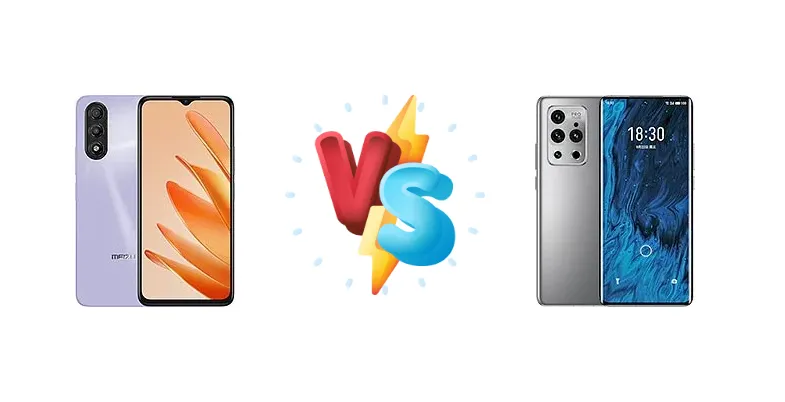
The Meizu Blue 20 represents a shift for the brand, opting for a Unisoc chipset while the 18s Pro stands as a refined Snapdragon 888+ flagship. This comparison dissects the core differences between these two devices, focusing on how their contrasting hardware impacts real-world performance, battery life, and overall user experience, especially considering the Blue 20's more recent release and potentially lower price point.
🏆 Quick Verdict
For most users, the Meizu 18s Pro offers a more consistently powerful experience thanks to the Snapdragon 888+. While the Unisoc T765 in the Blue 20 is capable, the 888+'s superior CPU and GPU performance, coupled with established optimization, provide a smoother experience for demanding tasks and gaming. However, the Blue 20's potential lower price makes it a compelling option for budget-conscious buyers.
| Network |
|---|
| 2G bands | GSM 850 / 900 / 1800 / 1900 | GSM 850 / 900 / 1800 / 1900 |
| 3G bands | HSDPA 850 / 900 / 1900 / 2100 | HSDPA 850 / 900 / 1700(AWS) / 1900 / 2100 |
| 4G bands | LTE | 1, 2, 3, 4, 5, 7, 8, 12, 34, 38, 39, 40, 41 |
| 5G bands | SA/NSA | 1, 3, 41, 77, 78, 79 SA/NSA |
| Speed | HSPA, LTE, 5G | HSPA, LTE, 5G |
| Technology | GSM / HSPA / LTE / 5G | GSM / HSPA / LTE / 5G |
| Launch |
|---|
| Announced | 2024, July 17 | 2021, September 22. Released 2021, September 23 |
| Status | Available. Released 2024, July | Discontinued |
| Body |
|---|
| Dimensions | 8.3 mm thickness | 162.5 x 73 x 8.1 mm (6.40 x 2.87 x 0.32 in) |
| SIM | Nano-SIM + Nano-SIM | Nano-SIM + Nano-SIM |
| Weight | - | 189 g (6.67 oz) |
| | - | Waterproof |
| Display |
|---|
| Protection | - | Corning Gorilla Glass 6 |
| Resolution | 1080 x 2400 pixels, 20:9 ratio (~404 ppi density) | 1440 x 3200 pixels, 20:9 ratio (~526 ppi density) |
| Size | 6.52 inches, 102.6 cm2 | 6.7 inches, 107.6 cm2 (~90.7% screen-to-body ratio) |
| Type | IPS LCD, 90Hz | Super AMOLED, 120Hz, HDR10+, 420 nits (typ), 1300 nits (peak) |
| Platform |
|---|
| CPU | Octa-core (2x2.3 GHz Cortex-A76 & 6x2.1 GHz Cortex-A55) | Octa-core (1x3.0 GHz Cortex-X1 & 3x2.42 GHz Cortex-A78 & 4x1.80 GHz Cortex-A55) |
| Chipset | Unisoc T765 (6 nm) | Qualcomm SM8350 Snapdragon 888+ 5G (5 nm) |
| GPU | Mali-G57 MC2 | Adreno 660 |
| OS | Flyme AIOS | Android 11, Flyme 9.2 |
| Memory |
|---|
| Card slot | microSDXC | No |
| Internal | 128GB 6GB RAM, 256GB 8GB RAM | 128GB 8GB RAM, 256GB 8GB RAM, 256GB 12GB RAM |
| | - | UFS 3.1 |
| Main Camera |
|---|
| Dual | 13 MP, AF (interpolated to 50 MP)
Secondary unspecified camera | - |
| Features | LED flash, panorama, HDR | LED flash, HDR, panorama |
| Triple | - | 50 MP, f/1.9, 23mm (wide), 1/1.31", 1.2µm, dual pixel PDAF, OIS
8 MP f/2.4, 79mm (telephoto), 1/4.4", 1.0µm, PDAF, 3x optical zoom
32 MP, f/2.2, 15mm, 130˚ (ultrawide), 1/2.8", 0.8µm
0.3 MP, TOF 3D, f/1.4, (depth) |
| Video | 4K@30fps, 1080p@30fps | 8K, 4K@30/60fps, 1080p; gyro-EIS, HDR |
| Selfie camera |
|---|
| Features | - | HDR |
| Single | 5 MP (interpolated to 8 MP) | 44 MP, f/2.4, (wide), 1/2.65”, 0.7µm |
| Video | 1080p@30fps | 4K@30fps, 1080p@30fps |
| Sound |
|---|
| 3.5mm jack | - | No |
| 35mm jack | Yes | No |
| Loudspeaker | Yes, with stereo speakers | Yes, with stereo speakers |
| Comms |
|---|
| Bluetooth | 5.0, A2DP | 5.2, A2DP, LE |
| NFC | Unspecified | Yes |
| Positioning | GPS, GALILEO, GLONASS, BDS | GPS (L1+L5), GLONASS, BDS, GALILEO, QZSS |
| Radio | No | No |
| USB | USB Type-C | USB Type-C |
| WLAN | Wi-Fi 802.11 a/b/g/n/ac, dual-band | Wi-Fi 802.11 а/b/g/n/ac/6e, dual-band, Wi-Fi Direct |
| Features |
|---|
| Sensors | Fingerprint (side-mounted); unspecified sensors | Fingerprint (under display, ultrasonic), accelerometer, gyro, proximity, compass |
| Battery |
|---|
| Charging | - | 40W wired, PD3.0, QC4, 40% in 15 min, 100% in 55 min
40W wireless
10W reverse wireless |
| Type | 5010 mAh | Li-Po 4500 mAh |
| Misc |
|---|
| Colors | Black, White, Purple | Blue, White, Gray |
| Models | - | M192Q |
| Price | - | About 610 EUR |
Meizu Blue 20
- Potentially lower price point
- More modern 6nm process (potentially better efficiency)
- Sleek design (typical of Meizu)
- Less powerful chipset (Unisoc T765)
- No wireless charging
- Software optimization may be less mature
Meizu 18s Pro
- Significantly more powerful Snapdragon 888+ chipset
- 40W wired and wireless charging
- Mature software optimization and stability
- Snapdragon 888+ is known to throttle under heavy load
- Potentially higher price
- Older chipset generation
Display Comparison
Detailed display specifications are missing, but both phones likely feature high-quality OLED panels typical of Meizu's flagship offerings. The key difference lies in the underlying processing power driving them. The Snapdragon 888+’s Adreno 660 GPU will deliver a smoother visual experience, particularly in graphically intensive applications and games, compared to the Mali-G57 MC4 in the Blue 20. Without specific refresh rate or brightness data, it's difficult to definitively declare a winner, but the 18s Pro's chipset provides a performance advantage.
Camera Comparison
Camera details are limited. However, the 18s Pro likely benefits from Qualcomm's Spectra 580 ISP, offering advanced image processing capabilities. Without sensor size or aperture information, a direct comparison is difficult. The 18s Pro’s image processing pipeline is more mature and refined, likely resulting in better dynamic range and low-light performance. The Blue 20’s camera performance will depend heavily on software optimization to compensate for the less powerful ISP. We can assume both phones offer capable camera systems, but the 18s Pro has a clear advantage in processing power.
Performance
The core of the difference lies in the chipsets. The Snapdragon 888+ (5nm) in the 18s Pro boasts a Cortex-X1 prime core clocked at 3.0 GHz, significantly outperforming the Cortex-A76 cores (2.3 GHz) in the Unisoc T765 (6nm) of the Blue 20. While the 6nm process of the T765 offers some efficiency gains, the architectural advantage and higher clock speeds of the 888+ translate to noticeably faster CPU performance. The Adreno 660 GPU in the 18s Pro also provides a substantial edge in graphics processing. The 18s Pro also benefits from LPDDR5 RAM, while the Blue 20's RAM type is unspecified, potentially impacting memory bandwidth. The 888+ is known to throttle under sustained load, but its peak performance still exceeds the T765.
Battery Life
Battery capacity is unspecified for both devices. However, the 18s Pro offers significantly faster charging: 40W wired, 40W wireless, and 10W reverse wireless. The Blue 20 lacks wireless charging capabilities. The 18s Pro can reach 40% charge in 15 minutes and 100% in 55 minutes, a substantial convenience advantage. Even with a similar battery capacity, the 18s Pro’s faster charging mitigates concerns about battery life, allowing for quick top-ups throughout the day. The Unisoc T765’s efficiency may partially offset the 888+'s higher power draw, but the charging speed difference is a major factor.
Buying Guide
Buy the Meizu Blue 20 if you prioritize a potentially lower price and are comfortable with a newer chipset that may require further software optimization. It's ideal for everyday tasks, social media, and casual gaming. Buy the Meizu 18s Pro if you demand consistent flagship performance, benefit from faster charging speeds (both wired and wireless), and value a proven track record of stability and optimization with the Snapdragon 888+ platform. This is the better choice for power users and mobile gamers.
Frequently Asked Questions
❓ Is the Unisoc T765 in the Blue 20 capable of handling demanding games like Genshin Impact?
While the Unisoc T765 can run Genshin Impact, you'll likely need to lower the graphics settings to achieve a consistently smooth frame rate. The Snapdragon 888+ in the 18s Pro will provide a significantly better gaming experience with higher settings and more stable performance.
❓ Does the Snapdragon 888+ in the 18s Pro suffer from significant overheating during prolonged gaming sessions?
The Snapdragon 888+ is known to throttle under sustained load, meaning performance will decrease over time to manage heat. However, Meizu's thermal management implementation in the 18s Pro likely mitigates this to some extent. Expect some performance drop, but it will still outperform the Blue 20 in extended gaming.
❓ How does the lack of wireless charging on the Blue 20 affect daily usability?
The absence of wireless charging on the Blue 20 is a convenience trade-off. Users accustomed to the ease of wireless charging will find it a significant omission. The 18s Pro’s 40W wireless charging offers a quick and convenient way to top up the battery without needing cables.
❓ Will the Meizu Blue 20 receive the same level of software support and updates as the 18s Pro?
Historically, Meizu's software support has been inconsistent. The 18s Pro, being an older and more established device, may receive more frequent and longer-term software updates compared to the newer Blue 20, which is running on a less common chipset.