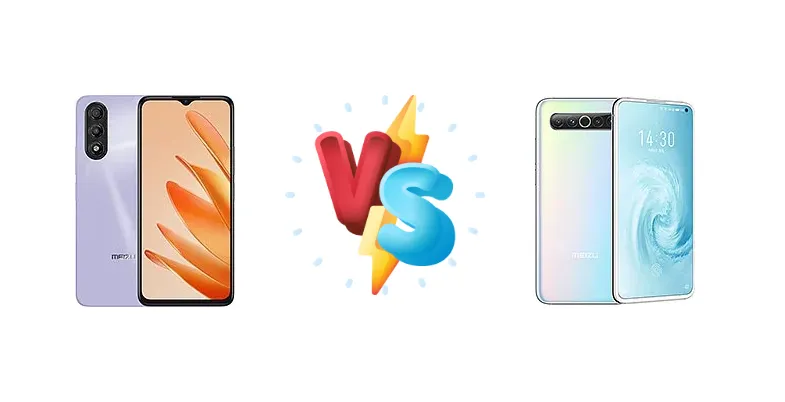
The Meizu Blue 20 represents a shift for the brand, opting for a Unisoc chipset while the Meizu 17 relied on the established Qualcomm Snapdragon 865. This comparison dissects the implications of this change, examining performance, battery efficiency, and overall user experience to determine which device offers the best value in today's market.
🏆 Quick Verdict
For the average user prioritizing raw performance and established software support, the Meizu 17 remains the superior choice due to its Snapdragon 865. However, the Meizu Blue 20 offers a compelling alternative for those seeking a more modern design and are willing to accept a slight performance trade-off for potentially better efficiency.
| Network |
|---|
| 2G bands | GSM 850 / 900 / 1800 / 1900 | GSM 850 / 900 / 1800 / 1900 |
| 3G bands | HSDPA 850 / 900 / 1900 / 2100 | HSDPA 850 / 900 / 1900 / 2100 |
| 4G bands | LTE | 1, 3, 5, 7, 8, 34, 38, 39, 40, 41 |
| 5G bands | SA/NSA | 41, 78, 79 SA/NSA |
| Speed | HSPA, LTE, 5G | HSPA, LTE, 5G |
| Technology | GSM / HSPA / LTE / 5G | GSM / CDMA / HSPA / LTE / 5G |
| | - | CDMA 800 & TD-SCDMA |
| Launch |
|---|
| Announced | 2024, July 17 | 2020, May 08. Released 2020, May 11 |
| Status | Available. Released 2024, July | Discontinued |
| Body |
|---|
| Dimensions | 8.3 mm thickness | 160 x 77.2 x 8.5 mm (6.30 x 3.04 x 0.33 in) |
| SIM | Nano-SIM + Nano-SIM | Nano-SIM + Nano-SIM |
| Weight | - | 199 g (7.02 oz) |
| Display |
|---|
| Resolution | 1080 x 2400 pixels, 20:9 ratio (~404 ppi density) | 1080 x 2340 pixels, 19.5:9 ratio (~390 ppi density) |
| Size | 6.52 inches, 102.6 cm2 | 6.6 inches, 106.9 cm2 (~86.6% screen-to-body ratio) |
| Type | IPS LCD, 90Hz | Super AMOLED, 120Hz, HDR10+, 700 nits (typ) |
| Platform |
|---|
| CPU | Octa-core (2x2.3 GHz Cortex-A76 & 6x2.1 GHz Cortex-A55) | Octa-core (1x2.84 GHz Cortex-A77 & 3x2.42 GHz Cortex-A77 & 4x1.80 GHz Cortex-A55) |
| Chipset | Unisoc T765 (6 nm) | Qualcomm SM8250 Snapdragon 865 5G (7 nm+) |
| GPU | Mali-G57 MC2 | Adreno 650 |
| OS | Flyme AIOS | Android 10, Flyme 8.1 |
| Memory |
|---|
| Card slot | microSDXC | No |
| Internal | 128GB 6GB RAM, 256GB 8GB RAM | 128GB 8GB RAM, 256GB 8GB RAM |
| | - | UFS 3.1 |
| Main Camera |
|---|
| Dual | 13 MP, AF (interpolated to 50 MP)
Secondary unspecified camera | - |
| Features | LED flash, panorama, HDR | 5-LED dual-tone flash, Auto-HDR, panorama |
| Quad | - | 64 MP, f/1.8, 26mm (wide), 1/1.72", 0.8µm, PDAF
12 MP, f/1.9, 24mm (wide), 1/2.55", 1.4µm, PDAF
8 MP, f/2.2, 16mm, 118˚ (ultrawide), 1/4.0", 1.12µm
5 MP (macro) |
| Video | 4K@30fps, 1080p@30fps | 4K@30/60fps, 1080p; gyro-EIS |
| Selfie camera |
|---|
| Features | - | HDR |
| Single | 5 MP (interpolated to 8 MP) | 20 MP, f/2.2, (wide), 0.8µm |
| Video | 1080p@30fps | 1080p@30fps |
| Sound |
|---|
| 3.5mm jack | - | No |
| 35mm jack | Yes | No |
| Loudspeaker | Yes, with stereo speakers | Yes, with stereo speakers |
| Comms |
|---|
| Bluetooth | 5.0, A2DP | 5.1, A2DP, LE |
| NFC | Unspecified | Yes |
| Positioning | GPS, GALILEO, GLONASS, BDS | GPS (L1+L5), GLONASS, BDS |
| Radio | No | No |
| USB | USB Type-C | USB Type-C 2.0 |
| WLAN | Wi-Fi 802.11 a/b/g/n/ac, dual-band | Wi-Fi 802.11 а/b/g/n/ac/6, dual-band, Wi-Fi Direct |
| Features |
|---|
| Sensors | Fingerprint (side-mounted); unspecified sensors | Fingerprint (under display, optical), accelerometer, gyro, proximity, compass |
| Battery |
|---|
| Charging | - | 30W wired, QC3, 45% in 30 min |
| Type | 5010 mAh | Li-Po 4500 mAh |
| Misc |
|---|
| Colors | Black, White, Purple | Green, Gray, Aurora White |
| Price | - | About 530 EUR |
Meizu Blue 20
- Potentially more efficient 6nm Unisoc T765 chipset
- Modern design language (assumed)
- Likely more affordable price point
- Lower peak performance compared to Snapdragon 865
- Less established software support for Unisoc chipset
- Limited information available on camera capabilities
Meizu 17
- Powerful Snapdragon 865 chipset for demanding tasks
- Proven performance and stability
- 30W fast charging with QC3 support
- Older chipset generation
- Potentially less power efficient than newer chipsets
- May be more expensive than the Blue 20
Display Comparison
Detailed display specifications are unavailable for the Blue 20. However, given its market positioning, it likely features an AMOLED panel. The Meizu 17 boasts a 6.6-inch Super AMOLED display. The Snapdragon 865's Adreno 650 GPU will drive higher frame rates in graphically intensive games on the Meizu 17's display. The 7nm+ process of the Snapdragon 865 also contributes to more efficient display power consumption compared to the 6nm Unisoc T765, potentially extending screen-on time.
Camera Comparison
Camera details for the Blue 20 are limited. The Meizu 17’s camera system, while not explicitly detailed in the provided data, is known to feature a capable main sensor and OIS. The Snapdragon 865’s ISP (Image Signal Processor) provides superior image processing capabilities, enabling faster autofocus, better dynamic range, and improved low-light performance compared to the Unisoc T765’s ISP. Without specific sensor details for the Blue 20, it’s difficult to make a direct comparison, but the Snapdragon 865’s processing power gives the Meizu 17 a clear advantage in image quality.
Performance
The core difference lies in the chipsets. The Meizu 17’s Snapdragon 865, built on a 7nm+ process, features a powerful Cortex-A77 prime core clocked at 2.84 GHz, alongside three more A77 cores and four A55 cores. This configuration delivers significantly higher peak performance than the Meizu Blue 20’s Unisoc T765. The T765, while utilizing a 6nm process, employs two Cortex-A76 cores at 2.3 GHz and six A55 cores at 2.1 GHz. While the 6nm node offers efficiency gains, the architectural advantage of the Snapdragon 865’s cores translates to superior multi-core and single-core performance, particularly noticeable in demanding tasks like video editing and high-end gaming. The Snapdragon 865 also benefits from Qualcomm’s optimized software and driver support.
Battery Life
The Meizu 17 supports 30W wired charging with QC3, reaching 45% charge in 30 minutes. Battery capacity for both devices is unknown. However, the Snapdragon 865’s 7nm+ process generally offers better power efficiency than the Unisoc T765’s 6nm process, meaning the Meizu 17 could potentially achieve longer battery life despite having a similar capacity. The 30W charging on the Meizu 17 provides a quick top-up, while the Blue 20’s charging speed is not specified, potentially making it slower to recharge.
Buying Guide
Buy the Meizu Blue 20 if you prioritize a sleek, modern design and are comfortable with a chipset that may require more software optimization. It's ideal for everyday tasks and moderate gaming. Buy the Meizu 17 if you demand consistent, high-end performance for demanding applications and gaming, and value the proven stability of the Snapdragon 865 platform. It's the better choice for power users and mobile gamers.
Frequently Asked Questions
❓ Will the Unisoc T765 in the Meizu Blue 20 struggle with graphically intensive games like Genshin Impact?
The Unisoc T765 is a capable chipset, but it won't deliver the same level of performance as the Snapdragon 865 in demanding games. You'll likely need to lower graphics settings to achieve smooth frame rates in titles like Genshin Impact. The Meizu 17, with its Adreno 650 GPU, will provide a significantly better gaming experience.
❓ How does the software support compare between the Meizu Blue 20 and the Meizu 17?
The Meizu 17 benefits from Qualcomm's mature software ecosystem and driver support, ensuring better optimization and stability. Unisoc chipsets, while improving, generally have less extensive software support, potentially leading to occasional bugs or compatibility issues. This is a key consideration for users who prioritize a seamless software experience.
❓ Is the 30W charging on the Meizu 17 still considered fast charging in 2024?
While 30W isn't the fastest charging available today, it's still a respectable charging speed and will provide a significant top-up in a short amount of time. The Meizu 17's QC3 support ensures compatibility with a wide range of chargers. The Blue 20's charging speed is unknown, but if it's slower than 30W, it will take longer to fully recharge.