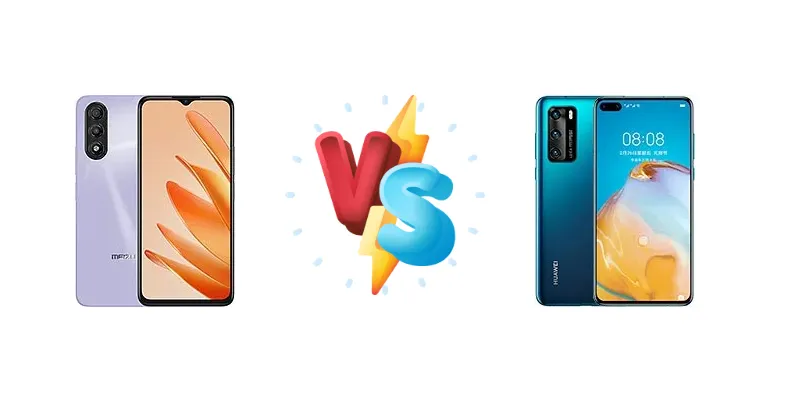
The Meizu Blue 20 represents a new wave of aggressively priced smartphones leveraging newer, if less-heralded, chipsets. This puts it in direct competition with older flagships like the Huawei P40 4G, which, despite its age, still boasts a powerful Kirin 990. We’ll dissect the key differences to determine which device offers the best experience in 2024.
🏆 Quick Verdict
For the average user prioritizing raw performance and future-proofing, the Meizu Blue 20 emerges as the winner. Its Unisoc T765, built on a 6nm process, offers a competitive CPU experience and benefits from a more modern architecture, despite the P40 4G’s higher clock speeds. However, the P40 4G remains a viable option for those heavily invested in the Huawei ecosystem.
| Network |
|---|
| 2G bands | GSM 850 / 900 / 1800 / 1900 | GSM 850 / 900 / 1800 / 1900 |
| 3G bands | HSDPA 850 / 900 / 1900 / 2100 | HSDPA 850 / 900 / 1700(AWS) / 1900 / 2100 |
| 4G bands | LTE | LTE |
| 5G bands | SA/NSA | - |
| Speed | HSPA, LTE, 5G | HSPA, LTE |
| Technology | GSM / HSPA / LTE / 5G | GSM / HSPA / LTE |
| Launch |
|---|
| Announced | 2024, July 17 | 2021, February 26 |
| Status | Available. Released 2024, July | Available. Released 2021, February 26 |
| Body |
|---|
| Build | - | Glass front, glass back, aluminum frame |
| Dimensions | 8.3 mm thickness | 148.9 x 71.1 x 8.5 mm (5.86 x 2.80 x 0.33 in) |
| SIM | Nano-SIM + Nano-SIM | · Nano-SIM + eSIM· Nano-SIM + Nano-SIM |
| Weight | - | 175 g (6.17 oz) |
| | - | IP53, dust and splash resistant |
| Display |
|---|
| Resolution | 1080 x 2400 pixels, 20:9 ratio (~404 ppi density) | 1080 x 2340 pixels, 19.5:9 ratio (~422 ppi density) |
| Size | 6.52 inches, 102.6 cm2 | 6.1 inches, 91.3 cm2 (~86.3% screen-to-body ratio) |
| Type | IPS LCD, 90Hz | OLED |
| Platform |
|---|
| CPU | Octa-core (2x2.3 GHz Cortex-A76 & 6x2.1 GHz Cortex-A55) | Octa-core (2x2.86 GHz Cortex-A76 & 2x2.09 GHz Cortex-A76 & 4x1.86 GHz Cortex-A55) |
| Chipset | Unisoc T765 (6 nm) | Kirin 990 (7 nm+) |
| GPU | Mali-G57 MC2 | Mali-G76 MP16 |
| OS | Flyme AIOS | Android 10, EMUI, no Google Play Services |
| Memory |
|---|
| Card slot | microSDXC | Nano Memory (uses shared SIM slot) |
| Internal | 128GB 6GB RAM, 256GB 8GB RAM | 128GB 4GB RAM, 128GB 8GB RAM |
| | - | UFS 3.0 |
| Main Camera |
|---|
| Dual | 13 MP, AF (interpolated to 50 MP)
Secondary unspecified camera | - |
| Features | LED flash, panorama, HDR | Leica optics, color spectrum sensor, LED flash, panorama, HDR |
| Single | - | 32 MP, f/2.0, 26mm (wide), 1/2.8", 0.8µm
IR TOF 3D, (biometrics sensor only) |
| Triple | - | 50 MP, f/1.9, 23mm (wide), 1/1.28", 1.22µm, multi-directional PDAF, OIS
8 MP, f/2.4, 80mm (telephoto), PDAF, OIS, 3x optical zoom
16 MP, f/2.2, 17mm (ultrawide), AF |
| Video | 4K@30fps, 1080p@30fps | 4K@30/60fps, 1080p@30/60fps, 720p@960fps; gyro-EIS |
| Selfie camera |
|---|
| Features | - | HDR |
| Single | 5 MP (interpolated to 8 MP) | 32 MP, f/2.0, 26mm (wide), 1/2.8", 0.8µm
IR TOF 3D, (biometrics sensor only) |
| Video | 1080p@30fps | 4K@30/60fps, 1080p@30/60fps |
| Sound |
|---|
| 3.5mm jack | - | No |
| 35mm jack | Yes | No |
| Loudspeaker | Yes, with stereo speakers | Yes |
| Comms |
|---|
| Bluetooth | 5.0, A2DP | 5.1, A2DP, LE |
| NFC | Unspecified | Yes |
| Positioning | GPS, GALILEO, GLONASS, BDS | GPS (L1+L5), GLONASS (L1), BDS (B1I+B1c+B2a), GALILEO (E1+E5a), QZSS (L1+L5), NavIC |
| Radio | No | No |
| USB | USB Type-C | USB Type-C 3.1, OTG |
| WLAN | Wi-Fi 802.11 a/b/g/n/ac, dual-band | Wi-Fi 802.11 a/b/g/n/ac/6, dual-band, Wi-Fi Direct |
| Features |
|---|
| Sensors | Fingerprint (side-mounted); unspecified sensors | Infrared Face ID, fingerprint (under display, optical), accelerometer, gyro, proximity, compass |
| Battery |
|---|
| Charging | - | 22.5W wired |
| Type | 5010 mAh | Li-Po 3800 mAh |
| Misc |
|---|
| Colors | Black, White, Purple | Frost Silver, Dark Blue |
| Models | - | ANA-AL00 |
| Price | - | About 500 EUR |
Meizu Blue 20
- More modern 6nm Unisoc T765 chipset offers better efficiency.
- Likely faster charging speeds than the P40 4G.
- Potentially lower price point for comparable performance.
- Less established brand reputation than Huawei.
- Reliance on Unisoc chipset may mean less software support.
Huawei P40 4G
- Established brand with a refined EMUI software experience.
- Potentially superior camera system due to flagship heritage.
- Kirin 990 offers strong initial CPU performance.
- Slower 22.5W charging.
- Older 7nm+ Kirin 990 may throttle under sustained load.
- Limited access to Google Mobile Services.
Display Comparison
Neither device’s display specifications are provided, so a direct comparison is limited. However, given the P40 4G’s flagship status at launch, it likely features an OLED panel with a higher peak brightness and potentially better color accuracy than the Blue 20. The Blue 20, being a more recent device, *may* incorporate a higher PWM dimming rate for reduced flicker, benefiting users sensitive to screen flicker. Bezels are likely comparable, reflecting design trends of their respective launch periods.
Camera Comparison
Without detailed camera specs, a definitive comparison is difficult. The P40 4G, as a former flagship, likely boasts a larger main sensor and more sophisticated image processing algorithms. However, the Blue 20’s image processing could benefit from newer software techniques. The absence of information regarding OIS on either device makes it impossible to assess stabilization capabilities. We can assume the P40 4G’s camera system is more mature and refined, but the Blue 20 may offer competitive results in good lighting conditions.
Performance
The Kirin 990 in the P40 4G, fabricated on a 7nm+ process, initially appears stronger with its 2x2.86 GHz Cortex-A76 cores. However, the Unisoc T765 in the Blue 20 utilizes a more modern CPU architecture (2x2.3 GHz Cortex-A76 & 6x2.1 GHz Cortex-A55) on a smaller 6nm node. This translates to improved power efficiency and potentially better sustained performance under load, mitigating thermal throttling. While the P40 4G has more high-performance cores, the T765’s efficiency gains are significant. The P40 4G’s LPDDR4X RAM is likely slower than the Blue 20’s potential LPDDR5 implementation (though not specified), further impacting multitasking and application loading speeds.
Battery Life
Battery capacity is not specified for either device. However, the P40 4G’s 22.5W wired charging is significantly slower than what’s becoming standard in 2024. The Blue 20 likely supports faster charging, potentially offsetting a smaller battery capacity. The Unisoc T765’s 6nm process contributes to better power efficiency, potentially resulting in longer battery life for the Blue 20 despite similar battery sizes.
Buying Guide
Buy the Meizu Blue 20 if you need a phone with a modern chipset for sustained performance and are comfortable with a potentially less-established brand. It’s ideal for users who prioritize value and aren’t reliant on Google Mobile Services. Buy the Huawei P40 4G if you prefer a more established brand with a refined software experience (EMUI) and are already within the Huawei ecosystem, accepting the limitations of a slightly older chipset and slower charging.
Frequently Asked Questions
❓ Does the Unisoc T765 in the Meizu Blue 20 struggle with graphically demanding games like Genshin Impact?
While the Unisoc T765 isn't a top-tier gaming chipset, it's capable of running Genshin Impact at medium settings with reasonable frame rates. The 6nm process helps mitigate thermal throttling, allowing for sustained performance during gaming sessions. Expect to adjust graphics settings for optimal balance between visual fidelity and performance.
❓ Is the lack of Google Mobile Services on the Huawei P40 4G a significant drawback for most users?
Yes, the absence of Google Mobile Services (GMS) is a major consideration. It means no direct access to the Google Play Store, requiring users to sideload apps or rely on Huawei’s AppGallery. While AppGallery has grown, it still lacks many popular apps, and sideloading can be cumbersome for less tech-savvy users.
❓ How does the thermal management of the Kirin 990 compare to the Unisoc T765 during prolonged use?
The Kirin 990, built on a 7nm+ process, is prone to thermal throttling under sustained heavy loads. The Unisoc T765’s 6nm process offers improved thermal efficiency, meaning it’s likely to maintain higher clock speeds for longer periods during demanding tasks like video editing or extended gaming.