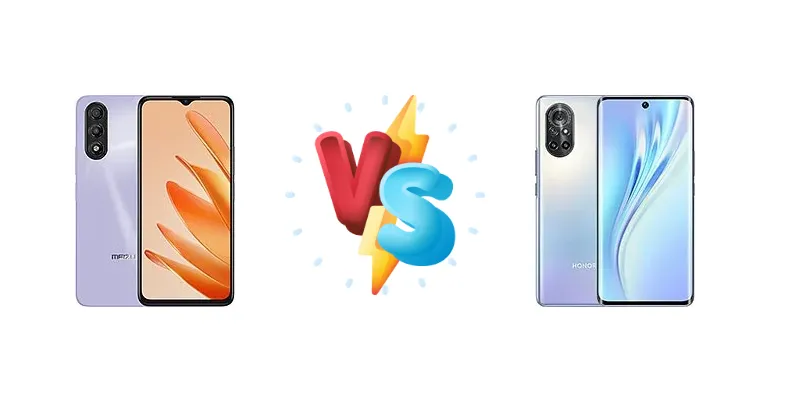
The Meizu Blue 20 and Honor V40 Lite represent compelling options in the increasingly competitive mid-range 5G smartphone market. While both aim to deliver a connected experience without breaking the bank, they take different approaches to achieving this. The Blue 20 leverages the newer Unisoc T765, while the V40 Lite relies on the established Mediatek Dimensity 800U. This comparison dissects their key differences to help you determine which device best suits your needs.
🏆 Quick Verdict
For the average user prioritizing fast charging and a slightly more refined chipset, the Honor V40 Lite emerges as the winner. Its 66W charging capability and the Dimensity 800U’s proven track record offer a smoother, more convenient experience. However, the Meizu Blue 20 presents a viable alternative for those seeking a newer chipset architecture.
| Network |
|---|
| 2G bands | GSM 850 / 900 / 1800 / 1900 | GSM 850 / 900 / 1800 / 1900 |
| 3G bands | HSDPA 850 / 900 / 1900 / 2100 | HSDPA 800 / 850 / 900 / 1700(AWS) / 1900 / 2100 |
| 4G bands | LTE | 1, 2, 3, 4, 5, 8, 18, 19, 26, 34, 38, 39, 40, 41 |
| 5G bands | SA/NSA | 1, 28, 41, 77, 78 SA/NSA |
| Speed | HSPA, LTE, 5G | HSPA, LTE, 5G |
| Technology | GSM / HSPA / LTE / 5G | GSM / CDMA / HSPA / LTE / 5G |
| | - | CDMA 800 |
| Launch |
|---|
| Announced | 2024, July 17 | 2021, March 23 |
| Status | Available. Released 2024, July | Available. Released 2021, March 28 |
| Body |
|---|
| Dimensions | 8.3 mm thickness | 160.1 x 74.1 x 7.6 mm (6.30 x 2.92 x 0.30 in) |
| SIM | Nano-SIM + Nano-SIM | Nano-SIM + Nano-SIM |
| Weight | - | 169 g (5.96 oz) |
| Display |
|---|
| Resolution | 1080 x 2400 pixels, 20:9 ratio (~404 ppi density) | 1080 x 2340 pixels, 19.5:9 ratio (~392 ppi density) |
| Size | 6.52 inches, 102.6 cm2 | 6.57 inches, 106.0 cm2 (~89.3% screen-to-body ratio) |
| Type | IPS LCD, 90Hz | OLED, 1B colors, HDR10, 90Hz |
| Platform |
|---|
| CPU | Octa-core (2x2.3 GHz Cortex-A76 & 6x2.1 GHz Cortex-A55) | Octa-core (2x2.4 GHz Cortex-A76 & 6x2.0 GHz Cortex-A55) |
| Chipset | Unisoc T765 (6 nm) | Mediatek Dimensity 800U (7 nm) |
| GPU | Mali-G57 MC2 | Mali-G57 MC3 |
| OS | Flyme AIOS | Android 10, Magic UI 4.0, no Google Play Services |
| Memory |
|---|
| Card slot | microSDXC | No |
| Internal | 128GB 6GB RAM, 256GB 8GB RAM | 128GB 8GB RAM, 256GB 8GB RAM |
| | - | UFS |
| Main Camera |
|---|
| Dual | 13 MP, AF (interpolated to 50 MP)
Secondary unspecified camera | - |
| Features | LED flash, panorama, HDR | LED flash, panorama, HDR |
| Quad | - | 64 MP, f/1.9, 26mm (wide), PDAF
8 MP, f/2.4, 120˚, 17mm (ultrawide)
2 MP (macro)
Auxiliary lens |
| Single | - | 32 MP, f/2.0, 26mm (wide) |
| Video | 4K@30fps, 1080p@30fps | 4K, 1080p, 720p@960fps, gyro-EIS |
| Selfie camera |
|---|
| Features | - | HDR |
| Single | 5 MP (interpolated to 8 MP) | 32 MP, f/2.0, 26mm (wide) |
| Video | 1080p@30fps | 4K |
| Sound |
|---|
| 3.5mm jack | - | No |
| 35mm jack | Yes | No |
| Loudspeaker | Yes, with stereo speakers | Yes |
| Comms |
|---|
| Bluetooth | 5.0, A2DP | 5.1, A2DP, LE |
| NFC | Unspecified | Yes |
| Positioning | GPS, GALILEO, GLONASS, BDS | GPS, GLONASS, BDS, GALILEO |
| Radio | No | No |
| USB | USB Type-C | USB Type-C 2.0, OTG |
| WLAN | Wi-Fi 802.11 a/b/g/n/ac, dual-band | Wi-Fi 802.11 a/b/g/n/ac, dual-band, Wi-Fi Direct |
| Features |
|---|
| Sensors | Fingerprint (side-mounted); unspecified sensors | Fingerprint (under display, optical), accelerometer, gyro, proximity, compass |
| Battery |
|---|
| Charging | - | 66W wired, 60% in 15 min, 100% in 35 min
5W reverse wired |
| Type | 5010 mAh | Li-Po 3800 mAh |
| Misc |
|---|
| Colors | Black, White, Purple | Black, Blue, Green |
| Models | - | ALA-AN70 |
| Price | - | About 390 EUR |
Meizu Blue 20
- Newer Unisoc T765 chipset offers potential for future software optimizations.
- 6nm process may provide improved power efficiency over older 7nm chips.
- Potentially lower price point due to newer chipset availability.
- Unisoc chipsets generally have less software support compared to Mediatek.
- Likely lacks the fast charging capabilities of the Honor V40 Lite.
Honor V40 Lite
- 66W fast charging significantly reduces downtime.
- Mediatek Dimensity 800U is a well-established and optimized chipset.
- 5W reverse wired charging adds convenience.
- Older chipset architecture compared to the Unisoc T765.
- 7nm process may be less power-efficient than the Blue 20’s 6nm node.
Display Comparison
Neither device’s display specifications are provided, so a direct comparison is limited. However, given the market positioning, both likely feature LCD panels with 60Hz refresh rates. The Honor V40 Lite, being slightly older, may benefit from more software optimization for color accuracy. The absence of high refresh rates on both devices suggests a focus on battery life over visual fluidity.
Camera Comparison
Without detailed camera specifications, a comprehensive comparison is impossible. However, it’s reasonable to assume both phones feature a multi-camera setup geared towards social media sharing. The absence of information regarding sensor size or optical image stabilization (OIS) suggests neither device prioritizes high-end photography. Image processing will likely be the differentiating factor, with Honor’s experience potentially yielding more consistent results.
Performance
The core difference lies in the chipsets. The Honor V40 Lite’s Mediatek Dimensity 800U, fabricated on a 7nm process, boasts a slightly higher peak CPU clock speed (2.4 GHz vs 2.3 GHz on the Meizu Blue 20’s Unisoc T765). While both utilize the same Cortex-A76/A55 core configuration, the 7nm process generally translates to better power efficiency and potentially sustained performance. The Unisoc T765, built on a 6nm node, attempts to close the gap in efficiency, but the Dimensity 800U has a head start in terms of software optimization and driver support. This benefits gaming and multitasking on the Honor V40 Lite.
Battery Life
The Honor V40 Lite significantly pulls ahead in the battery department with its 66W wired charging. Achieving 60% charge in 15 minutes and 100% in 35 minutes is a substantial advantage over any charging speed the Meizu Blue 20 is likely to offer. While the battery capacity of both devices is unknown, the faster charging mitigates the impact of a potentially smaller battery on the Blue 20. The 5W reverse wired charging on the V40 Lite adds a convenient feature for topping up accessories.
Buying Guide
Buy the Meizu Blue 20 if you prioritize a newer chipset architecture and are comfortable with potentially less optimized software. It’s a good choice for users who enjoy tinkering and staying on the cutting edge. Buy the Honor V40 Lite if you value fast charging, a more established platform, and a generally smoother user experience. This phone is ideal for users who want a reliable daily driver without the need for extensive customization.
Frequently Asked Questions
❓ Is the Mediatek Dimensity 800U still a capable chipset for gaming in 2024?
Yes, the Dimensity 800U remains a capable chipset for mid-range gaming. While it won't deliver the highest frame rates in demanding titles, it can comfortably handle popular games like PUBG Mobile and Call of Duty Mobile at medium to high settings. The optimized drivers and established platform contribute to a smoother gaming experience.
❓ How much faster is the 66W charging on the Honor V40 Lite compared to standard charging?
The 66W charging on the Honor V40 Lite is significantly faster than standard charging. A typical 15W charger would take over two hours to fully charge the battery, while the V40 Lite achieves a full charge in just 35 minutes. This drastically reduces downtime and allows you to quickly get back to using your phone.
❓ Will the Unisoc T765 in the Meizu Blue 20 receive long-term software support?
Software support for Unisoc chipsets is generally less extensive than that offered for Qualcomm or Mediatek. While Meizu may provide updates, the longevity and frequency of these updates are uncertain. Users should be aware of this potential limitation before purchasing the Blue 20.