
Meizu 22 vs Xiaomi Redmi K70 Pro: A Deep Dive into Snapdragon Power and Charging Speed
| Phones Images | |||||
|---|---|---|---|---|---|
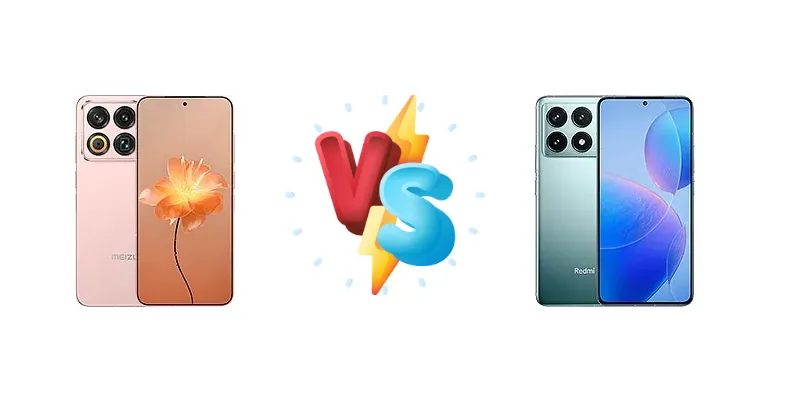
|
🏆 Quick Verdict
For the average user prioritizing raw performance and the fastest charging, the Xiaomi Redmi K70 Pro emerges as the winner. Its Snapdragon 8 Gen 3 chipset offers a demonstrable performance advantage, coupled with 120W wired charging that fully replenishes the battery in just 18 minutes. However, the Meizu 22’s 66W wireless charging is a strong counterpoint for convenience.
| PHONES | ||
|---|---|---|
| Phone Names | Meizu 22 | Xiaomi Redmi K70 Pro |
| Network | ||
|---|---|---|
| 2G bands | GSM 850 / 900 / 1800 / 1900 | GSM 850 / 900 / 1800 / 1900 |
| 3G bands | HSDPA 850 / 900 / 1700(AWS) / 2100 | HSDPA 800 / 850 / 900 / 1700(AWS) / 2100 |
| 4G bands | 1, 3, 4, 5, 8, 18, 19, 26, 28, 34, 38, 39, 40, 41, 42, 48, 66 | 1, 3, 4, 5, 8, 18, 19, 26, 28, 34, 38, 39, 40, 41, 42, 48, 66 |
| 5G bands | 1, 3, 5, 8, 26, 28, 38, 40, 41, 48, 66, 77, 78, 80, 81, 83, 84, 89 SA/NSA | 1, 3, 5, 8, 28, 38, 41, 48, 66, 77, 78 SA/NSA |
| Speed | HSPA, LTE, 5G | HSPA, LTE, 5G |
| Technology | GSM / HSPA / LTE / 5G | GSM / CDMA / HSPA / CDMA2000 / LTE / 5G |
| Launch | ||
|---|---|---|
| Announced | 2025, September 16 | 2023, November 29 |
| Status | Available. Released 2025, September 19 | Available. Released 2023, November 29 |
| Body | ||
|---|---|---|
| Build | Glass front, aluminum frame | - |
| Dimensions | 152 x 71 x 8.2 mm (5.98 x 2.80 x 0.32 in) | 160.9 x 75 x 8.2 mm (6.33 x 2.95 x 0.32 in) |
| SIM | Nano-SIM + Nano-SIM | Nano-SIM + Nano-SIM |
| Weight | 190 g (6.70 oz) | 209 g (7.37 oz) |
| Display | ||
|---|---|---|
| Resolution | 1200 x 2670 pixels, 20:9 ratio (~465 ppi density) | 1440 x 3200 pixels, 20:9 ratio (~526 ppi density) |
| Size | 6.3 inches, 95.7 cm2 (~88.7% screen-to-body ratio) | 6.67 inches, 107.4 cm2 (~89.0% screen-to-body ratio) |
| Type | LTPO OLED, 120Hz, HDR10+, 1800 nits (HBM), 6000 nits (peak) | OLED, 68B colors, 120Hz, Dolby Vision, HDR10+, 4000 nits (peak) |
| Platform | ||
|---|---|---|
| CPU | Octa-core (1x3.21 GHz Cortex-X4 & 3x3.0 GHz Cortex-A720 & 2x2.8 GHz Cortex-A720 & 2x2.0 GHz Cortex-A720) | Octa-core (1x3.3 GHz Cortex-X4 & 3x3.2 GHz Cortex-A720 & 2x3.0 GHz Cortex-A720 & 2x2.3 GHz Cortex-A520) |
| Chipset | Qualcomm SM8735 Snapdragon 8s Gen 4 (4 nm) | Qualcomm SM8650-AB Snapdragon 8 Gen 3 (4 nm) |
| GPU | Adreno 825 | Adreno 750 |
| OS | Android 15, Flyme AIOS 2 | Android 14, HyperOS |
| Memory | ||
|---|---|---|
| Card slot | No | No |
| Internal | 256GB 12GB RAM, 512GB 12GB RAM, 512GB 16GB RAM, 1TB 16GB RAM | 256GB 12GB RAM, 256GB 16GB RAM, 512GB 12GB RAM, 512GB 16GB RAM, 1TB 24GB RAM |
| Main Camera | ||
|---|---|---|
| Features | Ring-LED flash, panorama, HDR | Color spectrum sensor, LED flash, HDR, panorama |
| Triple | 50 MP, f/1.7, 24mm (wide), 1/1.3", PDAF, OIS 50 MP, f/2.5, 72mm (periscope telephoto), 1/1.95", PDAF (15cm - ∞), OIS, 3x optical zoom 50 MP, f/2.1, 13mm, 122˚ (ultrawide), 1/2.88" | 50 MP, f/1.6, (wide), 1/1.55", 1.0µm, PDAF, OIS 50 MP, (telephoto), PDAF, 2x optical zoom 12 MP, (ultrawide) |
| Video | 4K@30/60fps, 1080p@30/60fps, gyro-EIS | 8K@24fps, 4K@24/30/60fps, 1080p@30/60/120/240/960fps, 720p@1920fps, gyro-EIS |
| Selfie camera | ||
|---|---|---|
| Features | HDR | HDR |
| Single | 50 MP, f/2.1, 22mm (wide), 1/2.88" | 16 MP, (wide) |
| Video | 4K@30/60fps, 1080p@30/60fps, gyro-EIS | 1080p@30/60fps, gyro-EIS |
| Sound | ||
|---|---|---|
| 35mm jack | No | No |
| Loudspeaker | Yes, with stereo speakers | Yes, with stereo speakers |
| Comms | ||
|---|---|---|
| Bluetooth | 5.4, A2DP, LE, aptX HD | 5.4, A2DP, LE, aptX HD, aptX Adaptive, aptX Lossless |
| Infrared port | Yes | Yes |
| NFC | Yes | Yes |
| Positioning | GPS (L1+L5), GLONASS (G1), BDS (B1I+B1c+B2a), GALILEO (E1+E5a), QZSS (L1+L5), NavIC (L5) | GPS (L1+L5), GLONASS (G1), BDS (B1I+B1c+B2a), GALILEO (E1+E5a), QZSS (L1+L5), NavIC (L5) |
| Radio | No | No |
| USB | USB Type-C 2.0/3.2, Display Port (1TB only) | USB Type-C, OTG |
| WLAN | Wi-Fi 802.11 а/b/g/n/ac/6e/7, dual-band | Wi-Fi 802.11 a/b/g/n/ac/6e/7, dual-band, Wi-Fi Direct |
| Features | ||
|---|---|---|
| Sensors | Fingerprint (under display, ultrasonic), accelerometer, gyro, proximity, compass | Fingerprint (under display, optical), accelerometer, proximity, gyro, compass |
| Battery | ||
|---|---|---|
| Charging | 80W wired, PD3 PPS, QC4+ 66W wireless 10W reverse wireless | 120W wired, PD3.0, QC3+, 100% in 18 min |
| Type | 5510 mAh | Li-Po 5000 mAh |
| Misc | ||
|---|---|---|
| Colors | Black, White, Pink | Black, Silver, Blue/Green, Lamborgini Green, Lamborgini Yellow |
| Models | - | 23117RK66C |
| Price | About 360 EUR | About 430 EUR |
Meizu 22
- 66W Wireless Charging offers convenience.
- Potentially more compact design.
- Meizu’s FlymeOS may appeal to some users.
- Snapdragon 8s Gen 4 is a step down from the 8 Gen 3.
- 80W wired charging is slower than the K70 Pro.
Xiaomi Redmi K70 Pro
- Snapdragon 8 Gen 3 delivers superior performance.
- 120W wired charging is incredibly fast.
- Likely better thermal management for sustained gaming.
- No wireless charging.
- Xiaomi’s MIUI can be feature-rich but sometimes bloated.
Display Comparison
While display specifications are not provided, both devices likely feature high refresh rate AMOLED panels given their flagship positioning. However, the Redmi K70 Pro, typical of Xiaomi’s approach, is expected to push peak brightness higher, potentially exceeding the Meizu 22. The choice of panel technology (LTPO or not) will significantly impact power efficiency and adaptive refresh rate smoothness, a detail crucial for gaming. Bezels are likely to be minimal on both, but the Meizu 22’s design language often prioritizes a more compact form factor, potentially resulting in slightly smaller screen real estate.
Camera Comparison
Without specific camera sensor details, it’s difficult to make a definitive judgment. However, Xiaomi typically equips its ‘Pro’ models with larger, higher-resolution sensors. The Redmi K70 Pro is likely to feature a more sophisticated camera system, potentially with a larger main sensor and more advanced image processing algorithms. The Meizu 22 may focus on computational photography and software enhancements to compensate for potentially smaller sensors. Lens apertures will be critical; wider apertures (lower f-number) allow for better low-light performance. The inclusion of Optical Image Stabilization (OIS) on the main sensor is expected on both, but its effectiveness will vary.
Performance
The core difference lies in the chipsets: the Xiaomi Redmi K70 Pro boasts the Snapdragon 8 Gen 3 (4nm) with a peak CPU clock of 3.3 GHz, while the Meizu 22 utilizes the Snapdragon 8s Gen 4 (4nm) clocked at 3.21 GHz. While both are 4nm chips, the 8 Gen 3’s architecture is a generation ahead, offering improvements in CPU and GPU performance. The K70 Pro’s CPU configuration (1x3.3 GHz Cortex-X4, 3x3.2 GHz Cortex-A720, 2x3.0 GHz Cortex-A720, 2x2.3 GHz Cortex-A520) provides a slight edge over the Meizu 22’s (1x3.21 GHz Cortex-X4, 3x3.0 GHz Cortex-A720, 2x2.8 GHz Cortex-A720, 2x2.0 GHz Cortex-A720) in sustained performance. The K70 Pro’s superior thermal design, a hallmark of the Redmi K series, will likely mitigate throttling better under prolonged load, benefiting gamers. Both devices will likely utilize LPDDR5x RAM, but the speed and configuration will impact multitasking responsiveness.
Battery Life
The Redmi K70 Pro’s 120W wired charging is a significant advantage, promising a full charge in just 18 minutes. This is substantially faster than the Meizu 22’s 80W wired charging. However, the Meizu 22 compensates with 66W wireless charging and 10W reverse wireless charging, offering greater convenience for users who prefer cable-free power-ups. While battery capacity isn’t specified, the faster charging of the K70 Pro effectively mitigates any potential disadvantage from a slightly smaller battery size. The inclusion of PD3.0 and QC3+ on the K70 Pro ensures broad compatibility with existing chargers.
Buying Guide
Buy the Meizu 22 if you value wireless charging convenience and a potentially more refined software experience, leaning into Meizu’s design aesthetic. Buy the Xiaomi Redmi K70 Pro if you demand the absolute fastest performance for gaming and demanding tasks, and prioritize the quickest possible wired charging speeds. The K70 Pro is the clear choice for power users.