
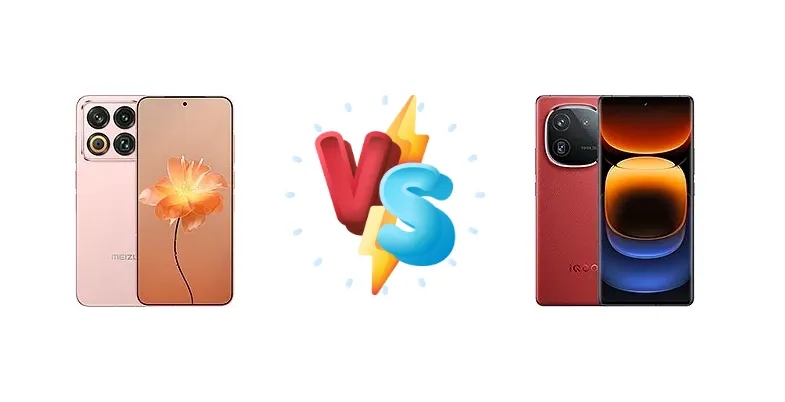
Meizu 22 vs. vivo iQOO 12 Pro: A Deep Dive into Snapdragon Power and Charging Speed
| Phones Images | |||||
|---|---|---|---|---|---|
|
🏆 Quick Verdict
For most users, the vivo iQOO 12 Pro emerges as the stronger choice. Its Snapdragon 8 Gen 3 chipset provides a demonstrable performance edge, and the 120W charging significantly reduces downtime. While the Meizu 22 offers a compelling package, the iQOO 12 Pro’s raw power and charging speed justify its position as the winner.
| PHONES | ||
|---|---|---|
| Phone Names | Meizu 22 | vivo iQOO 12 Pro |
| Network | ||
|---|---|---|
| 2G bands | GSM 850 / 900 / 1800 / 1900 | GSM 850 / 900 / 1800 / 1900 |
| 3G bands | HSDPA 850 / 900 / 1700(AWS) / 2100 | HSDPA 800 / 850 / 900 / 1700(AWS) / 1900 / 2100 |
| 4G bands | 1, 3, 4, 5, 8, 18, 19, 26, 28, 34, 38, 39, 40, 41, 42, 48, 66 | 1, 2, 3, 4, 5, 7, 8, 12, 17, 18, 19, 20, 25, 26, 28, 34, 38, 39, 40, 41, 42, 66 |
| 5G bands | 1, 3, 5, 8, 26, 28, 38, 40, 41, 48, 66, 77, 78, 80, 81, 83, 84, 89 SA/NSA | 1, 2, 3, 5, 7, 8, 12, 20, 25, 26, 28, 66, 38, 40, 41, 77, 78 SA/NSA |
| Speed | HSPA, LTE, 5G | HSPA, LTE, 5G |
| Technology | GSM / HSPA / LTE / 5G | GSM / CDMA / HSPA / CDMA2000 / LTE / 5G |
| Launch | ||
|---|---|---|
| Announced | 2025, September 16 | 2023, November 07 |
| Status | Available. Released 2025, September 19 | Available. Released 2023, November 14 |
| Body | ||
|---|---|---|
| Build | Glass front, aluminum frame | - |
| Dimensions | 152 x 71 x 8.2 mm (5.98 x 2.80 x 0.32 in) | 164.6 x 75.4 x 8.6 mm or 8.8 mm |
| SIM | Nano-SIM + Nano-SIM | Nano-SIM + Nano-SIM |
| Weight | 190 g (6.70 oz) | 205 g or 210 g (7.23 oz) |
| Display | ||
|---|---|---|
| Resolution | 1200 x 2670 pixels, 20:9 ratio (~465 ppi density) | 1440 x 3200 pixels, 20:9 ratio (~518 ppi density) |
| Size | 6.3 inches, 95.7 cm2 (~88.7% screen-to-body ratio) | 6.78 inches, 111.0 cm2 (~89.4% screen-to-body ratio) |
| Type | LTPO OLED, 120Hz, HDR10+, 1800 nits (HBM), 6000 nits (peak) | LTPO AMOLED, 1B colors, 144Hz, HDR10+, 1600 nits (HBM), 3000 nits (peak) |
| Platform | ||
|---|---|---|
| CPU | Octa-core (1x3.21 GHz Cortex-X4 & 3x3.0 GHz Cortex-A720 & 2x2.8 GHz Cortex-A720 & 2x2.0 GHz Cortex-A720) | Octa-core (1x3.3 GHz Cortex-X4 & 3x3.2 GHz Cortex-A720 & 2x3.0 GHz Cortex-A720 & 2x2.3 GHz Cortex-A520) |
| Chipset | Qualcomm SM8735 Snapdragon 8s Gen 4 (4 nm) | Qualcomm SM8650-AB Snapdragon 8 Gen 3 (4 nm) |
| GPU | Adreno 825 | Adreno 750 |
| OS | Android 15, Flyme AIOS 2 | Android 14, up to 2 major Android upgrades, Funtouch 14 (International), OriginOS 4 (China) |
| Memory | ||
|---|---|---|
| Card slot | No | No |
| Internal | 256GB 12GB RAM, 512GB 12GB RAM, 512GB 16GB RAM, 1TB 16GB RAM | 256GB 16GB RAM, 512GB 16GB RAM, 1TB 16GB RAM |
| Main Camera | ||
|---|---|---|
| Features | Ring-LED flash, panorama, HDR | Color spectrum sensor, Dual-LED flash, HDR, panorama |
| Triple | 50 MP, f/1.7, 24mm (wide), 1/1.3", PDAF, OIS 50 MP, f/2.5, 72mm (periscope telephoto), 1/1.95", PDAF (15cm - ∞), OIS, 3x optical zoom 50 MP, f/2.1, 13mm, 122˚ (ultrawide), 1/2.88" | 50 MP, f/1.7, 23mm (wide), 1/1.3", 1.2µm, ulti-directional PDAF, OIS 64 MP, f/2.6, 70mm (periscope telephoto), 1/2.0", PDAF, OIS, 3x optical zoom 50 MP, f/2.0, 15mm, 119˚ (ultrawide), AF |
| Video | 4K@30/60fps, 1080p@30/60fps, gyro-EIS | 8K@30fps, 4K@24/30/60fps, 1080p@30/60/120/240fps, gyro-EIS |
| Selfie camera | ||
|---|---|---|
| Features | HDR | HDR |
| Single | 50 MP, f/2.1, 22mm (wide), 1/2.88" | 16 MP, f/2.5, (wide) |
| Video | 4K@30/60fps, 1080p@30/60fps, gyro-EIS | 1080p@30fps, gyro-EIS |
| Sound | ||
|---|---|---|
| 35mm jack | No | No |
| Loudspeaker | Yes, with stereo speakers | Yes, with stereo speakers |
| Comms | ||
|---|---|---|
| Bluetooth | 5.4, A2DP, LE, aptX HD | 5.4, A2DP, LE, aptX HD, aptX Adaptive, aptX Lossless |
| Infrared port | Yes | Yes |
| NFC | Yes | Yes |
| Positioning | GPS (L1+L5), GLONASS (G1), BDS (B1I+B1c+B2a), GALILEO (E1+E5a), QZSS (L1+L5), NavIC (L5) | GPS (L1+L5), GLONASS (G1), BDS (B1I+B1c+B2a), GALILEO (E1+E5a), QZSS (L1+L5) |
| Radio | No | No |
| USB | USB Type-C 2.0/3.2, Display Port (1TB only) | USB Type-C 2.0, OTG |
| WLAN | Wi-Fi 802.11 а/b/g/n/ac/6e/7, dual-band | Wi-Fi 802.11 a/b/g/n/ac/6/7, tri-band, Wi-Fi Direct |
| Features | ||
|---|---|---|
| Sensors | Fingerprint (under display, ultrasonic), accelerometer, gyro, proximity, compass | Fingerprint (under display, ultrasonic), accelerometer, gyro, proximity, compass |
| Battery | ||
|---|---|---|
| Charging | 80W wired, PD3 PPS, QC4+ 66W wireless 10W reverse wireless | 120W wired 50W wireless 10W reverse wireless |
| Type | 5510 mAh | 5100 mAh |
| Misc | ||
|---|---|---|
| Colors | Black, White, Pink | Black, Red, White (BMW M branding) |
| Models | - | V2329A |
| Price | About 360 EUR | About 650 EUR |
Meizu 22
- Potentially more efficient Snapdragon 8s Gen 4 chipset
- Faster 66W wireless charging
- Likely refined software experience (Meizu's Flyme OS)
- Slightly less powerful CPU compared to Snapdragon 8 Gen 3
- Slower 80W wired charging
vivo iQOO 12 Pro
- More powerful Snapdragon 8 Gen 3 chipset
- Blazing-fast 120W wired charging
- Potentially brighter display
- May run hotter under sustained load
- Wireless charging is slower at 50W
Display Comparison
While display specifications aren't provided, both devices likely feature high refresh rate AMOLED panels. However, the iQOO series historically prioritizes high peak brightness, suggesting a potentially more visible outdoor experience. The Meizu 22, given its focus on refinement, may emphasize color accuracy and calibration. Without specific data, it's reasonable to assume both offer excellent viewing experiences, but the iQOO 12 Pro likely has a brightness advantage.
Camera Comparison
Camera details are absent, but both brands typically equip their flagships with competitive camera systems. The iQOO 12 Pro, being a performance-focused device, may prioritize computational photography and video recording capabilities. Meizu often focuses on natural image processing. Without sensor size or aperture information, it’s difficult to definitively declare a winner, but the iQOO 12 Pro’s more powerful ISP (integrated signal processor) within the Snapdragon 8 Gen 3 likely provides an edge in image processing speed and quality.
Performance
The core difference lies in the chipsets. The iQOO 12 Pro’s Snapdragon 8 Gen 3 (4nm) boasts a slightly higher peak CPU clock speed (3.3 GHz vs 3.21 GHz on the Meizu 22’s Snapdragon 8s Gen 4) and a more mature architecture. The iQOO 12 Pro’s CPU configuration (1x3.3 GHz Cortex-X4, 3x3.2 GHz Cortex-A720, 2x3.0 GHz Cortex-A720, 2x2.3 GHz Cortex-A520) versus the Meizu 22’s (1x3.21 GHz Cortex-X4, 3x3.0 GHz Cortex-A720, 2x2.8 GHz Cortex-A720, 2x2.0 GHz Cortex-A720) indicates a stronger focus on sustained performance in the iQOO 12 Pro. Both utilize LPDDR5x RAM, but the iQOO 12 Pro’s superior chipset will likely translate to better multitasking and gaming performance.
Battery Life
The iQOO 12 Pro’s 120W wired charging is a significant advantage, promising a full charge in under 20 minutes. The Meizu 22’s 80W charging is still fast, but noticeably slower. While battery capacity isn’t specified, the iQOO 12 Pro’s faster charging mitigates any potential capacity disadvantage. Both offer 10W reverse wireless charging, but the Meizu 22’s 66W wireless charging is a substantial benefit for users who frequently utilize this feature.
Buying Guide
Buy the Meizu 22 if you prioritize a potentially more efficient chipset with the Snapdragon 8s Gen 4 and value wireless charging convenience with its 66W capability. Buy the vivo iQOO 12 Pro if you demand the absolute fastest performance available in an Android phone, coupled with the quickest wired charging on the market, making it ideal for gamers and power users.