
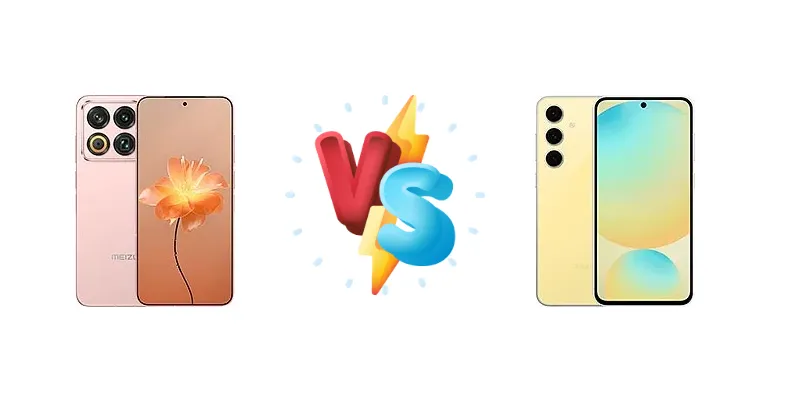
Meizu 22 vs. Samsung Galaxy S24 FE: A Deep Dive into Performance and Power
| Phones Images | |||||
|---|---|---|---|---|---|
|
🏆 Quick Verdict
For users prioritizing raw performance and incredibly fast charging, the Meizu 22 takes the lead. However, the Samsung Galaxy S24 FE counters with superior battery endurance and a more established software ecosystem, making it the better choice for those valuing all-day usability and long-term support.
| PHONES | ||
|---|---|---|
| Phone Names | Meizu 22 | Samsung Galaxy S24 FE |
| Network | ||
|---|---|---|
| 2G bands | GSM 850 / 900 / 1800 / 1900 | GSM 850 / 900 / 1800 / 1900 |
| 3G bands | HSDPA 850 / 900 / 1700(AWS) / 2100 | HSDPA 850 / 900 / 1700(AWS) / 1900 / 2100 |
| 4G bands | 1, 3, 4, 5, 8, 18, 19, 26, 28, 34, 38, 39, 40, 41, 42, 48, 66 | 1, 2, 3, 4, 5, 7, 8, 12, 17, 18, 19, 20, 25, 26, 28, 32, 38, 40, 41, 66 - International |
| 5G bands | 1, 3, 5, 8, 26, 28, 38, 40, 41, 48, 66, 77, 78, 80, 81, 83, 84, 89 SA/NSA | 1, 2, 3, 5, 7, 8, 12, 20, 25, 26, 28, 38, 40, 41, 66, 75, 77, 78 SA/NSA/Sub6 - International |
| Speed | HSPA, LTE, 5G | HSPA, LTE, 5G |
| Technology | GSM / HSPA / LTE / 5G | GSM / HSPA / LTE / 5G |
| Launch | ||
|---|---|---|
| Announced | 2025, September 16 | 2024, September 26 |
| Status | Available. Released 2025, September 19 | Available. Released 2024, October 03 |
| Body | ||
|---|---|---|
| Build | Glass front, aluminum frame | Glass front (Gorilla Glass Victus+), glass back (Gorilla Glass Victus+), aluminum frame |
| Dimensions | 152 x 71 x 8.2 mm (5.98 x 2.80 x 0.32 in) | 162 x 77.3 x 8 mm (6.38 x 3.04 x 0.31 in) |
| SIM | Nano-SIM + Nano-SIM | · Nano-SIM· Nano-SIM + Nano-SIM· Nano-SIM + eSIM· eSIM + eSIM |
| Weight | 190 g (6.70 oz) | 213 g (7.51 oz) |
| Display | ||
|---|---|---|
| Protection | - | Corning Gorilla Glass Victus+, Mohs level 5 |
| Resolution | 1200 x 2670 pixels, 20:9 ratio (~465 ppi density) | 1080 x 2340 pixels, 19.5:9 ratio (~385 ppi density) |
| Size | 6.3 inches, 95.7 cm2 (~88.7% screen-to-body ratio) | 6.7 inches, 110.2 cm2 (~88.0% screen-to-body ratio) |
| Type | LTPO OLED, 120Hz, HDR10+, 1800 nits (HBM), 6000 nits (peak) | Dynamic AMOLED 2X, 120Hz, HDR10+, 1900 nits (peak) |
| Platform | ||
|---|---|---|
| CPU | Octa-core (1x3.21 GHz Cortex-X4 & 3x3.0 GHz Cortex-A720 & 2x2.8 GHz Cortex-A720 & 2x2.0 GHz Cortex-A720) | 10-core (1x3.1 GHz + 2x2.9 GHz + 3x2.6 GHz + 4x1.95 GHz) |
| Chipset | Qualcomm SM8735 Snapdragon 8s Gen 4 (4 nm) | Exynos 2400e (4 nm) |
| GPU | Adreno 825 | Xclipse 940 |
| OS | Android 15, Flyme AIOS 2 | Android 14, up to 7 major Android upgrades, One UI 8.0 |
| Memory | ||
|---|---|---|
| Card slot | No | No |
| Internal | 256GB 12GB RAM, 512GB 12GB RAM, 512GB 16GB RAM, 1TB 16GB RAM | 128GB 8GB RAM, 256GB 8GB RAM, 512GB 8GB RAM |
| Main Camera | ||
|---|---|---|
| Features | Ring-LED flash, panorama, HDR | LED flash, HDR, panorama |
| Triple | 50 MP, f/1.7, 24mm (wide), 1/1.3", PDAF, OIS 50 MP, f/2.5, 72mm (periscope telephoto), 1/1.95", PDAF (15cm - ∞), OIS, 3x optical zoom 50 MP, f/2.1, 13mm, 122˚ (ultrawide), 1/2.88" | 50 MP, f/1.8, 24mm (wide), 1/1.57", 1.0µm, dual pixel PDAF, OIS 8 MP, f/2.4, 75mm (telephoto), 1/4.4", 1.0µm, PDAF, OIS, 3x optical zoom 12 MP, f/2.2, 13mm, 123˚ (ultrawide), 1/3.0", 1.12µm |
| Video | 4K@30/60fps, 1080p@30/60fps, gyro-EIS | 8K@30fps, 4K@30/60/120fps, 1080p@30/60/120/240fps |
| Selfie camera | ||
|---|---|---|
| Features | HDR | - |
| Single | 50 MP, f/2.1, 22mm (wide), 1/2.88" | 10 MP, f/2.4, 26mm (wide), 1/3.0", 1.22µm |
| Video | 4K@30/60fps, 1080p@30/60fps, gyro-EIS | 4K@30/60fps, 1080p@30/60fps; gyro-EIS |
| Sound | ||
|---|---|---|
| 35mm jack | No | No |
| Loudspeaker | Yes, with stereo speakers | Yes, with stereo speakers |
| Comms | ||
|---|---|---|
| Bluetooth | 5.4, A2DP, LE, aptX HD | 5.3, A2DP, LE |
| Infrared port | Yes | - |
| NFC | Yes | Yes |
| Positioning | GPS (L1+L5), GLONASS (G1), BDS (B1I+B1c+B2a), GALILEO (E1+E5a), QZSS (L1+L5), NavIC (L5) | GPS, GLONASS, GALILEO, BDS |
| Radio | No | Unspecified |
| USB | USB Type-C 2.0/3.2, Display Port (1TB only) | USB Type-C 3.2, OTG |
| WLAN | Wi-Fi 802.11 а/b/g/n/ac/6e/7, dual-band | Wi-Fi 802.11 a/b/g/n/ac/6e, dual-band or tri-band (market/region dependent), Wi-Fi Direct |
| Features | ||
|---|---|---|
| Sensors | Fingerprint (under display, ultrasonic), accelerometer, gyro, proximity, compass | Fingerprint (under display, optical), accelerometer, gyro, compass |
| Battery | ||
|---|---|---|
| Charging | 80W wired, PD3 PPS, QC4+ 66W wireless 10W reverse wireless | 25W wired, PD, QC2, 50% in 30 min 15W wireless Reverse wireless |
| Type | 5510 mAh | 4700 mAh |
| Misc | ||
|---|---|---|
| Colors | Black, White, Pink | Blue, Graphite, Gray, Mint, Yellow |
| Models | - | SM-S721B, SM-S721B/DS, SM-S721U1, SM-S721U, SM-S721W, SM-S7210, SM-S721N |
| Price | About 360 EUR | $ 249.74 / C$ 498.99 / £ 335.00 / € 387.00 / ₹ 34,180 |
| SAR | - | 0.94 W/kg (head) 0.71 W/kg (body) |
| SAR EU | - | 0.86 W/kg (head) 1.29 W/kg (body) |
| EU LABEL | ||
|---|---|---|
| Battery | - | 42:00h endurance, 2000 cycles |
| Energy | - | Class B |
| Free fall | - | Class A (270 falls) |
| Repairability | - | Class C |
Meizu 22
- Blazing-fast 80W wired and 66W wireless charging
- Potentially superior gaming performance with Snapdragon 8s Gen 4
- More efficient 4nm Snapdragon chipset
- Battery life potentially lower than S24 FE
- Software ecosystem less established than Samsung’s One UI
Samsung Galaxy S24 FE
- Exceptional battery life with 42-hour endurance
- Brighter display for outdoor visibility (1372 nits)
- Mature software experience with Samsung’s One UI
- Slower charging speeds (25W wired, 15W wireless)
- Exynos 2400e may exhibit more thermal throttling
Display Comparison
The Samsung Galaxy S24 FE boasts a significantly brighter display, reaching a measured 1372 nits, crucial for comfortable outdoor viewing. While the Meizu 22’s display specs are currently unavailable, Samsung’s panel technology is well-regarded for its color accuracy. The S24 FE’s brightness advantage is a tangible benefit for users frequently exposed to sunlight. We anticipate the Meizu 22 will offer a competitive display, but likely won't match the S24 FE's peak output.
Camera Comparison
Without detailed camera specifications for the Meizu 22, it’s difficult to make a direct comparison. However, the Galaxy S24 FE’s camera system is expected to feature a capable main sensor with optical image stabilization (OIS). The S24 FE’s image processing is known for its vibrant colors and scene optimization. We expect the Meizu 22 to focus on delivering natural-looking images, but its success will depend on sensor size and image processing algorithms. The presence of a 2MP macro camera on the S24 FE is largely inconsequential, as image quality from such sensors is typically limited.
Performance
The Meizu 22’s Qualcomm Snapdragon 8s Gen 4 (4nm) is architecturally more focused on performance than the Samsung Galaxy S24 FE’s Exynos 2400e (4nm). The Snapdragon’s Cortex-X4 prime core, clocked at 3.21 GHz, promises a performance edge in single-threaded tasks and gaming. The Exynos 2400e utilizes a 10-core configuration, but its core clock speeds are more varied, potentially leading to less consistent performance. The Snapdragon 8s Gen 4’s 4nm process should also offer better thermal efficiency, reducing the likelihood of throttling during extended gaming sessions. The S24 FE's performance will be strong, but the Meizu 22 is positioned to deliver a more consistently powerful experience.
Battery Life
The Samsung Galaxy S24 FE excels in battery endurance, offering a measured 42-hour endurance and 11:48 hours of active use. While the Meizu 22’s battery capacity is unknown, the S24 FE’s longevity is a significant advantage. The Meizu 22 compensates with incredibly fast charging: 80W wired, 66W wireless, and 10W reverse wireless. The S24 FE’s 25W wired and 15W wireless charging are considerably slower. The Meizu 22 can potentially offset a smaller battery capacity with its rapid recharge times, reaching a full charge much faster than the S24 FE.
Buying Guide
Buy the Meizu 22 if you need a phone that maximizes gaming performance and minimizes downtime with its 80W wired and 66W wireless charging. It’s ideal for power users who frequently push their devices. Buy the Samsung Galaxy S24 FE if you prefer a phone with exceptional battery life, a brighter display for outdoor visibility, and the broader software features and ecosystem benefits of Samsung’s One UI.