
Meizu 22 vs Realme GT5 Pro: A Deep Dive into Snapdragon Power and Charging Speed
| Phones Images | |||||
|---|---|---|---|---|---|
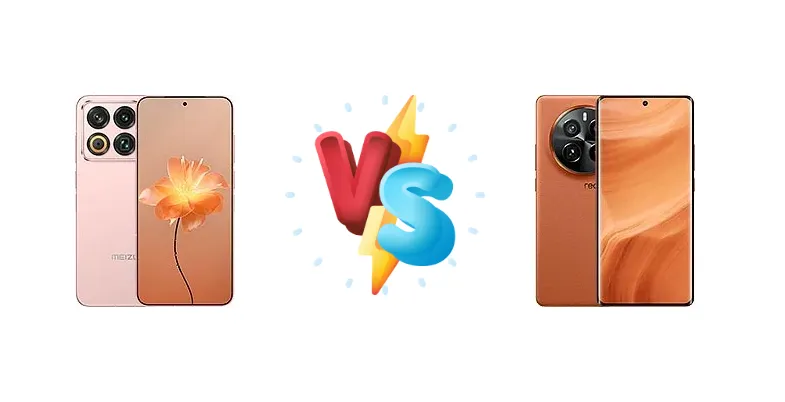
|
🏆 Quick Verdict
For most users, the Realme GT5 Pro emerges as the stronger choice. Its Snapdragon 8 Gen 3 chipset provides a noticeable performance edge, coupled with a significantly longer battery life (14:16h active use) and faster 100W wired charging. While the Meizu 22 offers wireless charging and a newer chip, the GT5 Pro’s real-world benefits are more substantial.
| PHONES | ||
|---|---|---|
| Phone Names | Meizu 22 | Realme GT5 Pro |
| Network | ||
|---|---|---|
| 2G bands | GSM 850 / 900 / 1800 / 1900 | GSM 850 / 900 / 1800 / 1900 |
| 3G bands | HSDPA 850 / 900 / 1700(AWS) / 2100 | HSDPA 850 / 900 / 2100 |
| 4G bands | 1, 3, 4, 5, 8, 18, 19, 26, 28, 34, 38, 39, 40, 41, 42, 48, 66 | 1, 3, 5, 7, 8, 28, 34, 38, 39, 40, 41 |
| 5G bands | 1, 3, 5, 8, 26, 28, 38, 40, 41, 48, 66, 77, 78, 80, 81, 83, 84, 89 SA/NSA | 1, 3, 5, 8, 28, 41, 77, 78 SA/NSA |
| Speed | HSPA, LTE, 5G | HSPA, LTE, 5G |
| Technology | GSM / HSPA / LTE / 5G | GSM / CDMA / HSPA / CDMA2000 / LTE / 5G |
| Launch | ||
|---|---|---|
| Announced | 2025, September 16 | 2023, December 07 |
| Status | Available. Released 2025, September 19 | Available. Released 2023, December 14 |
| Body | ||
|---|---|---|
| Build | Glass front, aluminum frame | Glass front, glass back or silicone polymer back (eco leather), aluminum frame |
| Dimensions | 152 x 71 x 8.2 mm (5.98 x 2.80 x 0.32 in) | 161.7 x 75.1 x 9.2 mm (6.37 x 2.96 x 0.36 in) |
| SIM | Nano-SIM + Nano-SIM | Nano-SIM + Nano-SIM |
| Weight | 190 g (6.70 oz) | 218 g / 224 g (7.69 oz) |
| Display | ||
|---|---|---|
| Resolution | 1200 x 2670 pixels, 20:9 ratio (~465 ppi density) | 1264 x 2780 pixels (~450 ppi density) |
| Size | 6.3 inches, 95.7 cm2 (~88.7% screen-to-body ratio) | 6.78 inches, 111.7 cm2 (~92.0% screen-to-body ratio) |
| Type | LTPO OLED, 120Hz, HDR10+, 1800 nits (HBM), 6000 nits (peak) | LTPO AMOLED, 1B colors, 144Hz, HDR10+, Dolby Vision, 4500 nits (peak) |
| Platform | ||
|---|---|---|
| CPU | Octa-core (1x3.21 GHz Cortex-X4 & 3x3.0 GHz Cortex-A720 & 2x2.8 GHz Cortex-A720 & 2x2.0 GHz Cortex-A720) | Octa-core (1x3.3 GHz Cortex-X4 & 3x3.2 GHz Cortex-A720 & 2x3.0 GHz Cortex-A720 & 2x2.3 GHz Cortex-A520) |
| Chipset | Qualcomm SM8735 Snapdragon 8s Gen 4 (4 nm) | Qualcomm SM8650-AB Snapdragon 8 Gen 3 (4 nm) |
| GPU | Adreno 825 | Adreno 750 |
| OS | Android 15, Flyme AIOS 2 | Android 14, upgradable to Android 15, Realme UI 6.0 |
| Memory | ||
|---|---|---|
| Card slot | No | No |
| Internal | 256GB 12GB RAM, 512GB 12GB RAM, 512GB 16GB RAM, 1TB 16GB RAM | 256GB 12GB RAM, 256GB 16GB RAM, 512GB 16GB RAM, 1TB 16GB RAM |
| Main Camera | ||
|---|---|---|
| Features | Ring-LED flash, panorama, HDR | Color spectrum sensor, Dual-LED dual-tone flash, HDR, panorama |
| Triple | 50 MP, f/1.7, 24mm (wide), 1/1.3", PDAF, OIS 50 MP, f/2.5, 72mm (periscope telephoto), 1/1.95", PDAF (15cm - ∞), OIS, 3x optical zoom 50 MP, f/2.1, 13mm, 122˚ (ultrawide), 1/2.88" | 50 MP, f/1.7, 23mm (wide), 1/1.43", 1.12µm, dual pixel PDAF, OIS 50 MP, f/2.6, 65mm (periscope telephoto), 1/1.56", 1.0µm, multi-directional PDAF, OIS, 2.7x optical zoom 8 MP, f/2.2, 16mm, 112˚ (ultrawide), 1/4.0", 1.12µm |
| Video | 4K@30/60fps, 1080p@30/60fps, gyro-EIS | 8K@24fps, 4K@30/60fps, 1080p@30/60fps, gyro-EIS, Dolby Vision |
| Selfie camera | ||
|---|---|---|
| Features | HDR | HDR, panorama |
| Single | 50 MP, f/2.1, 22mm (wide), 1/2.88" | 32 MP, f/2.5, 22mm (wide), 1/2.74" |
| Video | 4K@30/60fps, 1080p@30/60fps, gyro-EIS | 4K@30fps, 1080p@30fps, gyro-EIS |
| Sound | ||
|---|---|---|
| 35mm jack | No | No |
| Loudspeaker | Yes, with stereo speakers | Yes, with stereo speakers (Dolby Atmos certified) |
| Comms | ||
|---|---|---|
| Bluetooth | 5.4, A2DP, LE, aptX HD | 5.4, A2DP, LE, aptX HD |
| Infrared port | Yes | Yes |
| NFC | Yes | Yes, 360˚ |
| Positioning | GPS (L1+L5), GLONASS (G1), BDS (B1I+B1c+B2a), GALILEO (E1+E5a), QZSS (L1+L5), NavIC (L5) | GPS (L1+L5), GLONASS, BDS (B1I+B1c+B2a), GALILEO (E1+E5a), QZSS (L1+L5), NavIC |
| Radio | No | No |
| USB | USB Type-C 2.0/3.2, Display Port (1TB only) | USB Type-C 3.2 |
| WLAN | Wi-Fi 802.11 а/b/g/n/ac/6e/7, dual-band | Wi-Fi 802.11 a/b/g/n/ac/6/7, tri-band, Wi-Fi Direct |
| Features | ||
|---|---|---|
| Sensors | Fingerprint (under display, ultrasonic), accelerometer, gyro, proximity, compass | Fingerprint (under display, optical), accelerometer, gyro, proximity, compass |
| Battery | ||
|---|---|---|
| Charging | 80W wired, PD3 PPS, QC4+ 66W wireless 10W reverse wireless | 100W wired, 50% in 12 min 50W wireless |
| Type | 5510 mAh | Li-Ion 5400 mAh |
| Misc | ||
|---|---|---|
| Colors | Black, White, Pink | Black, Silver, Orange |
| Models | - | RMX3888 |
| Price | About 360 EUR | About 430 EUR |
Meizu 22
- 66W Wireless Charging offers convenience.
- Snapdragon 8s Gen 4 aims for efficiency.
- Potentially better thermal management due to chip design.
- Performance likely trails the Snapdragon 8 Gen 3.
- Limited battery life information available.
Realme GT5 Pro
- Snapdragon 8 Gen 3 delivers top-tier performance.
- Excellent 14:16h active use battery life.
- 100W wired charging for incredibly fast top-ups.
- Wireless charging is slower at 50W.
- May run hotter under sustained heavy loads.
Display Comparison
The Realme GT5 Pro boasts a brighter display, reaching a measured peak of 1660 nits, crucial for outdoor visibility. While the Meizu 22’s display specs are currently unavailable, Realme’s panel offers a significant advantage in challenging lighting conditions. Both devices likely utilize AMOLED technology, but the GT5 Pro’s brightness is a clear differentiator. We expect both to have high refresh rates, but the GT5 Pro’s brightness will be more impactful for everyday use.
Camera Comparison
Detailed camera specifications for the Meizu 22 are currently limited. The Realme GT5 Pro is expected to feature a robust camera system, likely including a high-resolution main sensor and advanced image processing capabilities. Without specific details on the Meizu 22’s sensor size, aperture, and OIS implementation, it’s difficult to make a direct comparison. However, Realme’s history suggests a strong emphasis on camera performance, making the GT5 Pro the likely winner in this category. We can assume both will offer a variety of shooting modes, but the GT5 Pro’s image processing pipeline will likely be more refined.
Performance
The Realme GT5 Pro’s Snapdragon 8 Gen 3 (4nm) holds a performance advantage over the Meizu 22’s Snapdragon 8s Gen 4 (4nm). The 8 Gen 3 features a slightly higher peak CPU clock speed (3.3 GHz vs 3.21 GHz) on its prime Cortex-X4 core, and a more powerful GPU. While both chips are built on the same 4nm process, the 8 Gen 3’s architecture provides a performance uplift. The GT5 Pro also benefits from potentially faster LPDDR5x RAM configurations, further enhancing responsiveness. The 8s Gen 4 in the Meizu 22 focuses on efficiency, potentially leading to better thermal management under sustained loads, but the GT5 Pro will likely deliver higher peak performance.
Battery Life
The Realme GT5 Pro’s 14:16h active use battery score demonstrates a significant advantage in endurance. While the Meizu 22’s battery capacity is unknown, the GT5 Pro’s combination of efficient chipset and optimized software delivers superior longevity. Furthermore, the GT5 Pro’s 100W wired charging (50% in 12 minutes) is considerably faster than the Meizu 22’s 80W wired charging. The GT5 Pro also offers 50W wireless charging, compared to the Meizu 22’s 66W wireless, but the wired charging speed is the more impactful difference for quick top-ups.
Buying Guide
Buy the Meizu 22 if you prioritize wireless charging convenience and are drawn to Meizu’s Flyme OS experience. Its 66W wireless charging and 80W wired charging offer flexibility. Buy the Realme GT5 Pro if you demand maximum performance for gaming and demanding tasks, and value extended battery life with incredibly fast 100W wired charging. It’s the better option for power users.