
Meizu 22 vs OnePlus 12R: A Deep Dive into Snapdragon Power and Charging Speed
| Phones Images | |||||
|---|---|---|---|---|---|
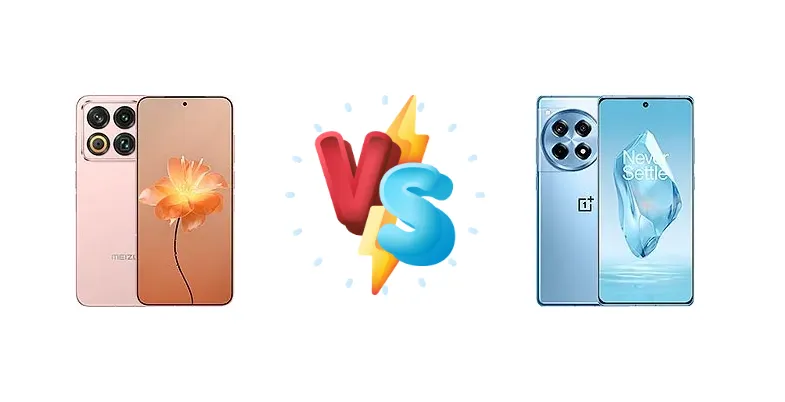
|
🏆 Quick Verdict
For most users, the OnePlus 12R emerges as the better value. Its Snapdragon 8 Gen 2 delivers excellent performance, coupled with a significantly faster 100W charging solution and a proven 14:32 hour active use battery life. While the Meizu 22’s 8s Gen 4 is promising, the OnePlus 12R’s established ecosystem and charging speed give it the edge.
| PHONES | ||
|---|---|---|
| Phone Names | Meizu 22 | OnePlus 12R |
| Network | ||
|---|---|---|
| 2G bands | GSM 850 / 900 / 1800 / 1900 | GSM 850 / 900 / 1800 / 1900 |
| 3G bands | HSDPA 850 / 900 / 1700(AWS) / 2100 | HSDPA 850 / 900 / 1700(AWS) / 1900 / 2100 |
| 4G bands | 1, 3, 4, 5, 8, 18, 19, 26, 28, 34, 38, 39, 40, 41, 42, 48, 66 | 1, 2, 3, 4, 5, 7, 8, 12, 17, 18, 19, 20, 26, 28, 32, 38, 39, 40, 41, 66 |
| 5G bands | 1, 3, 5, 8, 26, 28, 38, 40, 41, 48, 66, 77, 78, 80, 81, 83, 84, 89 SA/NSA | 1, 2, 3, 5, 7, 8, 12, 20, 28, 38, 40, 41, 66, 77, 78 SA/NSA |
| Speed | HSPA, LTE, 5G | HSPA, LTE, 5G |
| Technology | GSM / HSPA / LTE / 5G | GSM / CDMA / HSPA / LTE / 5G |
| Launch | ||
|---|---|---|
| Announced | 2025, September 16 | 2024, January 23 |
| Status | Available. Released 2025, September 19 | Available. Released 2024, February 06 |
| Body | ||
|---|---|---|
| Build | Glass front, aluminum frame | Glass front (Gorilla Glass Victus 2), aluminum frame, glass back |
| Dimensions | 152 x 71 x 8.2 mm (5.98 x 2.80 x 0.32 in) | 163.3 x 75.3 x 8.8 mm (6.43 x 2.96 x 0.35 in) |
| SIM | Nano-SIM + Nano-SIM | · Nano-SIM + Nano-SIM + eSIM (max 2 at a time)· Nano-SIM + Nano-SIM |
| Weight | 190 g (6.70 oz) | 207 g (7.30 oz) |
| Display | ||
|---|---|---|
| Protection | - | Corning Gorilla Glass Victus 2 |
| Resolution | 1200 x 2670 pixels, 20:9 ratio (~465 ppi density) | 1264 x 2780 pixels (~450 ppi density) |
| Size | 6.3 inches, 95.7 cm2 (~88.7% screen-to-body ratio) | 6.78 inches, 111.7 cm2 (~90.9% screen-to-body ratio) |
| Type | LTPO OLED, 120Hz, HDR10+, 1800 nits (HBM), 6000 nits (peak) | LTPO4 AMOLED, 1B colors, 120Hz, HDR10+, Dolby Vision, 1600 nits (HBM), 4500 nits (peak) |
| Platform | ||
|---|---|---|
| CPU | Octa-core (1x3.21 GHz Cortex-X4 & 3x3.0 GHz Cortex-A720 & 2x2.8 GHz Cortex-A720 & 2x2.0 GHz Cortex-A720) | Octa-core (1x3.2 GHz Cortex-X3 & 2x2.8 GHz Cortex-A715 & 2x2.8 GHz Cortex-A710 & 3x2.0 GHz Cortex-A510) |
| Chipset | Qualcomm SM8735 Snapdragon 8s Gen 4 (4 nm) | Qualcomm SM8550-AB Snapdragon 8 Gen 2 (4 nm) |
| GPU | Adreno 825 | Adreno 740 |
| OS | Android 15, Flyme AIOS 2 | Android 14, up to 3 major Android upgrades, OxygenOS 15 |
| Memory | ||
|---|---|---|
| Card slot | No | No |
| Internal | 256GB 12GB RAM, 512GB 12GB RAM, 512GB 16GB RAM, 1TB 16GB RAM | 128GB 8GB RAM, 256GB 8GB RAM, 256GB 12GB RAM, 256GB 16GB RAM |
| Main Camera | ||
|---|---|---|
| Features | Ring-LED flash, panorama, HDR | Laser AF, color spectrum sensor, LED flash, HDR, panorama |
| Triple | 50 MP, f/1.7, 24mm (wide), 1/1.3", PDAF, OIS 50 MP, f/2.5, 72mm (periscope telephoto), 1/1.95", PDAF (15cm - ∞), OIS, 3x optical zoom 50 MP, f/2.1, 13mm, 122˚ (ultrawide), 1/2.88" | 50 MP, f/1.8, 24mm (wide), 1/1.56", 1.0µm, multi-directional PDAF, OIS 8 MP, f/2.2, 16mm, 112˚ (ultrawide), 1/4.0", 1.12µm 2 MP (macro) |
| Video | 4K@30/60fps, 1080p@30/60fps, gyro-EIS | 4K@30/60fps, 1080p@30/60/120/240fps, gyro-EIS, OIS |
| Selfie camera | ||
|---|---|---|
| Features | HDR | HDR, panorama |
| Single | 50 MP, f/2.1, 22mm (wide), 1/2.88" | 16 MP, f/2.4, 26mm (wide), 1/3", 1.0µm |
| Video | 4K@30/60fps, 1080p@30/60fps, gyro-EIS | 1080p@30fps, gyro-EIS |
| Sound | ||
|---|---|---|
| 35mm jack | No | No |
| Loudspeaker | Yes, with stereo speakers | Yes, with stereo speakers |
| Comms | ||
|---|---|---|
| Bluetooth | 5.4, A2DP, LE, aptX HD | 5.3, A2DP, LE, aptX HD |
| Infrared port | Yes | Yes |
| NFC | Yes | Yes |
| Positioning | GPS (L1+L5), GLONASS (G1), BDS (B1I+B1c+B2a), GALILEO (E1+E5a), QZSS (L1+L5), NavIC (L5) | GPS, GALILEO, GLONASS, BDS, QZSS |
| Radio | No | No |
| USB | USB Type-C 2.0/3.2, Display Port (1TB only) | USB Type-C 2.0 |
| WLAN | Wi-Fi 802.11 а/b/g/n/ac/6e/7, dual-band | Wi-Fi 802.11 a/b/g/n/ac/6/7, dual-band |
| Features | ||
|---|---|---|
| Sensors | Fingerprint (under display, ultrasonic), accelerometer, gyro, proximity, compass | Fingerprint (under display, optical), accelerometer, gyro, proximity, compass |
| Battery | ||
|---|---|---|
| Charging | 80W wired, PD3 PPS, QC4+ 66W wireless 10W reverse wireless | 100W wired, 100% in 26 min |
| Type | 5510 mAh | Li-Ion 5500 mAh |
| Misc | ||
|---|---|---|
| Colors | Black, White, Pink | Iron Gray, Cool Blue, Electric Violet, Sunset Dune |
| Models | - | CPH2609, CPH2585, CPH2611 |
| Price | About 360 EUR | € 410.84 / $ 399.95 / £ 649.00 |
| SAR | - | 1.19 W/kg (head) 0.82 W/kg (body) |
Meizu 22
- Newer Snapdragon 8s Gen 4 chipset
- 66W Wireless Charging
- 10W Reverse Wireless Charging
- Limited information on camera specs
- Slower 80W wired charging compared to OnePlus 12R
OnePlus 12R
- Proven Snapdragon 8 Gen 2 performance
- 100W SuperVOOC charging (26 min full charge)
- Excellent 14:32h active use battery life
- Older chipset generation
- No wireless charging
Display Comparison
The OnePlus 12R boasts a display capable of reaching 1181 nits of peak brightness, ensuring excellent visibility even in direct sunlight. While the Meizu 22’s display specifications are currently unavailable, OnePlus’s brightness figure sets a high bar. Both phones utilize 4nm chipsets, which contribute to thermal efficiency, potentially allowing for sustained peak brightness without significant throttling. The absence of LTPO information for the Meizu 22 means we can’t yet assess its adaptive refresh rate capabilities, a feature commonly found in this price bracket and contributing to battery savings.
Camera Comparison
Detailed camera specifications for the Meizu 22 are currently lacking. The OnePlus 12R’s camera system, while not explicitly detailed in the provided data, typically features a high-resolution main sensor with OIS. Without knowing the sensor size, aperture, or image processing algorithms employed by the Meizu 22, it’s difficult to make a direct comparison. The absence of information regarding the Meizu 22’s camera suggests it may not be a primary selling point, while the OnePlus 12R likely offers a more refined and predictable camera experience.
Performance
The core of this comparison lies in the chipsets. The OnePlus 12R’s Snapdragon 8 Gen 2 (4nm) features a Cortex-X3 prime core clocked at 3.2 GHz, alongside Cortex-A715 and A710 performance cores. The Meizu 22, however, utilizes the newer Snapdragon 8s Gen 4 (4nm) with a Cortex-X4 prime core at 3.21 GHz, and a different configuration of A720 cores. While clock speeds are similar, the architectural improvements in the X4 core and the 8s Gen 4’s overall design *should* offer incremental gains in single-core performance and efficiency. However, the 8 Gen 2’s mature optimization and proven thermal management give it a strong advantage in sustained workloads. The OnePlus 12R benefits from a well-established software ecosystem optimized for the 8 Gen 2.
Battery Life
The OnePlus 12R shines in battery and charging. Its active use score of 14:32 hours demonstrates excellent endurance. Crucially, it supports 100W wired charging, achieving a full charge in just 26 minutes. The Meizu 22 offers 80W wired charging, 66W wireless, and 10W reverse wireless, providing flexibility but falling short of the OnePlus 12R’s sheer charging speed. While the Meizu 22’s wireless charging is a plus, the OnePlus 12R’s faster wired charging is more practical for most users.
Buying Guide
Buy the Meizu 22 if you prioritize having the latest silicon and are intrigued by Meizu’s Flyme OS, potentially benefiting from future software optimizations tailored to the Snapdragon 8s Gen 4. Buy the OnePlus 12R if you value a proven track record of performance, exceptionally fast charging, and a longer-lasting battery, making it ideal for power users and gamers.